AI-generated illustration
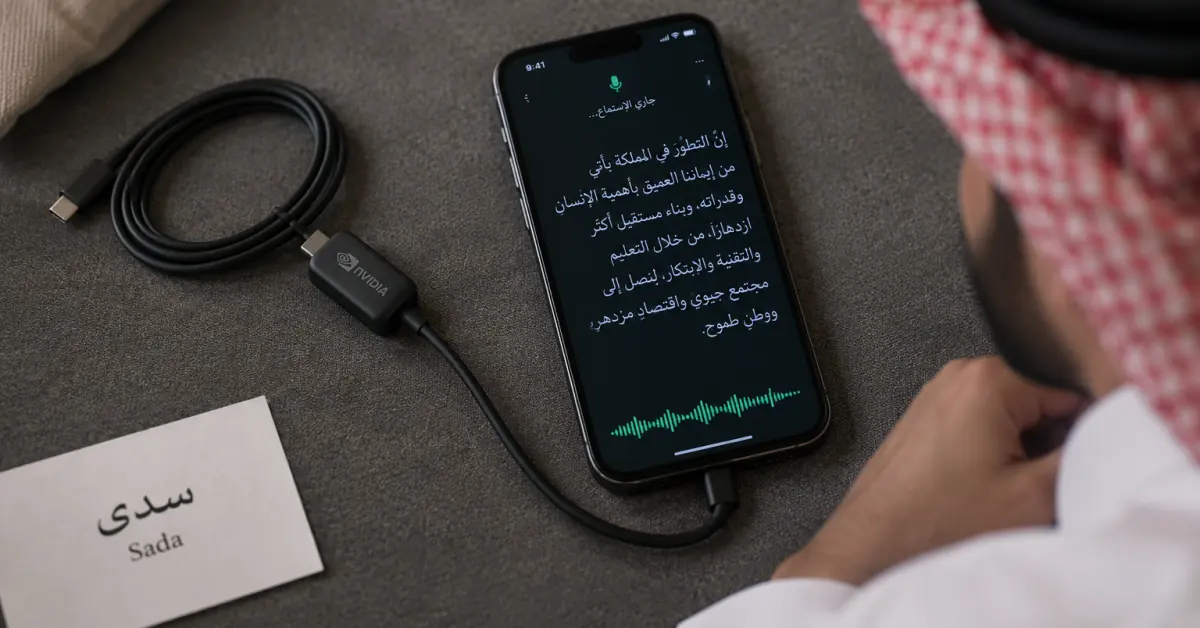
NVIDIA has used the Saudi audio dataset created by SDAIA to train its Nemotron 3.5 ASR speech recognition model. The technical update significantly improved automated transcription performance across regional Arabic accents, according to reporting by Arab News.
Substantial Drop in Error Rates
The speech model initially misidentified approximately 55 of every 100 words spoken in Saudi dialects. After developers trained the system on 133.7 hours of Najdi and Hijazi audio, the word error rate dropped to roughly 30 percent. Furthermore, character-level errors across the entire collection fell from 31.6 percent down to 12.2 percent.
The training procedure required four and a half hours using two graphic processing units. Performance metrics also showed gains in Modern Standard Arabic and English, proving that localized audio tuning did not degrade general language processing in AI applications.
Structure of the Saudi Audio Dataset
The Saudi Data and AI Authority launched the audio repository, known as Sada, in partnership with the Saudi Broadcasting Authority. The complete library contains approximately 667 hours of transcribed Arabic speech. Specifically, the broadcasting authority supplied more than 600 hours sourced from 57 television series and programs covering more than 10 distinct accents across Saudi Arabia.
SDAIA categorized the media into more than 125,000 indexed audio clips and published the collection on Kaggle. This setup allowed engineers to isolate specific dialect recordings while reserving 20 hours strictly for model validation and testing, establishing a clear benchmark for regional speech evaluation.
Real-Time Interactive Use Cases
Engineers optimized the Nemotron 3.5 ASR architecture for high-speed voice platforms, achieving system latency starting at 80 milliseconds. As a result, the technology supports live broadcast subtitling, meeting transcriptions, and automated customer service call processing without noticeable processing delays.
The low response time assists developers creating conversational voice assistants for smartphones and computers. In addition, NVIDIA published its technical workflows so international researchers can apply similar training methods to other regional languages and underrepresented dialects.
Advancing Dialect Support in Software
Regional Arabic dialects have historically presented substantial technical hurdles for automated voice models due to variations in pronunciation, vocabulary, and grammar. The availability of structured data directly addresses this challenge by giving machine learning algorithms representative training samples.
Public access to the Saudi audio dataset provides research institutions with resources for speaker identification, demographic classification, and text-to-speech tools. These tools help engineers build voice-enabled apps tailored directly for Arabic speakers in the region.