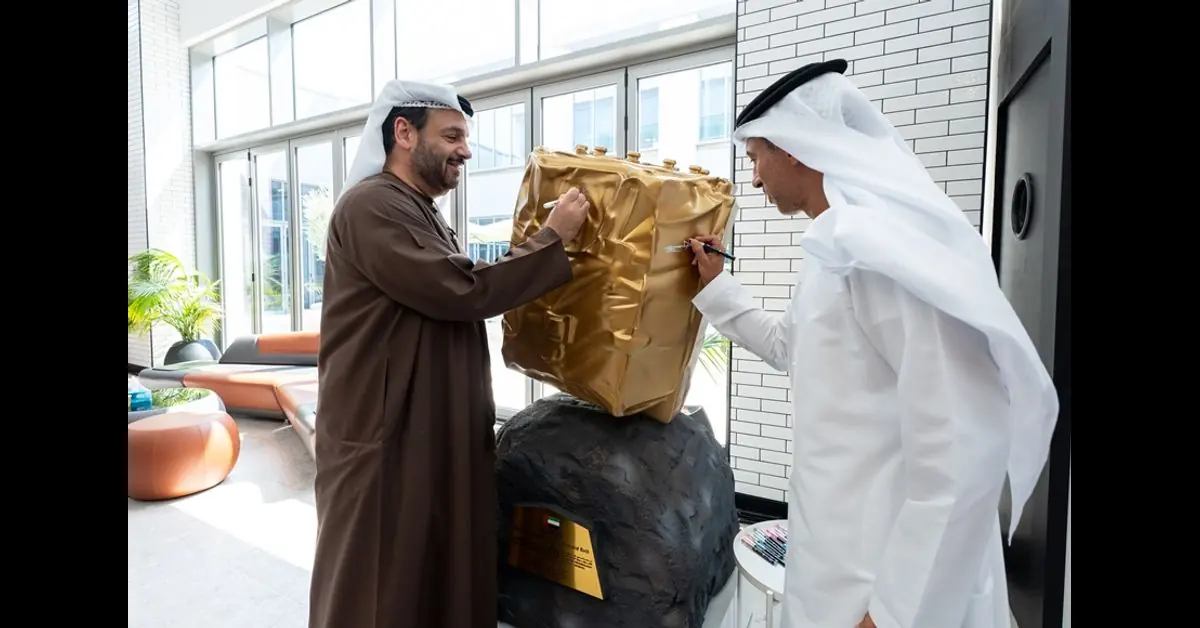
The Technology Innovation Institute has completed its autonomous asteroid-landing probe designed for the Emirates Mission to the Asteroid Belt. Developed entirely in Abu Dhabi by the Propulsion and Space Research Center, the device will travel to Colorado in the United States for final integration with the MBR Explorer spacecraft ahead of a scheduled March 2028 launch from Japan.
Engineering the Autonomous Asteroid-Landing Probe
The asteroid-landing probe serves as the only deployable payload aboard the MBR Explorer. Built in collaboration with the UAE Space Agency, HEX20, Khalifa University, and UAE University National Space Science and Technology Center, the unit features an onboard digital processing unit that manages data processing, image selection, and power management. Moreover, the hardware relies on specialized computers to operate without ground control commands during its journey through deep space.
“If you want to build serious technological capability, you take on a problem that forces you to push further. For this mission, that means a probe that must make decisions and operate on its own in deep space.”
H.E. Faisal Al Bannai, Secretary General, Advanced Technology Research Council
Eight-Year Flight Path Across the Solar System
The spacecraft will traverse approximately 5 billion kilometers over eight years, utilizing gravity-assist maneuvers at Venus, Earth, and Mars. During this cruise, the primary vessel will perform close flybys of six asteroids before reaching its final destination. In addition, the mission incorporates advanced smart devices and two optical cameras to capture wide-field and high-resolution imagery across planetary encounters.
Dr. Najwa Aaraj, Chief Executive Officer at TII, stated that the project translates advanced research into operational space engineering designed to withstand extreme thermal and radiation environments billions of kilometers from Earth.
Landing Operations on Asteroid 269 Justitia
Upon reaching 269 Justitia in early 2036, the MBR Explorer will spend seven months descending from an initial orbit of 250 kilometers. The asteroid-landing probe will separate during a low-altitude pass to make direct physical contact with the surface. Consequently, the unit will excavate surface material and transmit close-range imagery to the main orbiter to investigate organic compounds believed to have originated in the outer Kuiper Belt.
Funding and National Space Strategy 2031
This initiative represents the second interplanetary voyage for the United Arab Emirates and supports the national economy through targeted research localization. Notably, the Supreme Space Council approved a AED 1 billion International Space Cooperation Program in May 2026 to foster international partnerships and train specialized engineers in line with the National Space Strategy 2031.