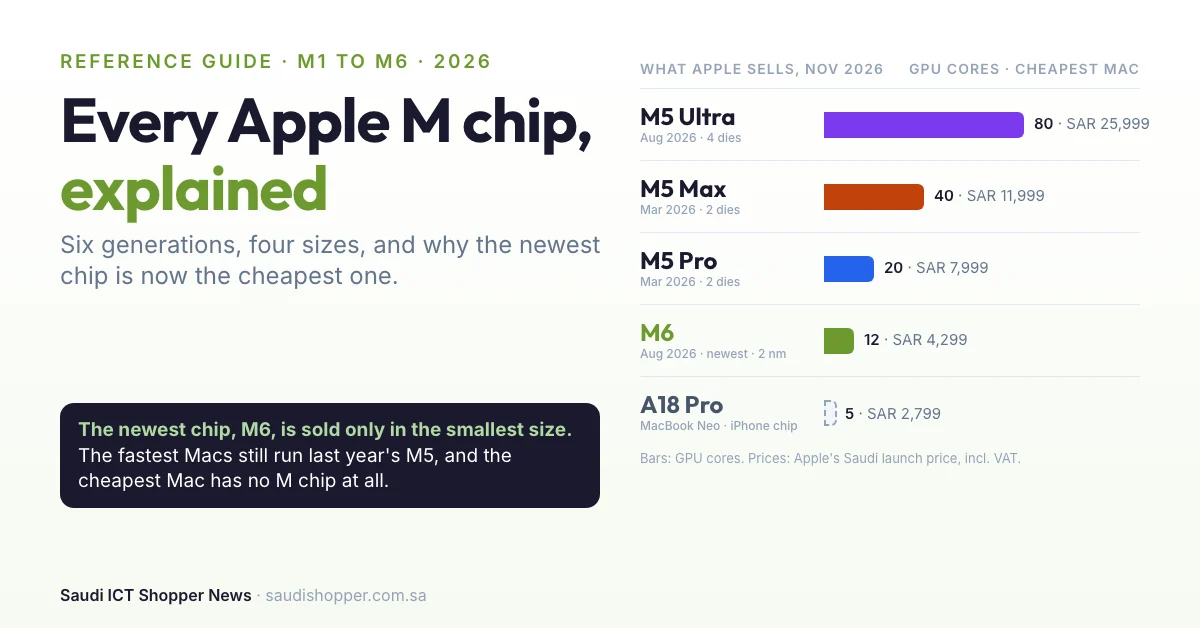
In November 2026 the newest Apple chip, the M6, is sold only in Apple’s cheapest tier. The fastest Macs you can buy still run last year’s M5. And the cheapest Mac of all, the SAR 2,799 MacBook Neo, has no M chip inside it: it runs the processor from a 2024 iPhone. The number on the chip has stopped being a ranking. This guide explains every Apple M chip from the 2020 M1 to the 2026 M6, in plain language, with the one engineering rule that makes the whole family make sense, and a cheat sheet for the day you stand in front of the shelf and the box says “M5 Pro”.
The short version
- Six generations, four sizes. M1 (2020) to M6 (2026). The number is the generation; the word after it (none, Pro, Max, Ultra) is the size of the chip. Most generations come in all four sizes. M4 never got an Ultra. M6 has only the base size.
- One rule explains the family: each generation is one design cut to size, with the CPU, graphics, Neural Engine and memory sealed in one package. The size sets the memory ceiling and the bandwidth, and nothing can be added later.
- A higher number is not a faster Mac. The 2023 M3 Pro was barely quicker than the M2 Pro. A base M6 has 12 graphics cores; the 2026 M5 Max has 40. Tier and memory decide what a Mac can do; the number only dates it.
- 16 GB has been the floor since October 2024. Before that, Apple sold a SAR 6,900 (est.) “Pro” laptop with 8 GB. Memory is the one choice you cannot undo.
- In 2026 the lineup inverted. M6 is base-only, the OLED MacBook Pro launched in October 2026 with M5 Pro and M5 Max, and Bloomberg reports Apple will skip the M6 Pro and Max and go straight to M7 in 2027.
- Saudi prices are Apple’s own since July 2025. Apple Store online launched in the Kingdom with Arabic support and Tamara instalments; every price in this guide is Apple’s SAR launch price. Apple Intelligence runs on every M-series Mac, but not yet in Arabic.
Every Apple M chip at a glance
Six generations, six years, one table. “Top memory” is the most the biggest chip in that family can hold; the base chip holds far less. Dates are Apple’s announcement dates. The last column is what each generation actually changed for someone buying a Mac.
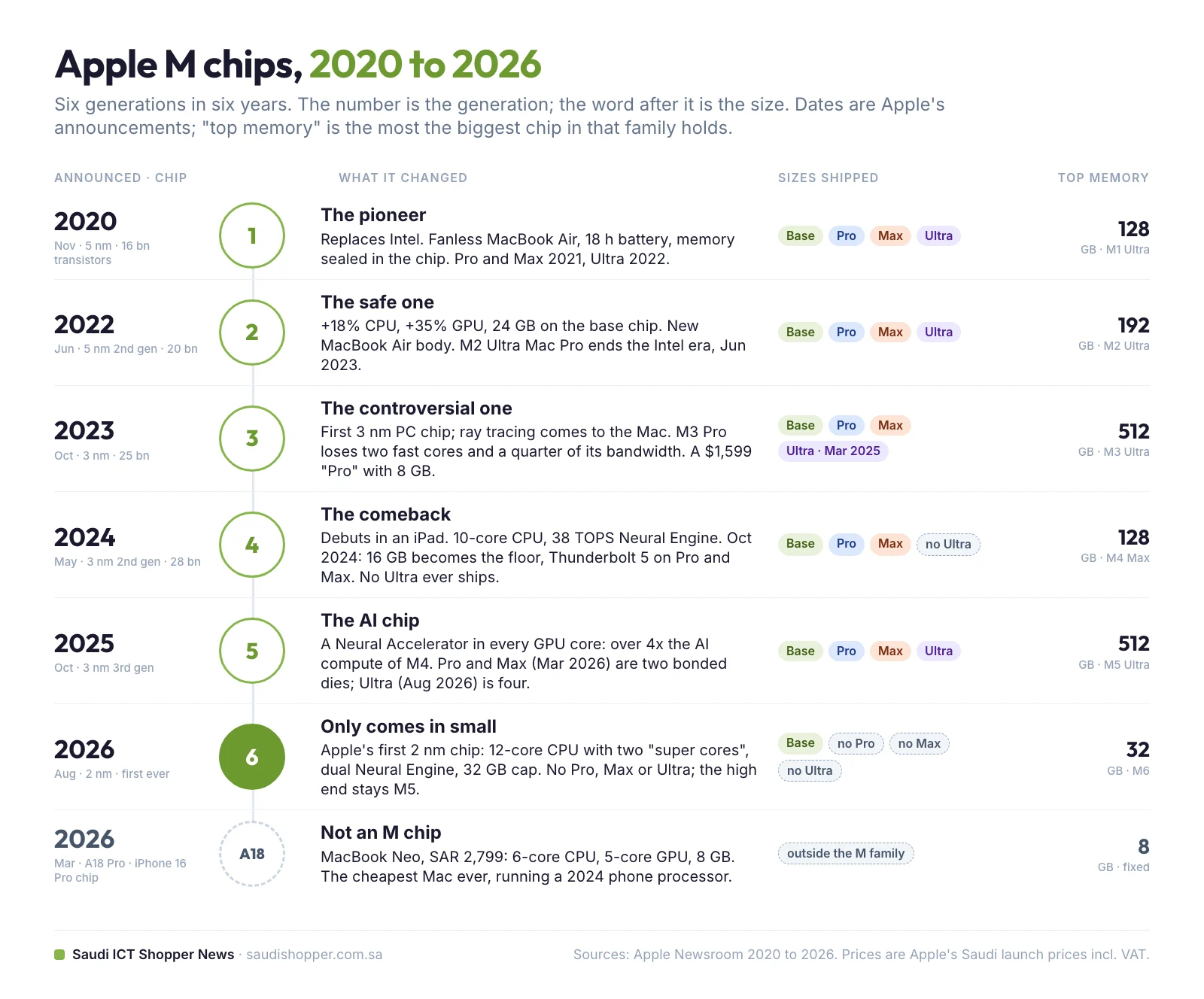
| Chip | Announced | Process | Sizes | Base CPU / GPU cores | Top memory in family | What it changed |
|---|---|---|---|---|---|---|
| M1 | Nov 2020 | 5 nm | Base, Pro, Max, Ultra | 8 / 8 | 128 GB (Ultra) | Replaced Intel. Fanless MacBook Air, all-day battery, memory moved inside the chip |
| M2 | Jun 2022 | 5 nm (2nd gen) | Base, Pro, Max, Ultra | 8 / 10 | 192 GB (Ultra) | Safe step: 18% CPU, 35% GPU. New MacBook Air design. Intel era ends Jun 2023 |
| M3 | Oct 2023 | 3 nm | Base, Pro, Max, Ultra (Mar 2025) | 8 / 10 | 512 GB (Ultra) | Ray tracing comes to the Mac. M3 Pro loses cores. 8 GB “Pro” laptop at $1,599 |
| M4 | May 2024 | 3 nm (2nd gen) | Base, Pro, Max | 10 / 10 | 128 GB (Max) | Debuts in an iPad. 16 GB becomes the floor. Thunderbolt 5. No Ultra ever ships |
| M5 | Oct 2025 | 3 nm (3rd gen) | Base, Pro, Max, Ultra | 10 / 10 | 512 GB (Ultra) | A Neural Accelerator in every GPU core: 4x the AI compute. Pro and Max are two dies; Ultra is four |
| M6 | Aug 2026 | 2 nm | Base only | 12 / 12 | 32 GB | Apple’s first 2 nm chip. Two “super cores”, dual Neural Engine. No Pro or Max |
| A18 Pro (MacBook Neo) | Mar 2026 | 3 nm (2024 iPhone chip) | Not an M chip | 6 / 5 | 8 GB | The SAR 2,799 Mac. Proof that the phone chip and the Mac chip are the same family |
First, a note on the names
Apple’s chip names have two parts and they mean different things. “M” plus a number is the generation: M1 is the 2020 design, M6 the 2026 one. The word after it is the size: nothing means the base chip, then Pro, Max and Ultra, each one a bigger cut of the same design with more cores, more memory and more bandwidth. An M5 Max is not a faster kind of M5. It is a bigger one.
Two more names arrived in 2026. With the M5 Pro and M5 Max, Apple renamed its fastest CPU cores “super cores” and introduced a new middle tier it now calls “performance cores”. In an interview with the German magazine Mac & i, Apple’s Anand Shimpi confirmed the super core is simply what used to be called the performance core, and the new performance core is a fresh design built for efficient multi-threaded work. So “4 performance cores” on a 2024 M4 and “4 performance cores” on a 2026 M6 are not the same thing. This guide says which is which.
And one name is not an M at all. The A18 Pro in the MacBook Neo is the chip from the iPhone 16 Pro. It runs macOS perfectly well, which tells you how close Apple’s phone and computer chips have become, but it sits outside the M family and this guide treats it that way.
The one rule that explains every Apple M chip
Each generation is one design, cut to size, with the memory sealed inside the package. Every M chip puts the CPU, the graphics, the Neural Engine and the memory together in one piece of silicon and its package. There is no separate graphics card, no memory slot, no upgrade later. Apple designs one set of cores per generation and then sells it in sizes: the base chip is one small die; Pro and Max are a bigger die (and since the M5 Pro, two dies bonded together); Ultra is two Max chips joined edge to edge by a connection Apple calls UltraFusion.
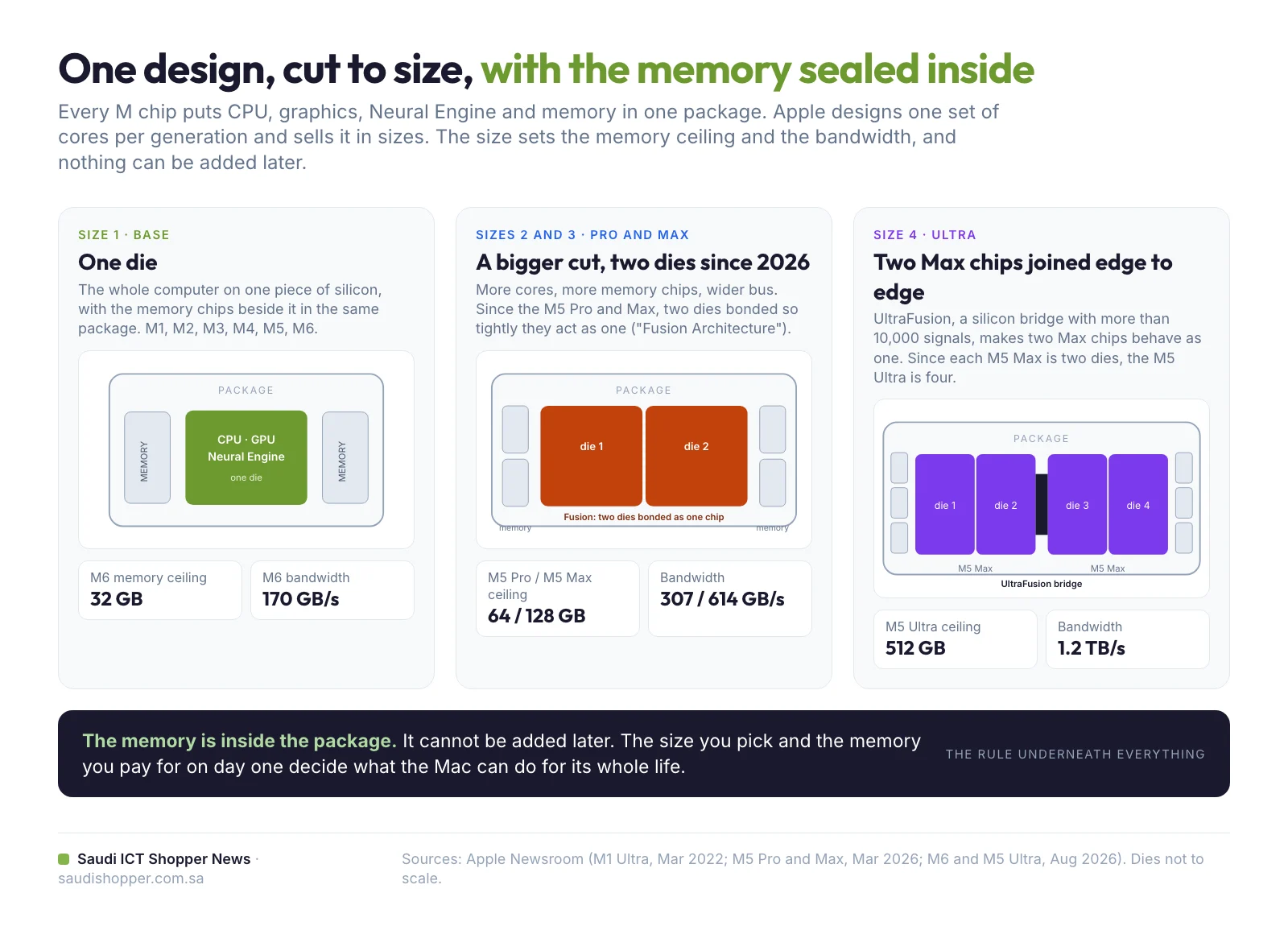
Think of it as one recipe baked in four tin sizes. The ingredients are the same; the tin decides how much you get. Because the memory is baked in with everything else, the size you pick also decides the memory ceiling (32 GB on a base M6, 512 GB on an M5 Ultra) and how fast that memory moves (170 GB/s on the M6, 1.2 TB/s on the Ultra). Everything in the rest of this guide comes back to that rule: which size, how much memory, and the fact that you choose both on the day you buy and never again.
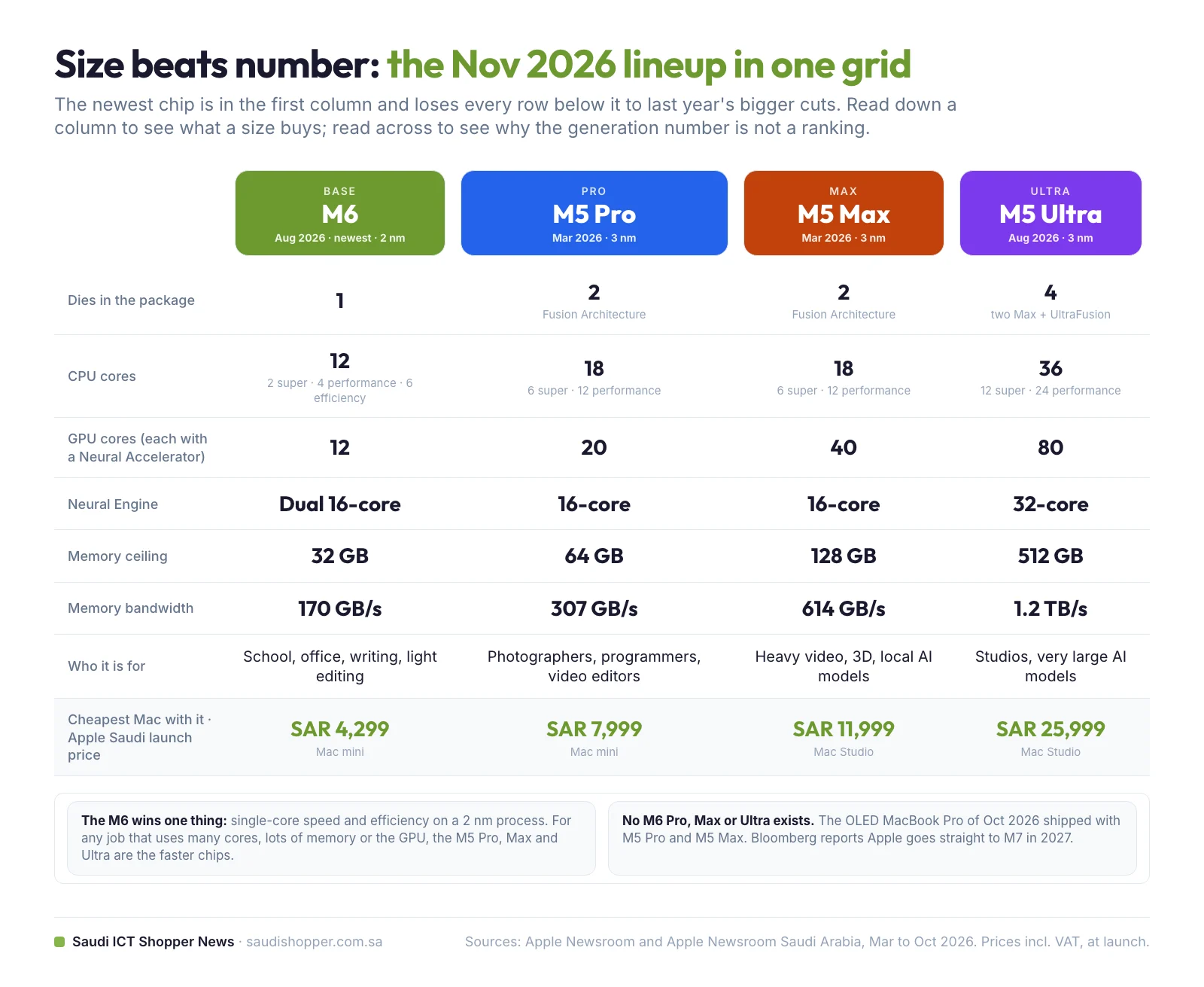
| Size | How it is built | Typical memory ceiling | Who it is for | Where it lives |
|---|---|---|---|---|
| Base (M6) | One die | 32 GB | School, office, writing, light photo and video | MacBook Air, MacBook Neo class, Mac mini, iMac, 14-inch MacBook Pro |
| Pro (M5 Pro) | Two dies, “Fusion Architecture” | 64 GB | Photographers, programmers, video editors | MacBook Pro, Mac mini |
| Max (M5 Max) | Two dies, more GPU | 128 GB | Heavy video, 3D, local AI models | MacBook Pro, Mac Studio |
| Ultra (M5 Ultra) | Two Max joined by UltraFusion (four dies) | 512 GB | Studios, very large AI models | Mac Studio |
M1 (November 2020): the pioneer
At WWDC in June 2020 Apple said it would move every Mac off Intel processors in “about two years”. The first result arrived on 10 November 2020: the M1, built on a 5 nm process with 16 billion transistors, an 8-core CPU (four fast, four efficient), up to 8 GPU cores and a 16-core Neural Engine. It shipped in the MacBook Air, the 13-inch MacBook Pro and the Mac mini, and it was the first time a mainstream laptop chip put the memory inside the package with the processor.
What people noticed was not the transistor count. The M1 MacBook Air had no fan at all, so it was silent, and Apple rated it at up to 18 hours of video playback, double what the Intel model managed. Many Intel MacBooks got hot and loud from a video call; the M1 Air stayed cool doing the same thing. The compromise was software: older Intel apps needed a translation layer called Rosetta 2. It worked so well that most people never knew it was running. (Rosetta’s time is now ending: Apple has said macOS 27 is the last version with full Rosetta support, and macOS 28 keeps only a cut-down version for old games.)
M1 Pro, M1 Max (2021) and M1 Ultra (2022): the four sizes appear
In October 2021 Apple cut the same design bigger. The M1 Pro had 10 CPU cores, up to 16 GPU cores, 32 GB of memory and 200 GB/s of bandwidth; the M1 Max doubled the graphics to 32 cores, the memory to 64 GB and the bandwidth to 400 GB/s, and carried 57 billion transistors. Both went into the redesigned 14-inch and 16-inch MacBook Pro. Then in March 2022 came the M1 Ultra for the new Mac Studio: two M1 Max dies joined by UltraFusion, a silicon bridge carrying more than 10,000 signals at 2.5 TB/s, giving 20 CPU cores, 64 GPU cores, 128 GB of memory and 114 billion transistors. The sizes have followed that pattern ever since.
M2 (June 2022): the safe one
The M2 arrived on 6 June 2022, first in a completely redesigned MacBook Air and an updated 13-inch MacBook Pro. Apple’s own numbers were modest: an 18 percent faster CPU, a 35 percent more powerful GPU, 20 billion transistors on a second-generation 5 nm process, memory up from 16 GB to 24 GB and bandwidth up 50 percent to 100 GB/s. A step forward, not a revolution.
The family followed the same shape. The M2 Pro (12 CPU cores, up to 19 GPU cores, 32 GB) and M2 Max (up to 38 GPU cores, 96 GB) came to the MacBook Pro in January 2023, with the M2 Pro also going into the Mac mini. The M2 Ultra (24 CPU cores, up to 76 GPU cores, 192 GB) arrived in June 2023 in the Mac Studio and a new Mac Pro, and with that Mac Pro Apple said “the Mac transition to Apple silicon is now complete”. Three years after the WWDC promise, slightly over the two it had given itself, no Mac shipped with an Intel chip.
In daily use the M2 felt very close to the M1. Browsing, writing and video calls were the same. The bigger change was the new MacBook Air body. If you already owned an M1, upgrading made little sense; for a new buyer the M2 was a solid, safe choice, and that is still true of a second-hand one today.
M3 (October 2023): the controversial one
On paper the M3, announced on 30 October 2023, was a milestone. Apple called the M3 family “the industry’s first 3-nanometer chips for a personal computer”. Smaller transistors mean more of them fit and each uses less power. And the graphics took a real jump: hardware-accelerated ray tracing, which makes light and reflections in games behave like the real thing; mesh shading, which draws complex 3D scenes more efficiently; and Dynamic Caching, which lets the GPU take exactly the memory each task needs instead of a fixed block. Before the M3, ray-traced games barely ran on a Mac. With it, they became possible.
Then came the problems. The M3 Pro had six fast cores where the M2 Pro had eight, one fewer GPU core, and 150 GB/s of memory bandwidth against the M2 Pro’s 200 GB/s, because Apple narrowed the memory bus. In the first benchmarks it scored about 6 percent higher than the M2 Pro in multi-core work. For a chip called Pro, that felt like a step backwards. Tellingly, every performance comparison in Apple’s own press release was against the M1, not the M2.
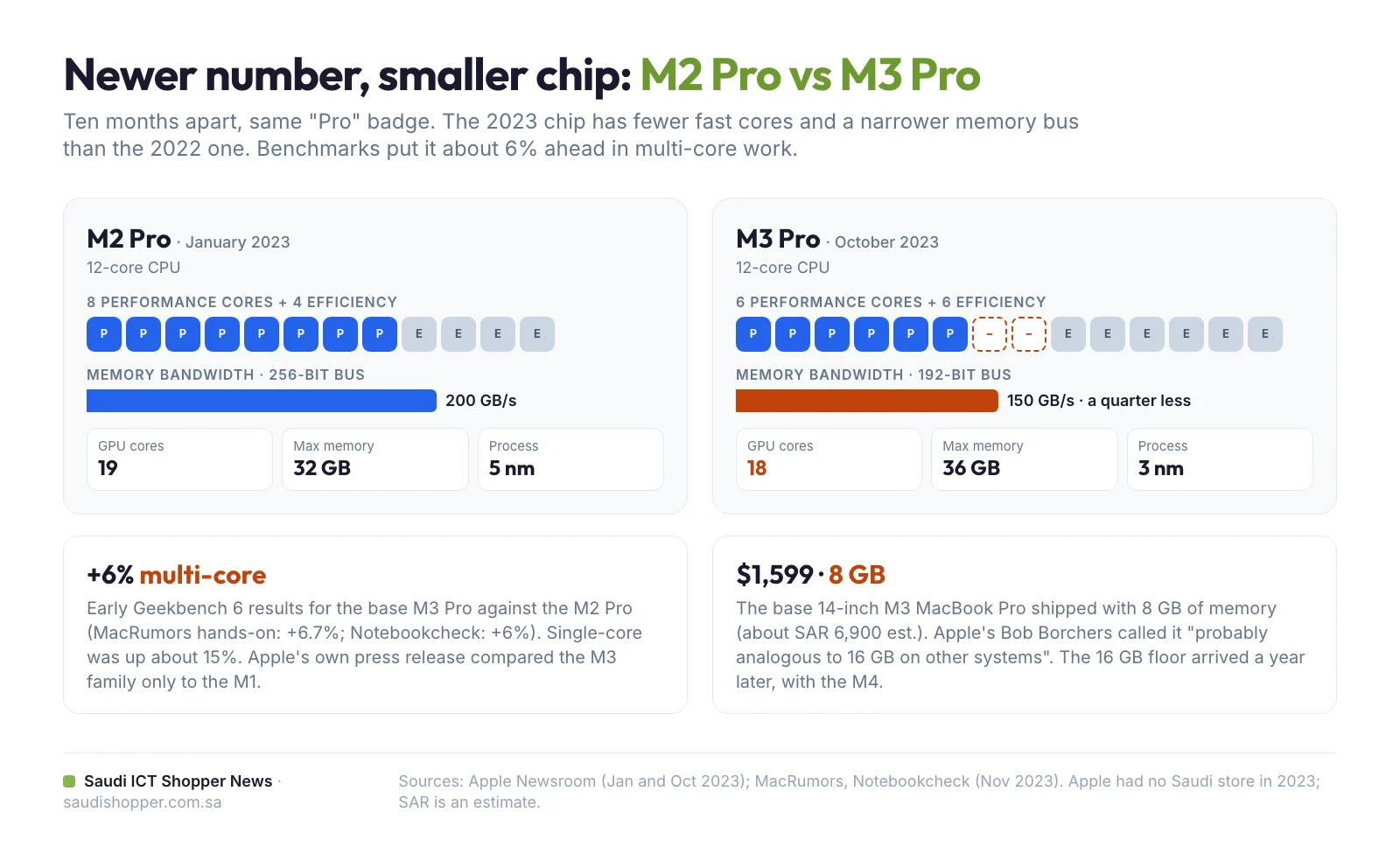
And it got worse. The base 14-inch M3 MacBook Pro cost $1,599 (about SAR 6,900 at today’s rate and VAT; Apple had no Saudi store then) and came with 8 GB of memory. Asked about it, Apple’s product marketing vice-president Bob Borchers said 8 GB on a Mac was “probably analogous to 16 GB on other systems”. Reviewers and buyers strongly disagreed, especially for a laptop with Pro in the name. The 8 GB M3 became the chip people warn each other about in second-hand listings.
The M3 Ultra that came 17 months late, and the M4 Ultra that never came
The M3 Ultra did not appear until 5 March 2025, in a refreshed Mac Studio: 32 CPU cores, up to 80 GPU cores, 184 billion transistors and, for the first time, up to 512 GB of memory, enough, Apple said, to run language models with more than 600 billion parameters on the desk. It launched beside a Mac Studio with the M4 Max, and no M4 Ultra was ever announced. Apple never explained why. It was the first sign that not every generation gets every size.
A higher number is not a faster Mac
The generation number dates the design. The size and the memory decide what the Mac can do. Three examples make the point. The 2023 M3 Pro was 6 percent faster than the 2023 M2 Pro in multi-core tests, with a quarter less memory bandwidth. A 2026 base M6 has 12 GPU cores and 170 GB/s; the 2026 M5 Max has 40 GPU cores and 614 GB/s, and will finish a video export or an AI job several times sooner. And an 8 GB M3 MacBook Pro is a worse computer in 2026 than a 16 GB M2 MacBook Air, whatever the number says.
Think of the number as the model year on a car and the size as the engine. A 2026 one-litre hatchback is not faster than a 2025 three-litre estate. It is newer, more efficient, and slower. Shop for the engine and the boot space, then be glad about the year.
M4 (May 2024): the comeback
The M4 had an unusual debut: on 7 May 2024, in an iPad Pro, not a Mac. Built on a second-generation 3 nm process with 28 billion transistors, its base version had a 10-core CPU (four fast, six efficient), a 10-core GPU and a Neural Engine rated at 38 trillion operations per second. Apple claimed up to 1.5x the CPU performance of the M2 and the same performance as the M2 at half the power.
The M4 reached Macs in October 2024, and that launch fixed the M3’s sore point. The new Mac mini “now starts with 16GB of unified memory”, Apple wrote, at the same $599 price (about SAR 2,600 est.), and the whole Mac line moved to a 16 GB floor, the MacBook Air included by March 2025. The M4 Pro (up to 14 CPU cores, 20 GPU cores, 64 GB, 273 GB/s) and M4 Max (16 CPU cores, 40 GPU cores, 128 GB, 546 GB/s) also brought Thunderbolt 5 to the Mac for the first time, at up to 120 Gb/s for external drives and displays.
With 16 GB as standard and a design still only two generations old, an M4 Mac is the value pick of 2026. For browsing, writing, calls and ordinary photo and video work it is more than enough, and after the June 2026 price rises it is often the cheapest way into a Mac with room to grow.
M5 (October 2025): the AI chip
The M5 arrived on 15 October 2025 in the 14-inch MacBook Pro (SAR 7,499), the iPad Pro and the Apple Vision Pro, and almost everything new about it was about AI. The headline change is inside the graphics: every one of the 10 GPU cores has its own Neural Accelerator, a small block built only for the maths that AI models run on. Apple says this gives the M5 over four times the peak GPU compute for AI of the M4 and over six times that of the M1. Graphics are up to 30 percent faster than the M4, memory bandwidth rises to 153 GB/s, and the separate 16-core Neural Engine is faster too.
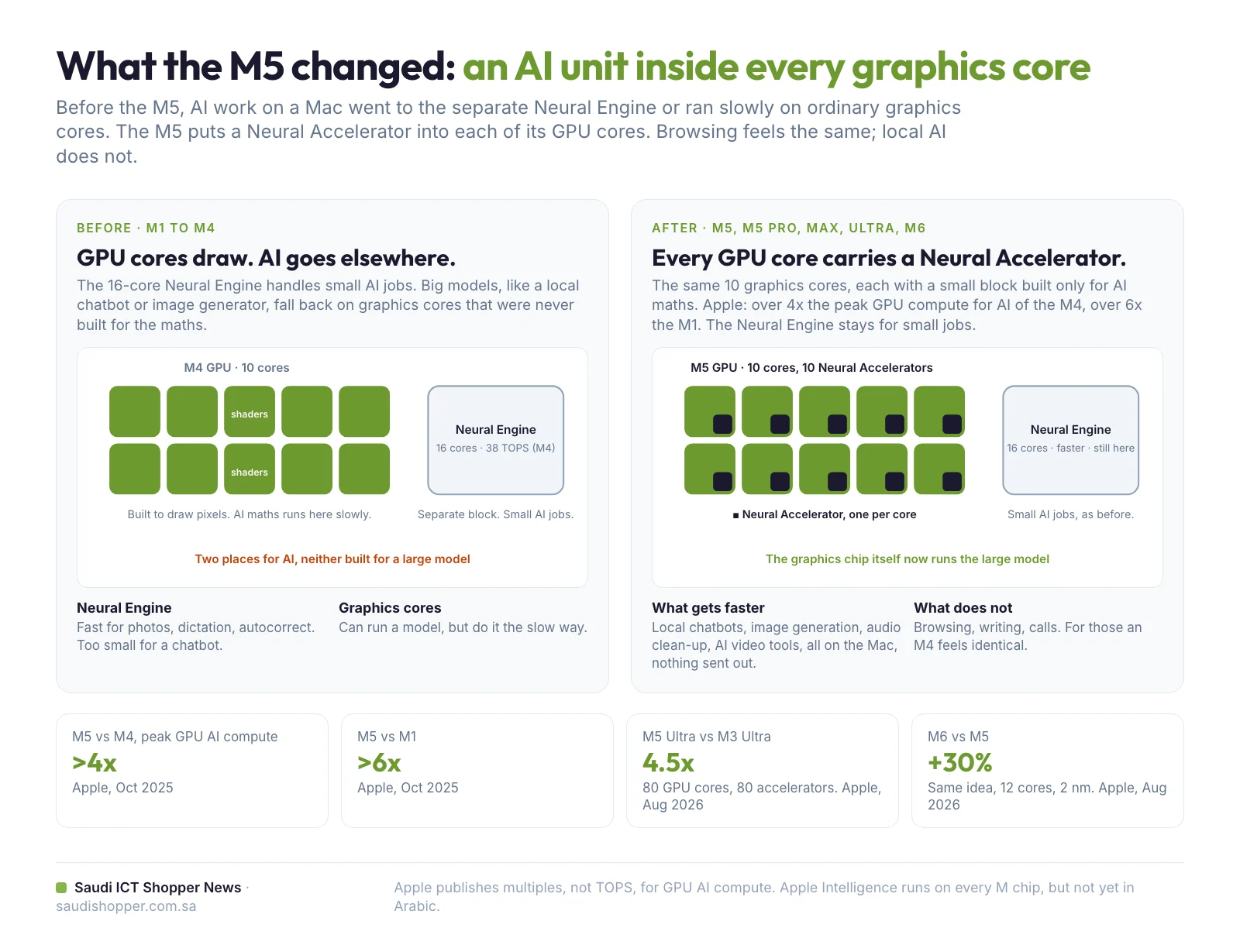
What that means at the desk: running a local chatbot, generating an image, or cleaning up audio on your own Mac, with nothing sent to a server, got several times faster. What it does not mean: browsing and writing feel any different from an M4. The M5 is a real upgrade if you use local AI tools, and a sideways step if you do not.
M5 Pro, M5 Max (March 2026) and M5 Ultra (August 2026): two dies, then four
On 3 March 2026 the M5 Pro and M5 Max changed how the big sizes are built. Both use what Apple calls a Fusion Architecture that “connects two dies into a single SoC”: two pieces of 3 nm silicon bonded so closely they behave as one chip. Think of two Lego bricks snapped together into one bigger brick. Both have an 18-core CPU made of 6 super cores and 12 of the new performance cores, with no efficiency cores at all. The Pro has up to 20 GPU cores, 64 GB and 307 GB/s; the Max up to 40 GPU cores, 128 GB and 614 GB/s. Apple’s figures: up to 30 percent more CPU performance than the M4 Pro and over four times the peak GPU AI compute. In Saudi Arabia the 14-inch MacBook Pro launched at SAR 10,499 with the M5 Pro and SAR 17,499 with the M5 Max.
Then on 25 August 2026 came the M5 Ultra for the Mac Studio (from SAR 25,999). It snaps two M5 Max chips together with UltraFusion, and since each Max is already two dies, the Ultra is four pieces of silicon working as one: up to 36 CPU cores (12 super, 24 performance), up to 80 GPU cores each with a Neural Accelerator, a 32-core Neural Engine, up to 512 GB of memory and 1.2 TB/s of bandwidth. Apple says it is up to 1.3x faster than the M3 Ultra in multi-threaded work and offers 4.5x its peak GPU AI compute. The 512 GB configuration followed in late October; Apple has not published a Saudi price for it, and in the US it costs $22,299 (about SAR 96,000 est.).
M6 (August 2026): the 2 nm chip that only comes in small
The M6 was announced on 25 August 2026, the same day as the M5 Ultra, and it is Apple’s first chip built on a 2 nm process. It has a 12-core CPU (2 super cores, 4 performance cores, 6 efficiency cores), a 12-core GPU with Neural Accelerators, a dual 16-core Neural Engine, up to 32 GB of memory and 170 GB/s of bandwidth. Apple’s claims: up to 1.2x the multi-threaded performance of the M5, nearly 30 percent more peak GPU AI compute, and up to 2.4x the CPU performance of the M1. It shipped first in the Mac mini on 22 September (SAR 4,299), then in the 14-inch MacBook Pro (SAR 9,499) and the iMac (from SAR 6,999), both announced on 27 October and in stores on 6 November 2026.
Put an M1 Mac next to an M6 Mac and simple tasks feel much the same. Video editing, 3D work and local AI are in a different class. But here is the unusual part. There is no M6 Pro, M6 Max or M6 Ultra. When Apple unveiled its new OLED touchscreen MacBook Pro on 28 October 2026, it shipped with the M5 Pro and M5 Max, not a bigger M6. In June 2026 Bloomberg’s Mark Gurman reported that Apple will skip the M6 Pro and Max entirely and move straight to an AI-focused M7 family in 2027. Apple has not confirmed that, but the October launches fit it. So in November 2026 the M6 is the fastest base chip Apple has ever made, and if you need more than the base, the answer is still an M5.
What the Saudi price tag and the language list say
Until July 2025 there was no Apple Store in Saudi Arabia, so every Mac price in the Kingdom was a reseller’s price. On 21 July 2025 Apple opened the Apple Store online and app in Saudi Arabia, with support in Arabic for the first time, engraving in Arabic, and Tamara instalments over four months at zero percent interest. Since then Apple publishes a Saudi riyal price for every new Mac on launch day, and those are the prices in this guide: MacBook Neo SAR 2,799; MacBook Air M5 SAR 4,999; Mac mini M6 SAR 4,299; iMac M6 from SAR 6,999; 14-inch MacBook Pro M6 SAR 9,499; OLED MacBook Pro from SAR 13,999; Mac Studio M5 Ultra from SAR 25,999. Apple also signed a lease in December 2025 for a flagship store in Diriyah Square, Riyadh. As of this writing no Saudi store has opened.
Two things a Saudi buyer should know that the box does not say. First, launch prices did not hold. On 25 June 2026 Apple raised prices across the Mac and iPad line, telling Reuters “we have never seen a component price increase this much, this quickly”, a reference to the memory shortage driven by AI data centres. The MacBook Neo went from $599 to $699 in the US and from SAR 2,799 to SAR 3,299 on apple.com/sa; the 13-inch MacBook Air M5 from SAR 4,999 to SAR 5,999. The cheapest Macs took the biggest percentage rise. Second, Apple Intelligence does not yet work in Arabic. Apple’s own list runs to 16 languages and Arabic is not on it. Every M-series Mac qualifies for Apple Intelligence, and the M5 and M6 are sold on AI, but an Arabic-first user gets those features only with the system language set to English. For that reader, the “AI chip” argument for paying more is weaker than the marketing suggests.
How the memory ceiling grew, and why 2026 bent the curve
Because memory is sealed inside the chip, the most useful number to track across the generations is not speed but how much memory each size can hold. The base chip went from 16 GB (M1) to 24 GB (M2, M3) to 32 GB (M4 onwards). The Ultra went from 128 GB to 192 GB to 512 GB. And the floor, the least memory Apple would sell you in a new Mac, stayed at 8 GB for four years before jumping to 16 GB in October 2024.
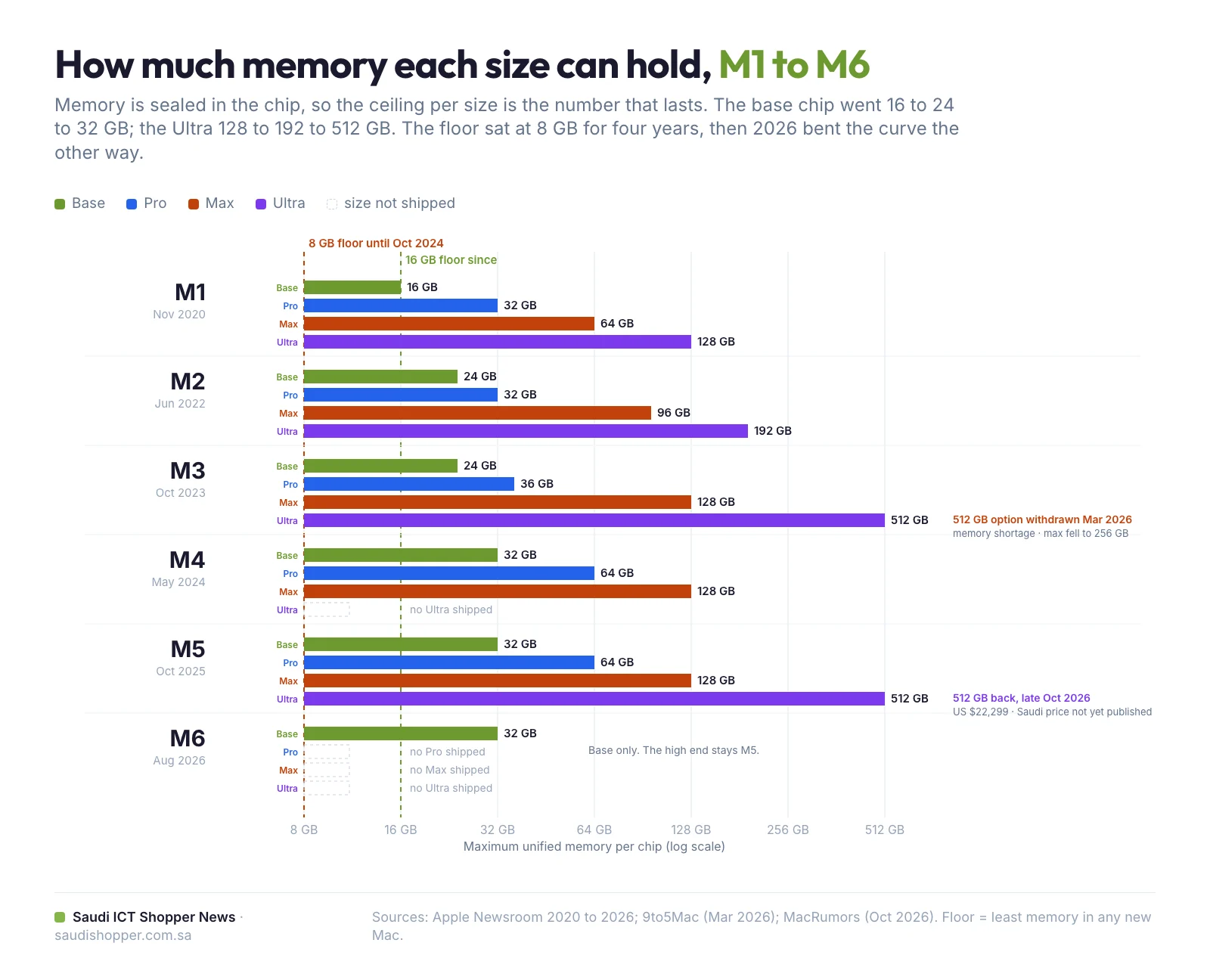
Then 2026 bent the curve the other way. In March, Apple quietly withdrew the 512 GB option from the M3 Ultra Mac Studio because of memory supply; the most you could order was 256 GB. In June came the line-wide price rise. The Mac mini, which had launched at $599 in 2024, was $899 by the time the M6 version shipped in September, a 50 percent increase in about two months. The 512 GB option returned with the M5 Ultra in late October, at $22,299 in the US. For the first time since the M1, the cost of memory, not the design of the chip, is what is moving Mac prices.
Which Apple chip should you buy? The cheat sheet
What all of this means when you are standing in a shop in Riyadh, Jeddah or Dammam, or scrolling apple.com/sa. Screenshot the card below, or read the rules.
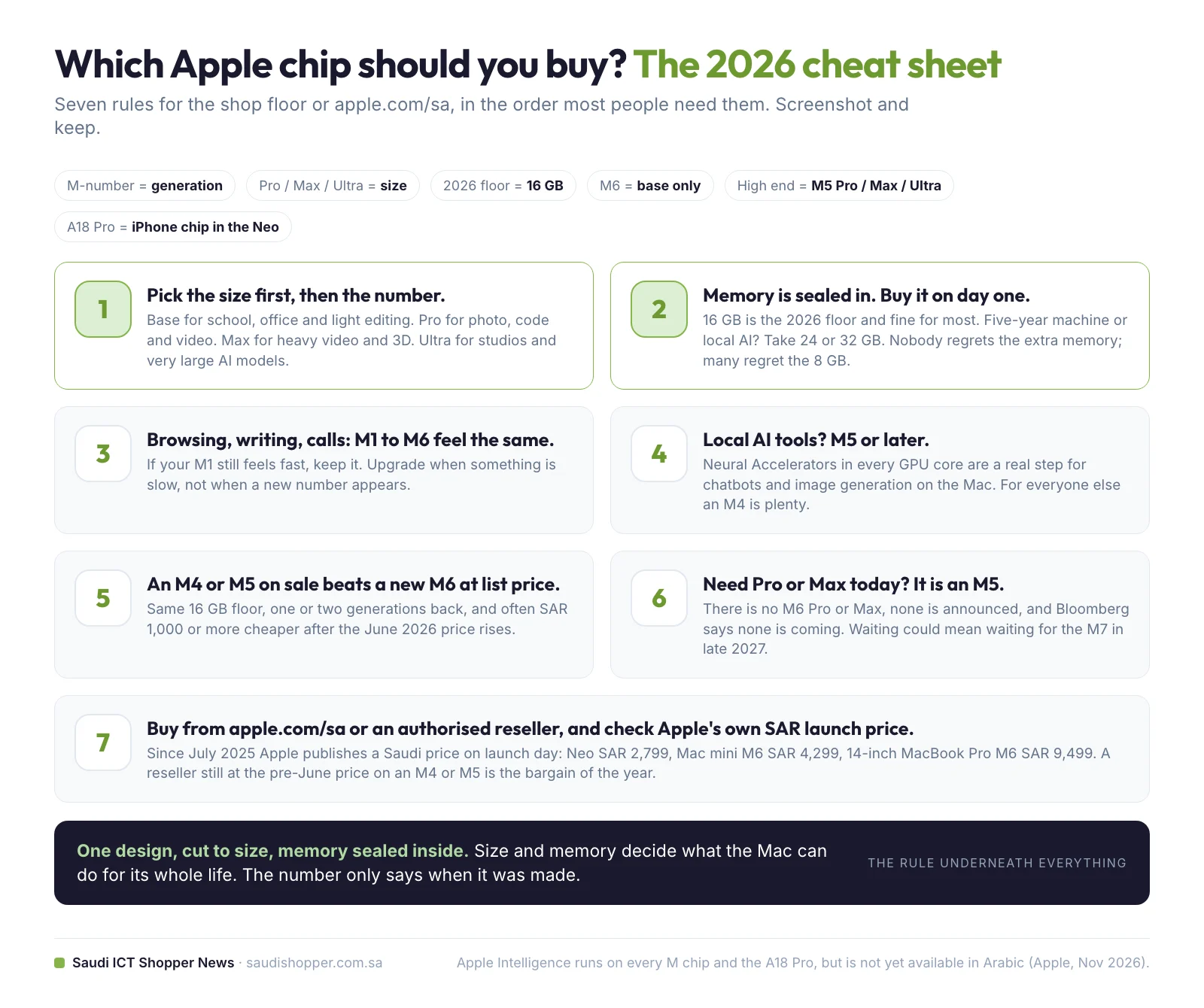
- Pick the size first, then the number. Base for school, office, writing and light editing. Pro for photographers, programmers and video editors. Max for heavy video and 3D. Ultra for studios and very large AI models. The size matters more than the generation for any heavy work.
- Memory is sealed in the chip, so buy it on day one. 16 GB is the floor in 2026 and fine for most people. If the Mac must last five years, or you run local AI, take 24 or 32 GB. Nobody has ever regretted the extra memory; many have regretted the 8 GB.
- For browsing, writing and calls, M1 to M6 feel the same. If your M1 still feels fast, keep it. Upgrade when something is actually slow, not when a new number appears.
- Local AI tools? M5 or later. The Neural Accelerators in every GPU core are a real step for chatbots and image generation on the Mac itself. For everyone else, an M4 is plenty.
- An M4 or M5 Mac on sale usually beats a new M6 at list price. Same 16 GB floor, one or two generations back, and often SAR 1,000 or more cheaper after the June 2026 rises.
- Need a Pro or Max today? It is an M5 Pro or M5 Max. There is no M6 version, none has been announced, and Bloomberg says none is coming. Waiting for one could mean waiting for the M7 in late 2027.
- Buy from apple.com/sa or an authorised Saudi reseller, and check Apple’s own SAR launch price. Since July 2025 Apple publishes it on launch day. A reseller still selling an M4 or M5 at its pre-June price is the bargain of the year.
And the rule underneath everything: one design, cut to size, with the memory sealed inside. The size and the memory you choose on the day decide what the Mac can do for its whole life. The number only tells you when it was made.
Apple chip glossary: the words on the box, in one sentence each
- Apple silicon: Apple’s own processors for Mac, iPad and iPhone, as opposed to the Intel chips Macs used until 2020.
- SoC (system on a chip): CPU, graphics, Neural Engine, memory controller and more on one piece of silicon.
- Unified memory: one pool of memory in the chip’s package, shared by the CPU and GPU, and not upgradeable after purchase.
- Memory bandwidth: how fast the chip can move data in and out of memory, in GB/s; it roughly doubles with each size.
- Base / Pro / Max / Ultra: the four sizes of each generation, from one small die to two Max chips joined together.
- UltraFusion: Apple’s silicon bridge that joins two Max dies into one Ultra chip (M1 Ultra onwards).
- Fusion Architecture: the 2026 design that builds the M5 Pro and M5 Max from two bonded dies.
- Super core: since 2026, Apple’s fastest CPU core, previously called the performance core.
- Performance core: before 2026, the fast core; since the M5 Pro, a new middle core built for efficient multi-threaded work.
- Efficiency core: the small, frugal CPU core that handles background work on a fraction of the power.
- Neural Engine: a separate block for AI tasks, 16 cores on most chips, measured in trillions of operations per second (TOPS).
- Neural Accelerator: since the M5, a small AI unit built into every GPU core, so the graphics chip itself runs AI models.
- Dynamic Caching: the M3 GPU feature that gives each task exactly the memory it needs in real time.
- Ray tracing: drawing light and reflections by following rays, done in hardware since the M3.
- Process node (nm): the manufacturing generation of the chip; 5 nm (M1, M2), 3 nm (M3 to M5), 2 nm (M6); smaller means more transistors and less power.
- Rosetta 2: the translation layer that runs Intel Mac apps on Apple silicon; full support ends with macOS 27.
- Thunderbolt 5: the 120 Gb/s port on M4 Pro and later Pro, Max and Ultra chips, for fast drives and displays.
Frequently asked questions about Apple M chips
No. The M6 is a base chip with a 12-core CPU and a 12-core GPU. The M5 Pro has an 18-core CPU and up to 20 GPU cores, with almost twice the memory bandwidth and a 64 GB ceiling. The M6 wins only in single-core speed and efficiency. For heavy video, 3D or AI work the M5 Pro is faster.
They are four sizes of the same generation’s design. Base is one small die with the fewest cores and the lowest memory ceiling (32 GB on the M6). Pro and Max are bigger (two bonded dies since the M5 Pro) with more GPU cores, more memory (64 GB and 128 GB) and more bandwidth. Ultra is two Max chips joined by UltraFusion, with up to 512 GB on the M5 Ultra.
No. On every Apple silicon Mac the memory is part of the chip package and cannot be changed after purchase. Choose the memory you will need for the life of the machine on the day you buy it.
For browsing, office work, writing, video calls and light photo and video editing, yes. 16 GB has been Apple’s minimum since October 2024. If you run local AI models, edit long videos or want the Mac to last five years or more, 24 GB or 32 GB is the safer choice. Avoid 8 GB machines.
For most people the M4 on sale. Both start at 16 GB, and in everyday use they feel the same. The M6 is faster in multi-threaded work and about 30 percent faster in AI tasks on the GPU, but after the June 2026 price rises a discounted M4 or M5 is often SAR 1,000 or more cheaper.
Apple has not announced one. The October 2026 OLED MacBook Pro launched with the M5 Pro and M5 Max. In June 2026 Bloomberg reported that Apple will skip the M6 Pro and Max and move to an M7 family in 2027. Treat that as a report, not a promise, but do not wait for an M6 Pro to buy a MacBook Pro.
The MacBook Neo uses the A18 Pro, the chip from the 2024 iPhone 16 Pro, with a 6-core CPU, 5-core GPU and 8 GB of memory. It runs full macOS and all Mac apps, including Apple Intelligence. It launched in March 2026 at SAR 2,799 in Saudi Arabia and is Apple’s cheapest laptop ever; the trade-offs are 8 GB of memory, no Thunderbolt and a simpler display.
Yes. Apple’s requirements list every M1 or later Mac for Apple Intelligence, and the M1 Macs run the current macOS. Some newer features, such as improved Dictation, need an M3 or later with at least 12 GB of memory.
Not yet. Apple’s supported-language list for Apple Intelligence has 16 languages and Arabic is not among them. On a Mac set to Arabic the features do not appear; switching the system and Siri language to English or another supported language enables them.
Yes, through Rosetta 2, which translates Intel apps automatically. Apple has said macOS 27 is the last version with full Rosetta 2 support and macOS 28 will keep only a reduced version for old games, so an app that has never been updated for Apple silicon is on borrowed time.
Sources
- Apple Newsroom, Apple announces Mac transition to Apple silicon (June 2020)
- Apple Newsroom, Apple unleashes M1 (November 2020); M1 Pro and M1 Max (October 2021); M1 Ultra (March 2022)
- Apple Newsroom, Apple unveils M2 (June 2022); M2 Pro and M2 Max (January 2023); M2 Ultra (June 2023)
- Apple Newsroom, M3, M3 Pro and M3 Max (October 2023); M3 Ultra (March 2025)
- Apple Newsroom, Apple introduces M4 (May 2024); M4 Pro and M4 Max and Mac mini with M4, 16 GB standard (October 2024)
- Apple Newsroom, Apple unleashes M5 (October 2025); M5 Pro and M5 Max (March 2026); M6 and M5 Ultra (August 2026)
- Apple Newsroom, 14-inch MacBook Pro with M6 (27 October 2026); MacBook Pro with PROLED XDR Display, M5 Pro and M5 Max (28 October 2026)
- Apple Newsroom Saudi Arabia (SAR prices): MacBook Neo, MacBook Air with M5, MacBook Pro with M5 Pro and M5 Max, Mac mini with M6, Mac Studio with M5 Max and M5 Ultra, 14-inch MacBook Pro with M6, iMac with M6
- Apple, Apple Intelligence: supported languages and devices (checked November 2026)
- MacRumors, 8GB RAM on M3 MacBook Pro “analogous to 16GB” on PCs, claims Apple (November 2023); Hands-on with the M3 Pro MacBook Pro (November 2023)
- 9to5Mac, Apple announces significant price increases for MacBooks, iPads, more (June 2026); Apple explains why M5 chips have three different core types (March 2026)
- Engadget, Apple will reportedly skip the M6 Pro and Max and jump straight to M7 (June 2026, citing Bloomberg)
- Arab News, Apple signs lease agreement to open flagship retail store in Diriyah Square (December 2025)
- Based on the explainer “10 分钟解释 M1 到 M6” (M1 to M6 explained in 10 minutes) by 馄饨智能 on Xiaohongshu.
Last updated November 2026. Prices are Apple’s Saudi launch prices in SAR including VAT; where Apple published no Saudi price, the US price is given with an estimate marked “est.”. Infographics by Saudi ICT Shopper News.