
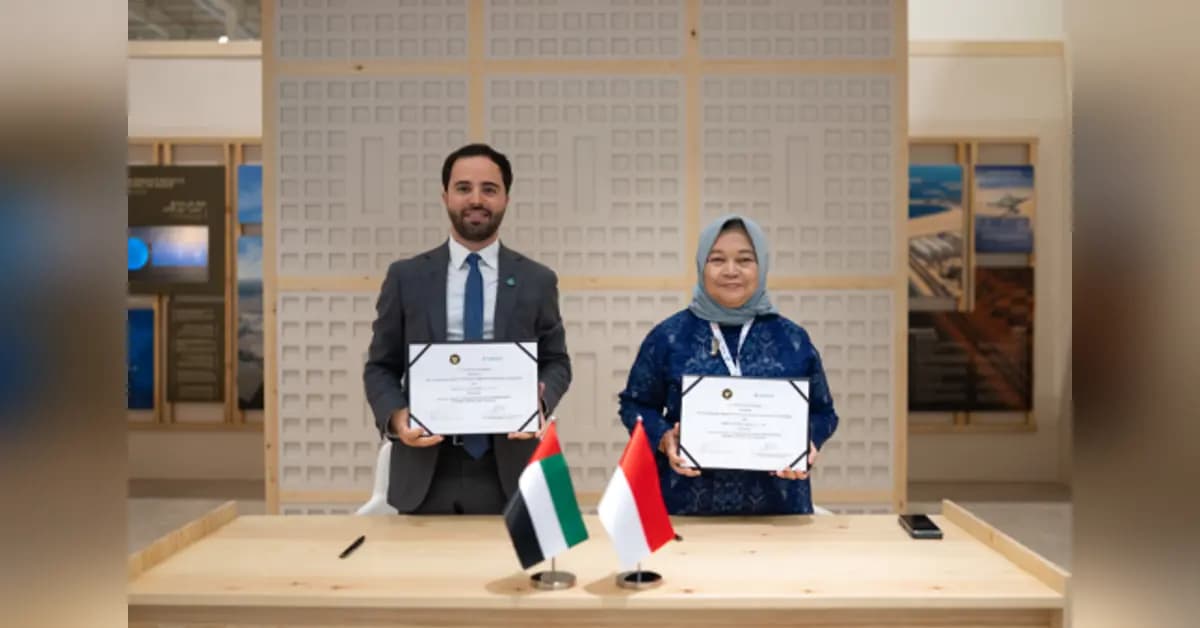
Effective mangrove restoration in Demak, Central Java, will now incorporate advanced digital models following a partnership agreed at COP31 in Antalya, Türkiye. Abu Dhabi-based nature technology company Nabat, operating under the Advanced Technology Research Council, signed the agreement with Indonesia’s Coordinating Ministry for Food Affairs to implement targeted environmental monitoring tools.
The agreement was signed by Dr Ir Nani Hendiarti, Deputy Coordinating Minister for Food Accessibility and Safety, and Mehdi Ajana, Vice President of Strategy and Growth at Nabat. The partnership deepens the environmental alliance established by the UAE and Indonesia, which previously launched the Mangrove Alliance for Climate at COP27. The project connects UAE-developed technical tools with Indonesian scientific expertise.
Technology for Mangrove Restoration
Under the agreement, Nabat will adapt its environmental algorithms to coastal conditions in Demak across two pilot initiatives. The first deployment focuses on site prioritisation to make mangrove restoration more accurate. Teams will combine satellite imagery with more than 20 environmental factors, including water movement, local elevation, soil composition, and tidal patterns.
The system evaluates site suitability to guide conservation work on the ground. Findings and tracking modules will integrate into NabatOS, the company’s dedicated software system for managing natural habitats with artificial intelligence.
Drone LiDAR and Carbon Verification
The second pilot project measures coastal carbon storage using modern sensor technologies. Field teams will deploy drones equipped with light detection and ranging (LiDAR) sensors alongside physical soil core sampling.
Consequently, these field measurements establish an accurate baseline of coastal carbon stocks. This dataset provides the foundation for future carbon monitoring, reporting, and scientific verification across the Demak region.
“This collaboration marks a stronger commitment by Indonesia and the UAE to pioneering science- and technology-driven solutions for mangrove conservation, climate action and coastal resilience. It also translates high-level diplomatic commitments into concrete action through the Mangrove Alliance for Climate (MAC), co-chaired by our two countries.”
Dr Ir Nani Hendiarti, Deputy Coordinating Minister for Food Accessibility and Safety of Indonesia
Capacity Building for Coastal Communities
In addition to algorithmic modeling, the initiative includes technical training for institutions and coastal residents. Indonesian academic and research partners will participate in participatory digital data collection programs.
These training sessions will teach local teams how to capture environmental metrics using digital instruments. Local participation ensures that community members contribute directly to conservation data collection and habitat verification efforts.
“At Nabat, we believe that restoring nature at scale requires science, technology and reliable data. Through this collaboration, we will adapt our ecology-specialised AI models to Indonesia’s local conditions, working alongside Indonesian experts to make restoration planning more precise and carbon monitoring more reliable. Our ambition is to turn advanced technology into practical tools that deliver measurable benefits for nature and the communities that depend on it.”
Reda Nidhakou, CEO of Nabat
Regional Environmental Cooperation
Meanwhile, the program reinforces ongoing cross-border environmental programs between the UAE and Southeast Asia. The work in Central Java provides an operational testing ground for nature-tech tools built within the Abu Dhabi research network.
As field operations expand in Demak, technical partners will collect verified data to guide future conservation strategies. The outputs from NabatOS will support regional authorities in planning subsequent coastal preservation measures.