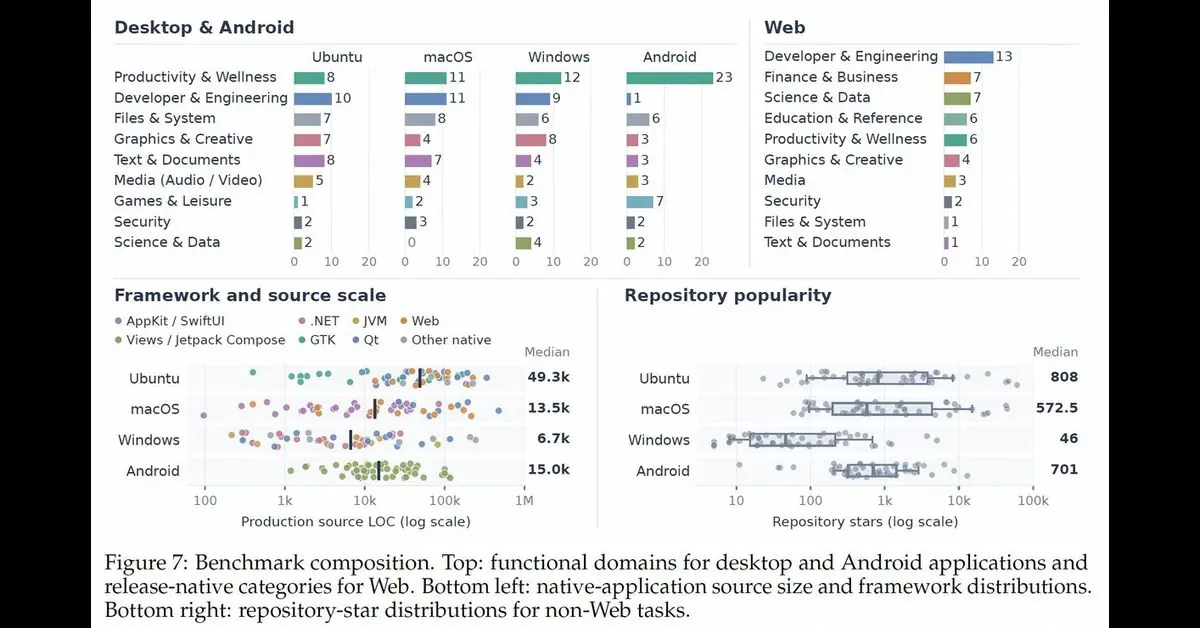
The RecreationBench benchmark is now available on Hugging Face to evaluate hybrid computer-use agents on the Ubuntu operating system. Developed by the Qwen research team, the resource establishes a standardized framework for testing how automated models interact with desktop software. Researchers and developers can use the dataset to analyze agent performance across multi-step digital workflows in open-source environments.
Overview of the RecreationBench Benchmark
The suite contains 250 distinct tasks centered on desktop application recreation across common productivity scenarios. Within the RecreationBench benchmark, testing protocols examine how well software models handle practical user interface operations, file manipulations, and command sequences. Furthermore, the standardized structure allows engineers to compare diverse model architectures under identical operating conditions and execution parameters.
Testing Capabilities on Ubuntu Systems
Specifically, the evaluation suite focuses on Ubuntu desktop environments to observe system-level agent behavior in realistic settings. Tasks require agents to interpret visual layouts, launch applications, process graphical interfaces, and execute specific productivity actions. Consequently, this testing setup provides measurable indicators of an agent’s operational accuracy, interface navigation ability, and error-recovery techniques during active sessions.
Standardized Methodology for Hybrid Agents
Evaluating hybrid computer-use systems requires assessing both visual perception and direct system interaction. The RecreationBench benchmark tests whether an automated model can recognize on-screen elements, manage interactive window states, and trigger appropriate input events such as keystrokes and pointer clicks. By structuring tests around concrete application workflows, the benchmark offers valuable insight into how models transition between high-level reasoning and low-level desktop control.
Integration with Open Machine Learning Frameworks
Hosting the dataset on Hugging Face ensures broad accessibility for developers and researchers across the artificial intelligence sector. In addition, the open release supports reproducible experiments across academic and industrial research labs. Teams working on automated computers workflows can integrate the benchmarks directly into their active evaluation pipelines without proprietary platform dependencies.
Outlook for Desktop Computer Automation
As software agents take on more interactive responsibilities in digital workspaces, standardized benchmarks serve as necessary verification checkpoints. The release of the RecreationBench benchmark offers a concrete metric for tracking progress in desktop automation and agent reliability. Technical teams can reference these 250 standardized tasks to identify strengths and limitations in current agent architectures, helping advance the reliability and autonomy of computer-use agents over time.