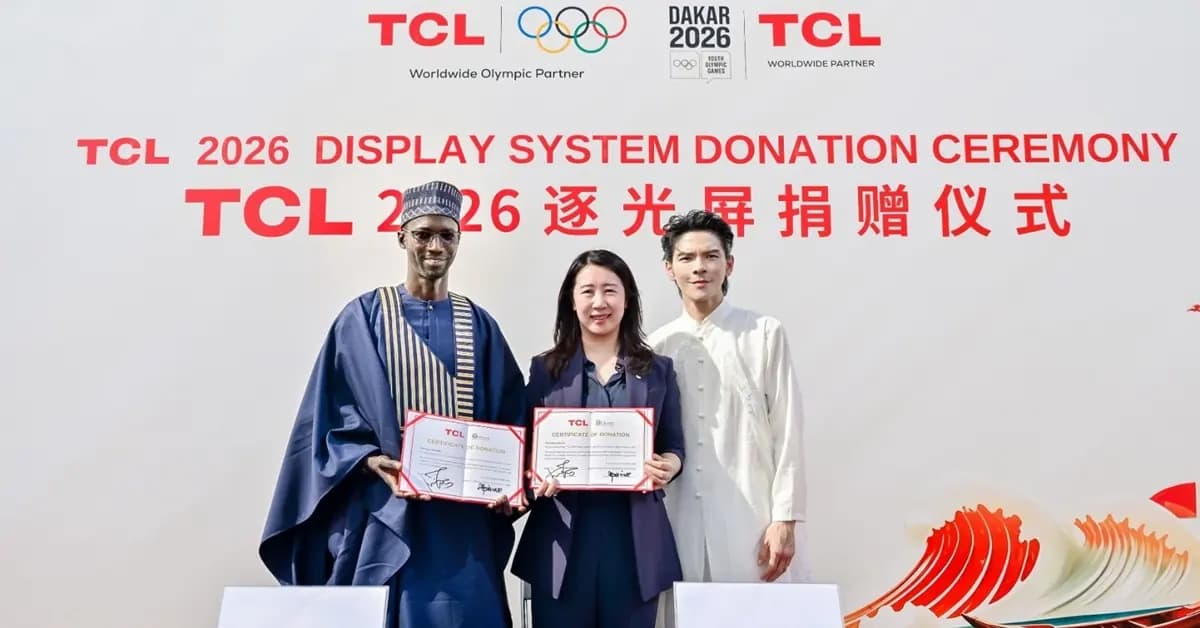
The TCL display system was officially donated to Université Amadou Mahtar Mbow in Senegal to serve the upcoming Dakar 2026 Youth Olympic Games. Powered entirely by solar energy, the installation functions as an outdoor information hub across the university grounds, which will house athletes during the competition. Furthermore, the unit delivers high visual output while consuming half the electricity required by standard commercial screens.
Operational Features of the TCL display system
The installation uses a 75-inch Field Sequential Color panel developed by TCL CSOT that achieves 4,000 nits of brightness. Remarkably, this unit draws approximately 300 watts during active operation. Conventional screens depend on color filter sheets, whereas this screen generates pictures by rapidly switching red, green, and blue illumination, which raises light transmittance above 15 percent.
Because direct sunlight frequently limits readability on typical outdoor monitors, this high transmittance design allows notifications to remain legible throughout daylight hours. The deployment reflects broader commercial efforts to place low-consumption screens into active public environments. These improvements provide clear benefits for smart devices placed in demanding outdoor environments.
Official Delegation and Institutional Statements
Multiple international delegates attended the formal handover ceremony in Senegal. Attendees included International Olympic Committee President Kirsty Coventry, university leader Professor Mababa Diagne, Senegalese Higher Education Minister Boubacar Camara, philanthropic representative Jacky Heung, and regional executive Sunny Yang.
“Powered by TCL’s advanced display technology, this new display system will create new possibilities for our campus facilities and support development for both students and faculty.”
Professor Mababa Diagne, President of Université Amadou Mahtar Mbow
Sunny Yang, General Manager of TCL Industries Middle East and Africa, stated that technology projects must provide direct utility to local populations. She noted that energy-efficient equipment supports long-term regional development while reducing operational demands on local infrastructure.
Community Initiatives in Dakar
In parallel with the screen installation, the company expanded cultural outreach through its TCLArt and TCLYoung programmes. Specifically, the enterprise joined the Yeesal urban art project to commission large public murals throughout Dakar. This undertaking backs 43 local artists, with particular attention to creators under the age of 35. These public murals depict African sporting figures, local cultural themes, and youth aspirations, leaving permanent installations across the capital.
Such initiatives connect technology adoption with civic participation and education programs. Consequently, the university installation combines practical student communication tools with wider public engagement across the surrounding urban district.
Commercial Expansion and Regional Footprint
This hardware donation reflects an operating presence across Africa that began in 2004. Today, company products reach consumer markets in roughly 50 African states, backed by six dedicated sales subsidiaries and three regional business units. Additionally, the manufacturer opened a flagship retail store in Johannesburg and organized direct retail distribution channels in Kenya.
These investments align with the company’s worldwide network of 50 research centres and 47 manufacturing hubs operating in over 160 countries. As the Dakar 2026 Youth Olympic Games approach, the TCL display system demonstrates how energy-saving screen architecture functions within active educational environments while supporting major international sporting venues in the emerging economy of West Africa.