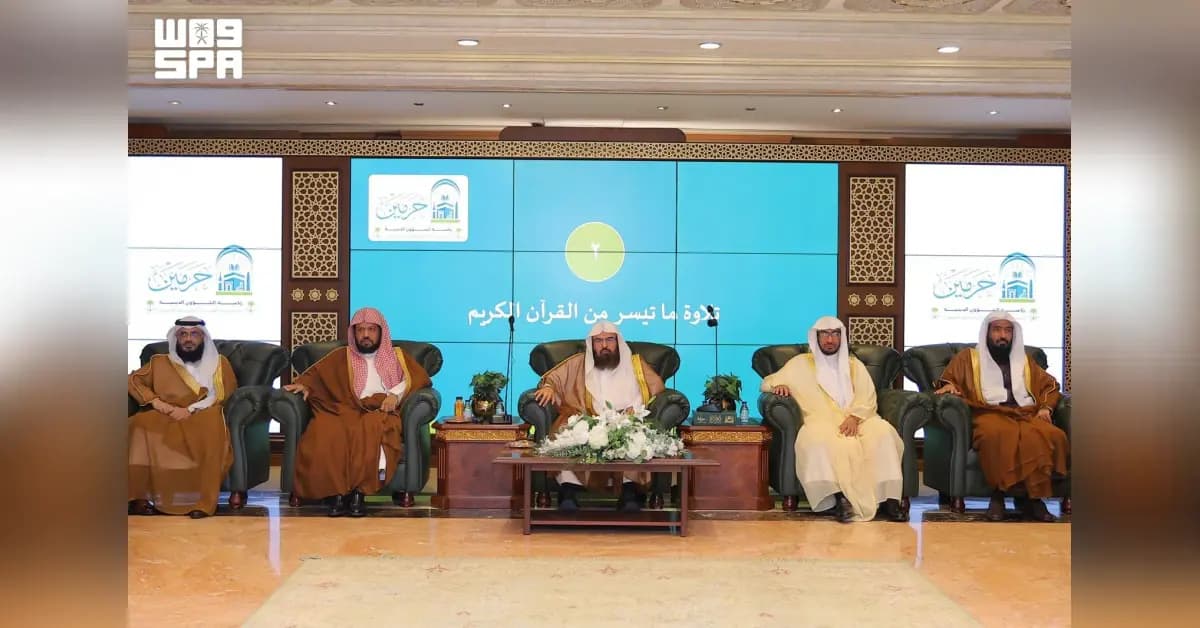
A new smart guidance system has been introduced at the Grand Mosque and the Prophet’s Mosque to handle religious inquiries from visitors. Sheikh Dr. Abdulrahman Al-Sudais, President of the Presidency for Religious Affairs at the Grand Mosque and the Prophet’s Mosque, inaugurated the project in Madinah, according to SPA (English). The initiative incorporates AI tools to deliver prompt answers to worshippers and pilgrims around the clock.
The launch event was attended by Dr. Ahmed bin Ali Al-Hudhaifi, Assistant President for Religious Affairs at the Prophet’s Mosque. In addition, the imams of the Prophet’s Mosque, Sheikh Dr. Abdullah bin Abdulrahman Al-Baijan and Sheikh Saleh bin Awad Al-Maghamsi, attended along with several department officials. The project responds to growing numbers of visitors seeking clear answers on religious practices.
Core Architecture of the Smart Guidance System
The platform operates through an automated assistant capable of answering recurrent inquiries using approved documentation. Moreover, the project provides religious specialists with practical digital utilities, such as automated question summaries and direct access to vetted source texts. Consequently, the smart guidance system ensures consistent interpretations while cutting waiting periods for worshippers across multiple languages.
The technical architecture consists of a text-based assistant alongside a voice-enabled tool undergoing technical evaluation. Specialized tools support human scholars, while a governed knowledge base maintains doctrinal accuracy. Furthermore, a dedicated performance monitoring center tracks operational quality and user interaction trends.
Human Oversight and Ethical Safeguards
Automated responses remain strictly limited to verified topics and frequent questions. Whenever a complex matter requires scholarly discretion, the software transfers the query to a qualified specialist. The operational framework mandates source documentation, privacy protection, and transparent disclosure informing users about machine-generated responses.
Phased Execution and Strategic Integration
The initiative follows structured implementation phases covering technical design, pilot testing, and operational deployment. Each stage adheres to specific standards for doctrinal precision, linguistic accuracy, data security, and system reliability, meeting modern expectations for digital apps.
“Modern technologies and artificial intelligence help facilitate access to reliable religious answers around the clock in multiple languages, reducing waiting times and ensuring consistency.”
Sheikh Dr. Abdulrahman Al-Sudais, President of Religious Affairs at the Two Holy Mosques
Future Operations and Service Analytics
The system records interaction data to identify peak visitor inquiry periods and recurring topics throughout the year. As a result, the Presidency can allocate scholars more effectively during busy pilgrimage seasons. This digital transformation aligns with broader modernization goals under Saudi Vision 2030, reinforcing high operational standards across public religious services.