

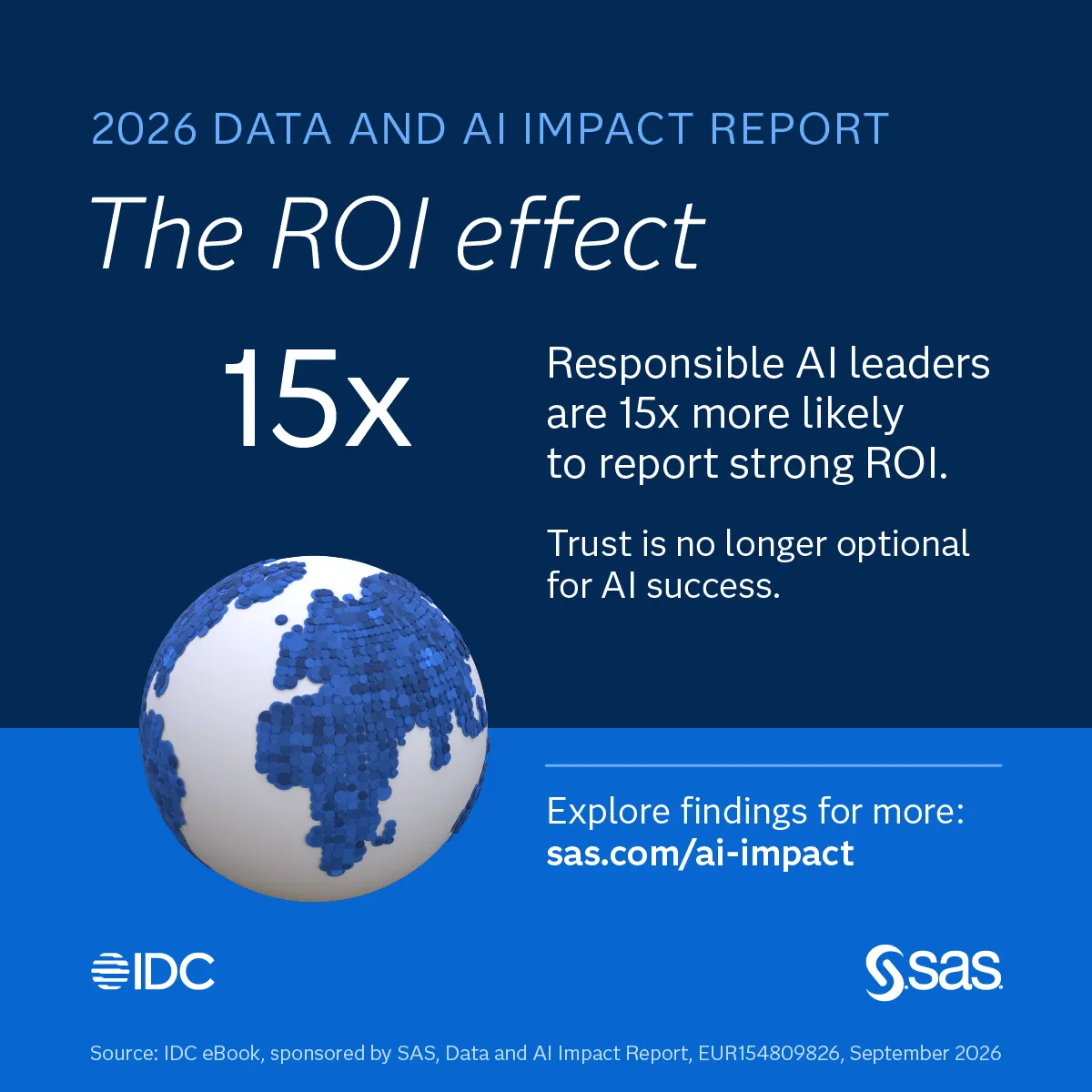
Adopting trustworthy AI practices makes organizations 15 times more likely to achieve strong returns on investment, according to a report published by SAS and IDC. The study, titled Data and AI Impact Report: The New Economics of Trust, examined deployments across 28 countries and revealed that structured oversight directly impacts financial performance.
Organizations with formal governance, reliable data pipelines, and clear audit mechanisms recorded double the return of their peers. Meanwhile, enterprises lacking these frameworks struggled to convert their artificial intelligence initiatives into measurable commercial gains within modern business operations.
“When AI works, it is impactful. However, state-of-the-art agents can have error rates that exceed 25% on complex tasks, which is unacceptable in high-stakes decision-making. In order to achieve accuracy and repeatability, organizations must embed domain expertise into agentic workflows, while keeping people at the center of governance and oversight.”
Bryan Harris, CTO at SAS
The Drivers Behind Trustworthy AI Success
The study found that 62% of organizations with trustworthy AI measures reported high returns on investment, compared to only 4% among organizations without such practices. Furthermore, leading institutions realized 1.85 times greater gains across 13 business metrics, including revenue growth and operational cost reductions.
To maintain this performance advantage, 85% of leading organizations plan to increase their governance spending by more than 10% this year. The divide between prepared enterprises and unprepared competitors continues to widen across international markets.
Employee Trust and the Impact of Decision Overrides
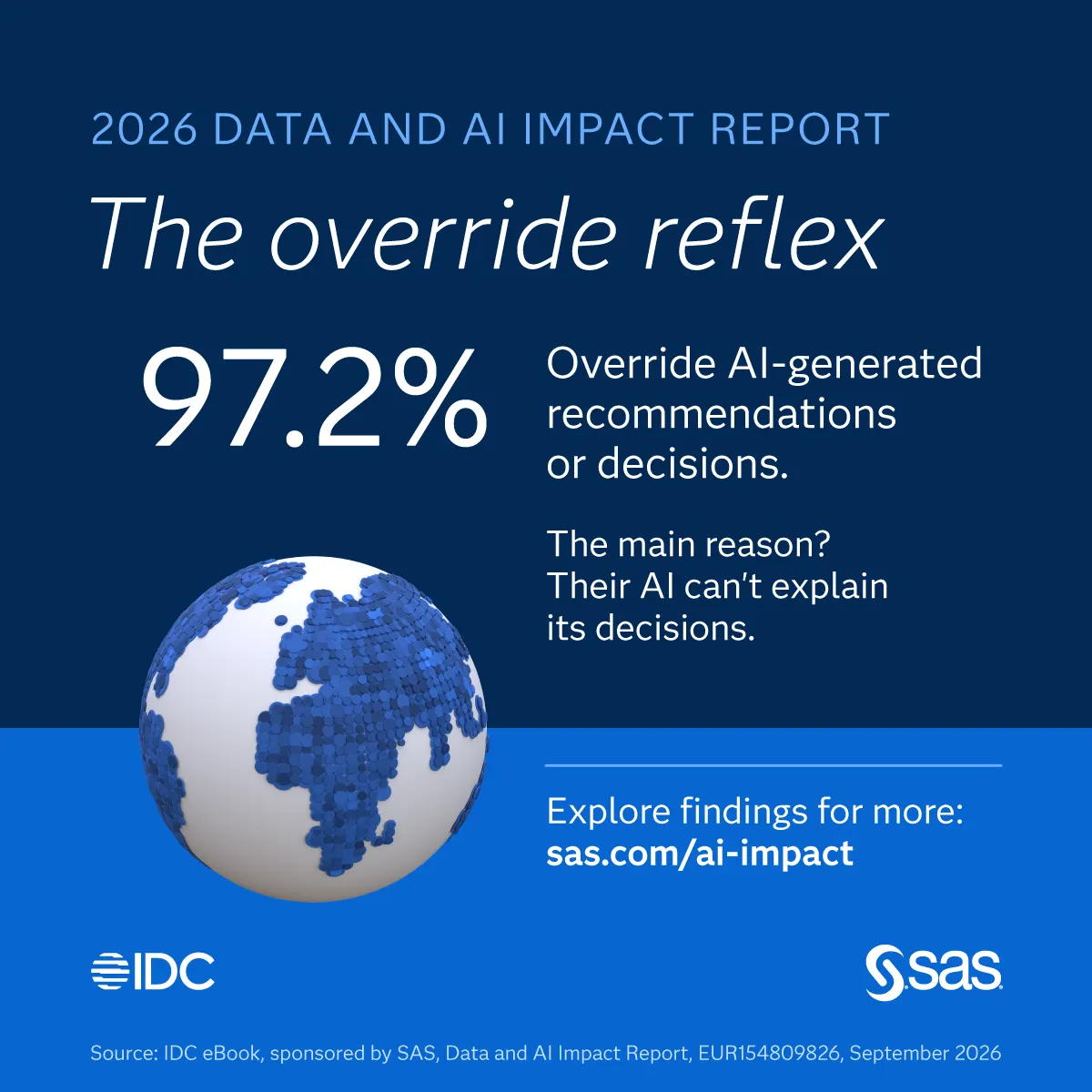
Employee hesitation remains a key operational barrier for enterprises deploying automated systems. The survey revealed that 97.2% of users override automated recommendations in certain scenarios. The primary driver for these manual interventions was the system’s inability to provide a clear explanation for its conclusions.
Confidence levels also dropped from 76% for standard generative tools down to 66% for autonomous agentic systems. When workers cannot verify how a software model reached an output, manual corrections increase, causing lost productivity and increased operational risks in enterprise software environments.
“As AI becomes more autonomous, organizations face a new challenge: maintaining confidence in systems people don’t fully understand. Stronger oversight, explainability, accountability and data foundations are becoming prerequisites for scaling AI successfully.”
Chris Marshall, Vice President at IDC
Saudi Arabia Accelerates Governance Frameworks
Saudi Arabia recorded notable progress in regional governance metrics, with its national Trustworthiness Index advancing 24.5 points to reach 63.5 in 2026. The Kingdom registered the fastest governance improvements in the global research, supported by structured national initiatives under Saudi Vision 2030.
Strategic alignment and oversight emerged as a top focus among Saudi organizations, rising 35 points to 50.7% in 2026. However, lack of explanation caused 41.8% of system overrides locally. In addition, only 3% of local enterprises mandate data-quality procedures for every project, while 6% require explainability controls.
“This progress reflects how quickly organizations in Saudi Arabia are strengthening the governance and accountability needed to support their AI ambitions. As AI becomes more autonomous, strengthening explainability and oversight will be critical to scaling adoption with confidence and translating innovation into sustainable value.”
Asad Makki, Country Representative, Saudi Arabia, SAS
Infrastructure Readiness and Sector Benchmarks
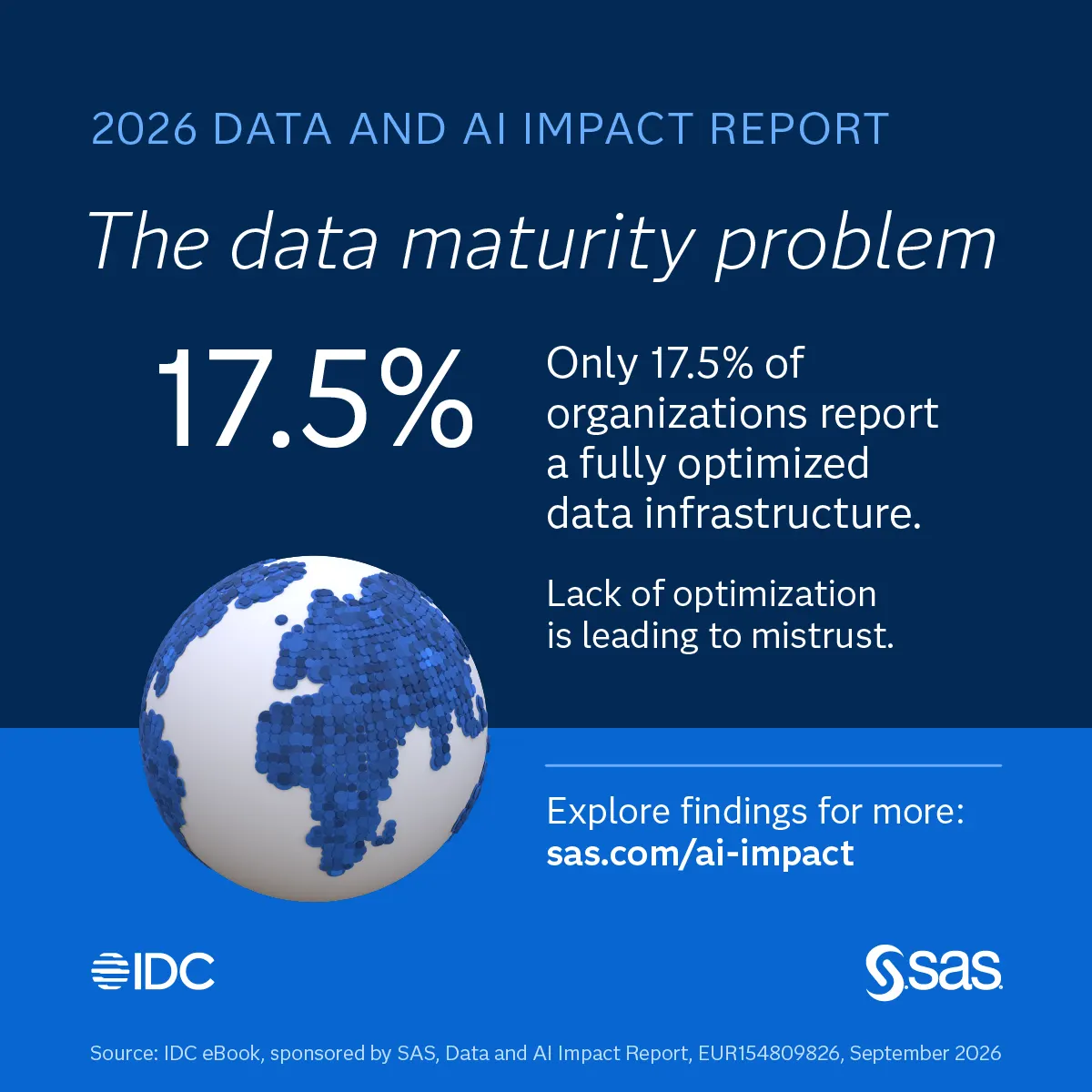
Data infrastructure maturity remains limited across participating organizations worldwide. Only 17.5% of surveyed enterprises maintain optimized data foundations capable of supporting autonomous agents. Organizations with mature architectures are four times more likely to achieve strong financial returns and six times more likely to enforce quality controls across cybersecurity and compliance workflows.
Sector adoption varied across the 2,699 surveyed decision-makers in 28 countries. In the banking sector, 85% of leading institutions established formal oversight frameworks, compared to 29% among slower adopters. Meanwhile, 41% of public sector leaders plan to increase governance investments by more than 20% during the coming year.