
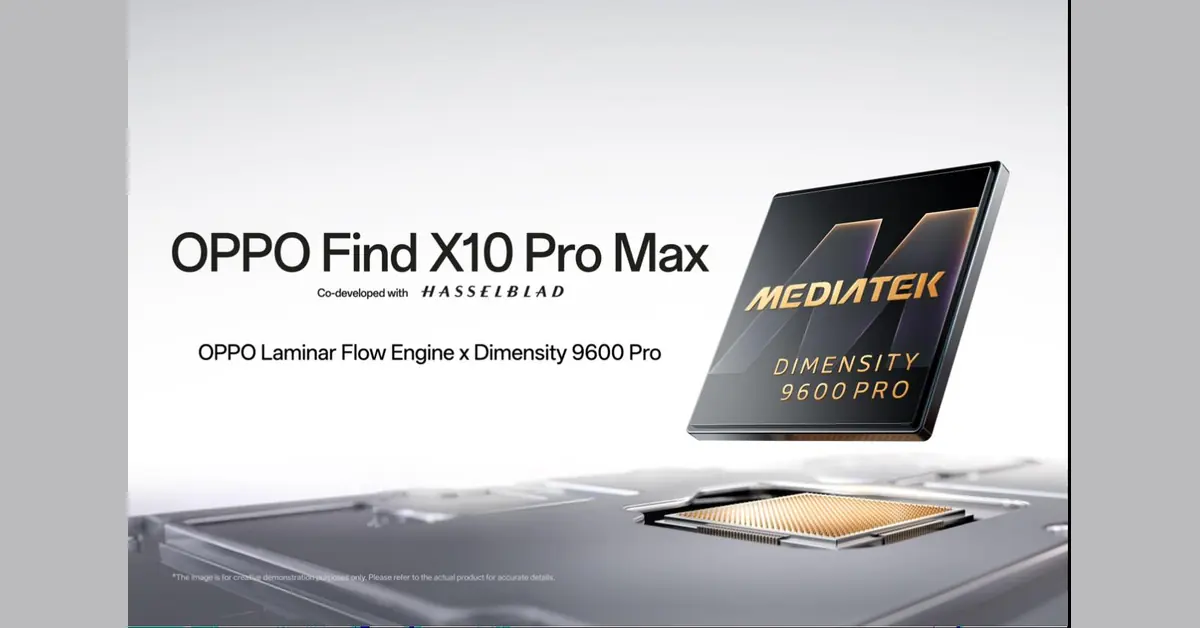
The new Dimensity 9600 Pro processor will power the upcoming OPPO Find X10 Pro Max smartphone during its global rollout across international markets for mobile devices. The platform introduces updated hardware architecture, enhanced power management, and dedicated on-device machine intelligence capabilities designed to support next-generation software features and compute-heavy workflows.
Architecture and Manufacturing Process
Manufactured on TSMC’s 2nm N2P process, the Dimensity 9600 Pro provides a 61% improvement in CPU multi-core energy efficiency compared to the prior generation. Specifically, the processor retains MediaTek’s All-Big-Core architecture with two 4.55GHz C2-Ultra cores and six performance cores. As a result, the configuration delivers a 17% gain in total CPU performance while utilizing independent frequency control for each individual core to schedule tasks accurately across varied mobile workloads.
Graphics and Visual Computing Capabilities
Graphics processing is handled by the G2-Ultra NX GPU, which incorporates hardware ray tracing and neural graphics functions for advanced gaming applications. Under sustained heavy workloads, the Dimensity 9600 Pro delivers approximately 27% higher performance to support demanding visual tasks on the OPPO Find X10 Pro Max, ensuring consistent frame delivery and improved rendering efficiency during extended interactive sessions.
Dual NPU and Artificial Intelligence Processing
Hardware processing for artificial intelligence relies on a dual-NPU architecture that pairs a high-performance unit with a power-conserving processor. The high-performance NPU achieves 51% faster large language model prefill speeds for computational imaging and generative model inference. Meanwhile, the efficient secondary unit reduces power consumption by 40% to run background tasks continuously without placing unnecessary drain on device battery resources.
Software Integration and System Optimization
To support sustained performance over extended operating periods, the smartphone incorporates the OPPO Laminar Flow Engine. Jointly engineered by both companies, this software framework restructures rendering operations and system scheduling to accelerate application launches. In addition, it stabilizes content loading during resource-intensive operations by optimizing data movement between the main chipset components and system memory.
Industry Context and Regional Availability
The deployment of leading-edge semiconductor nodes highlights the mobile industry’s continuous push to deliver increased computing throughput within compact thermal envelopes. Following its international unveiling, the device is scheduled to arrive in Saudi Arabia, with local retail dates and configurations to be confirmed later. The release represents the continuation of the Find series across the region’s market for premium smart devices.