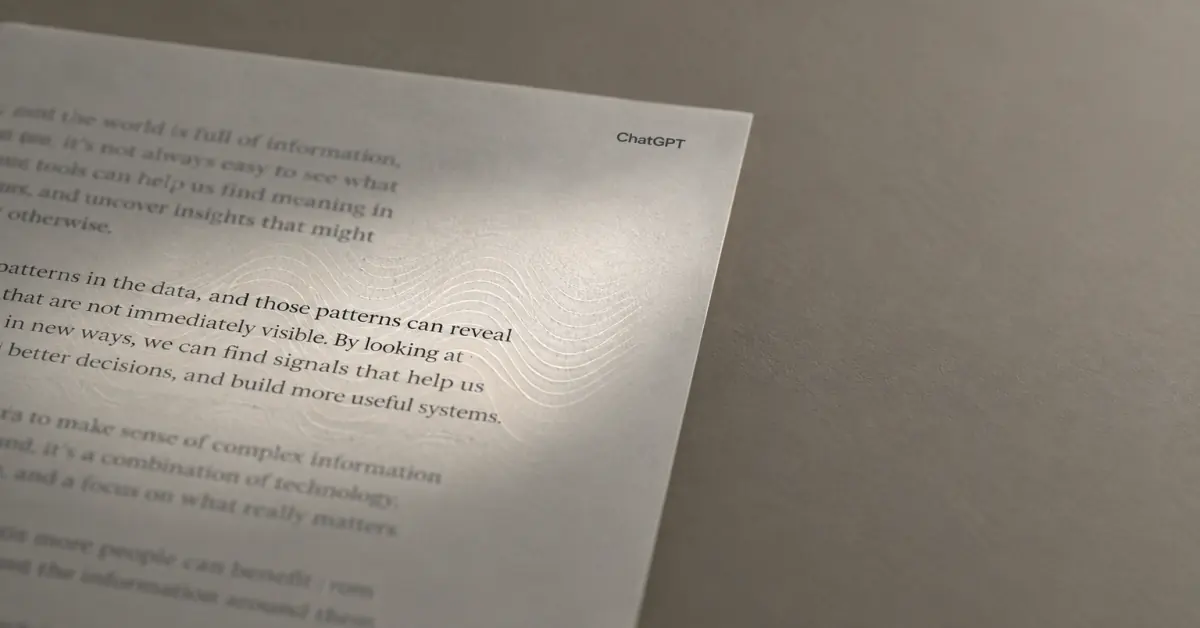
AI-generated illustration
OpenAI has introduced its OpenAI text watermarking technology, known as textGrain, to label content generated by ChatGPT and Codex within the European Union. The rollout addresses transparency mandates set by the EU AI Act, which took effect in August. According to reporting by Ars Technica, the feature operates by default in the EU while remaining off by default in other global regions.
How OpenAI Text Watermarking Operates
The underlying system inserts an invisible statistical signal into the word selections made by large language models. This subtle pattern does not alter the quality, meaning, or readability of the generated output for human readers. However, authorized entities equipped with a specialized detector can identify whether a passage originated from the company’s systems. In addition, developer access through the application programming interface allows global customers to opt in for select models.
Detection Rates and System Limitations
Internal evaluations show that the detector achieves a 92 percent success rate on unmodified 400-token passages. Nevertheless, detection accuracy drops significantly when users edit the material. Replacing 10 percent of words with synonyms lowers detection to 66 percent, while altering 25 percent of words reduces the rate to 17 percent. The technology also experiences lower reliability in domain-specific contexts like mathematics and in shorter or translated texts.
“Our text watermarking technology, textGrain, adds an invisible statistical signal to the model’s word choices.”
OpenAI Technical Report
OpenAI stated that a detected watermark does not measure human contribution, establish copyright ownership, identify specific users, or verify factual accuracy. Conversely, the absence of a watermark does not prove human authorship. To ensure controlled testing, the company is limiting detector access to approved researchers and expert organizations through a formal application process.
Regulatory Context Across the AI Sector
The move follows Article 50 of the EU AI Act, which requires providers of generative artificial intelligence systems to ensure machine-detectable outputs. Competitor Anthropic introduced text watermarking for Claude earlier this year on a global scale. In contrast, OpenAI has restricted default activation to European jurisdictions while maintaining optional API controls. Existing providers operating in Europe face a December 2 deadline to align with the framework.
Open Source Plans and Future Outlook
The organisation plans to release textGrain as an open-source project to encourage collaborative research across the developer community. Technical documentation will receive regular updates as detection methodologies improve. Developers building software applications and security teams monitoring cybersecurity standards can assess how watermarking withstands extensive editing over time.