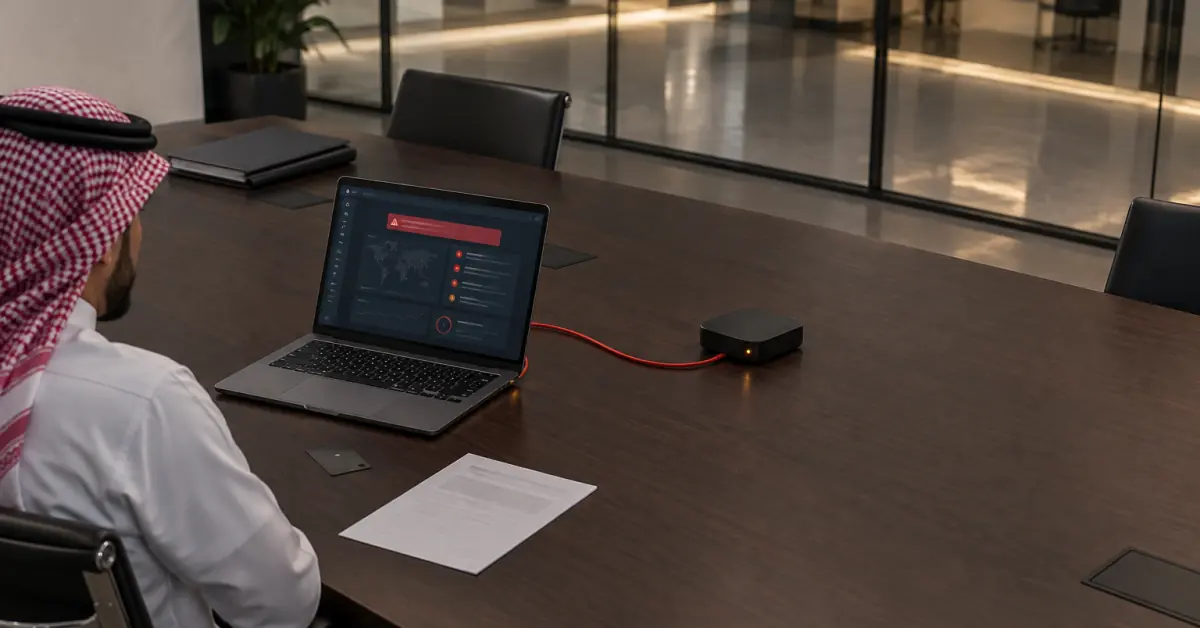
AI-generated illustration
Organisations facing insider security incidents in Saudi Arabia incur average annual losses of $1.95 million according to a study released by Trellix in Riyadh. The report highlights that rising automation and human error represent growing financial and operational threats to local enterprises. Furthermore, sixty-three percent of surveyed entities that suffered an incident confirmed resulting data exposure or loss.
Operational Impact on Saudi Entities
Financial penalties represent merely one dimension of the disruptions experienced across the Kingdom. Operational downtime affected forty-three percent of impacted businesses, while forty-five percent reported reputational damage among key clients. As a result, businesses face severe consequences extending across service continuity and customer retention.
Moreover, accidental negligence from staff caused forty-seven percent of insider security incidents recorded in the study. Malicious actions by employees accounted for thirty-one percent of registered events. Crucially, autonomous agents and enterprise AI tools caused twenty percent of all recorded internal breaches, demonstrating the dual nature of emerging automation systems.
“When AI agents operate inside your trusted boundary at machine speed, the resilient organisations will be the ones governing them like the privileged identities they are, while simultaneously building an agentic SOC to respond at the speed of the threat, not a human workflow.”
David Soto, Chief Information Security Officer, Trellix
Rising Accountability for Security Leaders
All security executives surveyed in Saudi Arabia stated that their duties expanded significantly over the past twelve months. In addition, seventy percent expressed direct concern regarding personal liability following an incident. Meanwhile, eighty percent noted that senior executives and board directors still fail to understand internal enterprise threats clearly.
Security leaders also reported notable blind spots in monitoring digital tools across workforce units. Specifically, eighty percent conceded having insufficient visibility into employee usage of machine learning applications. Consequently, eighty percent confirmed their organisations remain unready to control threats originating from autonomous software identities.
Detection Windows for Insider Security Incidents
Detection latency poses significant challenges for enterprise defense teams in the Kingdom. Saudi organisations currently take an average of 5.1 hours to identify internal threats and an additional 8.4 hours to execute incident responses. Therefore, total investigation and containment duration reaches 13.5 hours on average, leaving systems vulnerable to rapid automated actions.

“Across Saudi Arabia, our conversations with customers keep coming back to the same question: how can they understand what trusted AI systems are doing and respond before an incident becomes a wider business loss? Security teams need to work with their own data and move quickly. For CISOs, that means being able to trace the actions of people and AI agents, put them in context, and contain harmful activity before it spreads.”
Khaled Alateeq, Regional Vice President, KSA at Trellix
Remediation and Technical Responses
To accelerate investigations, enterprise teams are deploying localized artificial intelligence platforms within private infrastructures. For example, Trellix Wise for Private Cloud aims to close response gaps by processing threat data locally without exposing proprietary business data. Such dedicated systems allow organisations to manage operational risks while retaining rigorous data governance across cloud environments.
Independent research agency Vanson Bourne gathered these insights by polling 600 security executives across international markets, including 40 leaders based in Saudi Arabia and 40 in the United Arab Emirates. Improving visibility into employee actions and autonomous scripts remains vital for local businesses aiming to maintain resilient cybersecurity architectures and protect enterprise economy standards.