
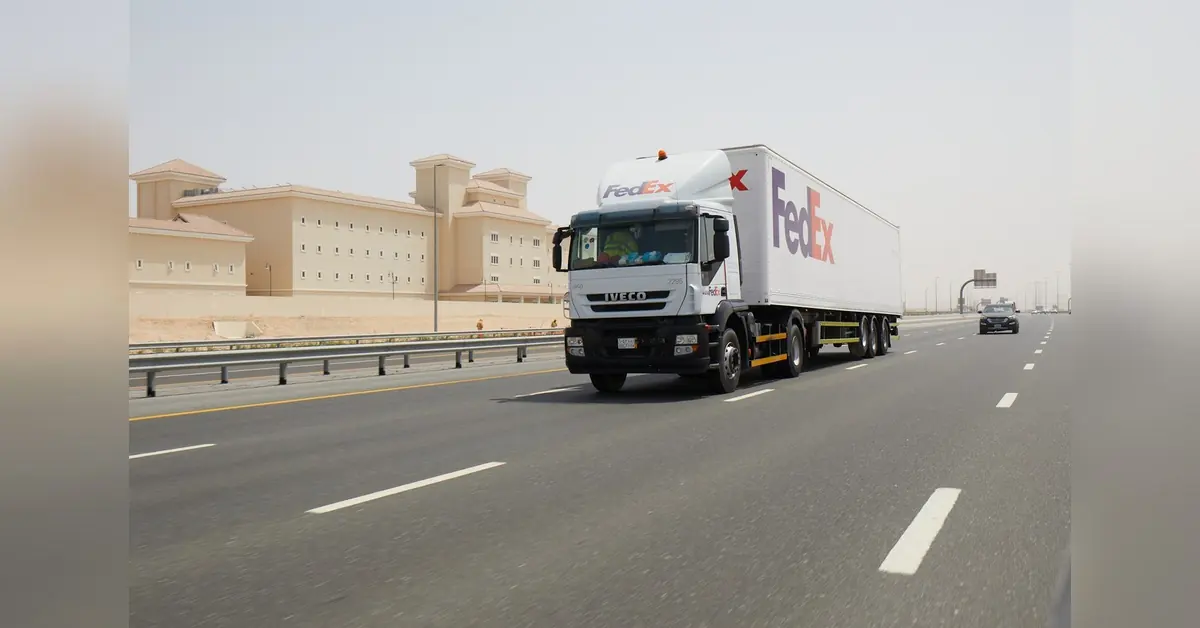
FedEx Middle East Road Network Truck
Federal Express Corporation has introduced dangerous goods transportation capabilities across its road network in five Gulf Cooperation Council markets, permitting regulated shipments between Saudi Arabia, the United Arab Emirates, Bahrain, Kuwait, and Oman. The setup operates through Regional Economy and Regional Economy Freight services to serve industrial supply chains.
The service addresses organizations handling sensitive inventory in sectors such as energy, chemicals, and health technology. Under the transport framework, qualified shippers can move laboratory diagnostic samples, healthcare supplies, lithium batteries, and dry ice under formal regional compliance guidelines.
Expanding dangerous goods transportation in the GCC
Intra-regional commerce within the Gulf Cooperation Council has increased the demand for cross-border freight solutions. The regional capability allows companies to manage dangerous goods transportation with day-definite schedules and end-to-end tracking across designated land routes.
“As industrial activity and intra-regional trade across the GCC continue to grow, businesses are navigating increasingly complex supply chains. Expanding the capabilities of our Middle East Road Network to support dangerous goods gives businesses greater flexibility to move critical commodities across GCC markets.”
Taarek Hinedi, Vice President of Operations and Planning & Engineering, FedEx Middle East, Indian Subcontinent and Africa
Covered Industries and Regulated Commodities
Specific technical requirements govern the road movement of hazardous cargo. The company stated that shipments must adhere to exact commodity parameters, origin and destination rules, and regional transport laws before dispatch.
Eligible materials accepted under the network include:
- Diagnostic specimens, clinical reagents, and medical healthcare supplies
- Industrial dry ice packaging and temperature-dependent items
- Specialized chemicals for manufacturing and energy sectors
- Lithium-ion cells and palletized electronic freight
Compliance Standards and Fleet Operations
Road movements operate in accordance with ADR guidelines, the international agreement governing the transport of dangerous cargo by highway. By providing compliant dangerous goods transportation, the logistics network addresses regulatory criteria across GCC borders.
The operational framework applies to small parcel deliveries as well as heavyweight palletized cargo. Furthermore, commercial carriers utilize structured customs procedures to prevent transit delays at cross-border checkpoints, supporting regional trade in the broader economy.
Integration with Regional Hub Infrastructure
Vehicles operating across GCC highway corridors integrate through the central logistics hub located at Dubai World Central airport. The facility connects road services with international air routes serving the Middle East, Indian Subcontinent, and Africa.
The company maintains a dedicated fleet of TIR-certified automotive transport units. A regional control tower tracks vehicle movements continuously using GPS data, giving operators detailed oversight over all cargo consignments from dispatch to final delivery.