Huawei ICT Competition 2026-2027 ME&CA
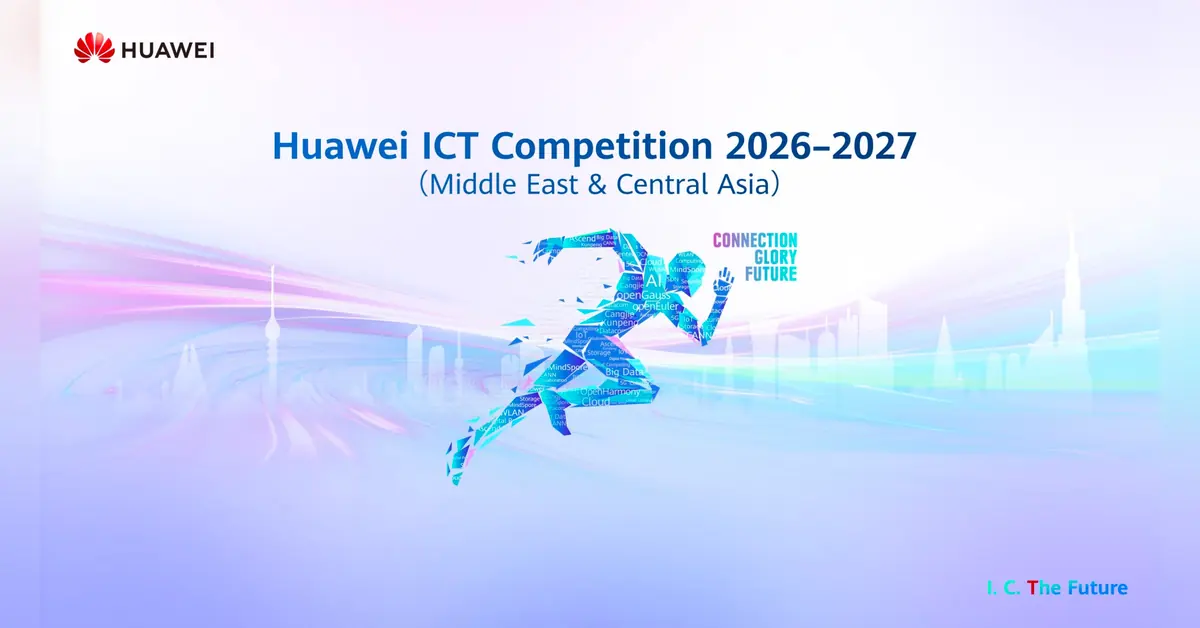
The Huawei ICT Competition has officially opened registration for its 2026–2027 regional cycle across the Middle East and Central Asia. The initiative aims to provide university students and academic staff with practical technical skills through structured learning programs and competitive challenges. Participants advance through local and regional stages, with qualifying teams earning opportunities to take part in the Global Final.
Structure of the Huawei ICT Competition
The 2026–2027 iteration consists of three main competitions divided across five specialized technical tracks. The Practice Competition features tracks in Network, Cloud, and Computing. These segments examine participant knowledge in data communication, security, wireless local area networks, data center networks, openEuler, openGauss, and Kunpeng hardware architectures.
In addition, students interested in artificial intelligence can participate in the Innovation Competition through the dedicated AI Innovation Track. This track focuses on general-purpose AI applications, autonomous agents, computing systems, storage technologies, ModelEngine, and Nexent. Furthermore, the event incorporates a Teaching Competition that highlights the Industry-Education Collaboration Track to support faculty development.
Regional Leadership on Technical Talent
Huawei executives noted that youth development remains central to meeting future digital infrastructure needs across the region. Technical education programs help align academic curricula with practical industry requirements, particularly in fields such as cybersecurity and cloud infrastructure.
“The Middle East and Central Asia is building an intelligent and digital future, and developing a strong pipeline of skilled young talent is critical to sustaining that progress. The Huawei ICT Competition brings universities, students, and the technology ecosystem closer and gives participants an opportunity to build practical capabilities in areas that are shaping the next phase of digital development, from cloud and computing to artificial intelligence.”
Cong Liang, Chief Strategy Officer of Huawei Middle East and Central Asia Region
Decade of Academic Collaboration
Since its inaugural regional edition during the 2016–2017 academic year, the program has expanded into an established fixture for higher education. Over the past 10 years, more than 180,000 students and teachers from over 800 universities across 19 countries in the Middle East and Central Asia have registered for the competition rounds.
The program maintains ties with major international bodies to widen student access to digital skills. It remains associated with the UNESCO Global Skills Academy partnership project. Furthermore, the event holds formal recognition on the China Association of Higher Education list of national university student competitions.
Global Final Qualification Path
Colleges and universities across the region can register student teams directly through official program channels. Teams will compete against regional peers before qualifying finalists travel to international rounds. The curriculum encourages direct hands-on testing with enterprise technologies in networking and telecommunications.