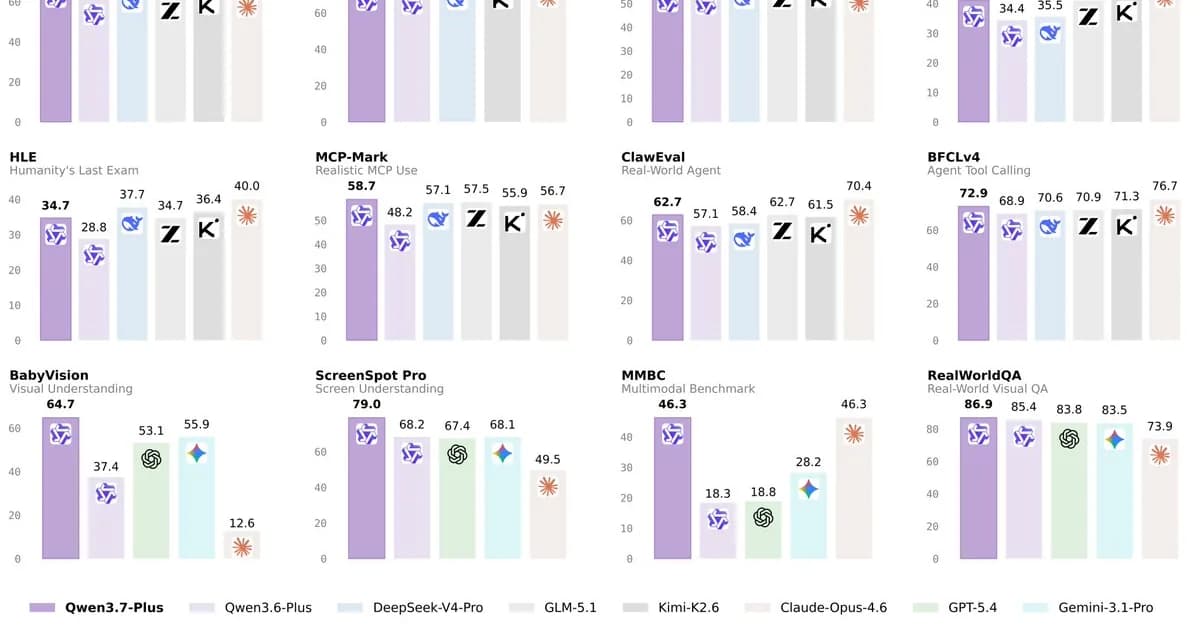
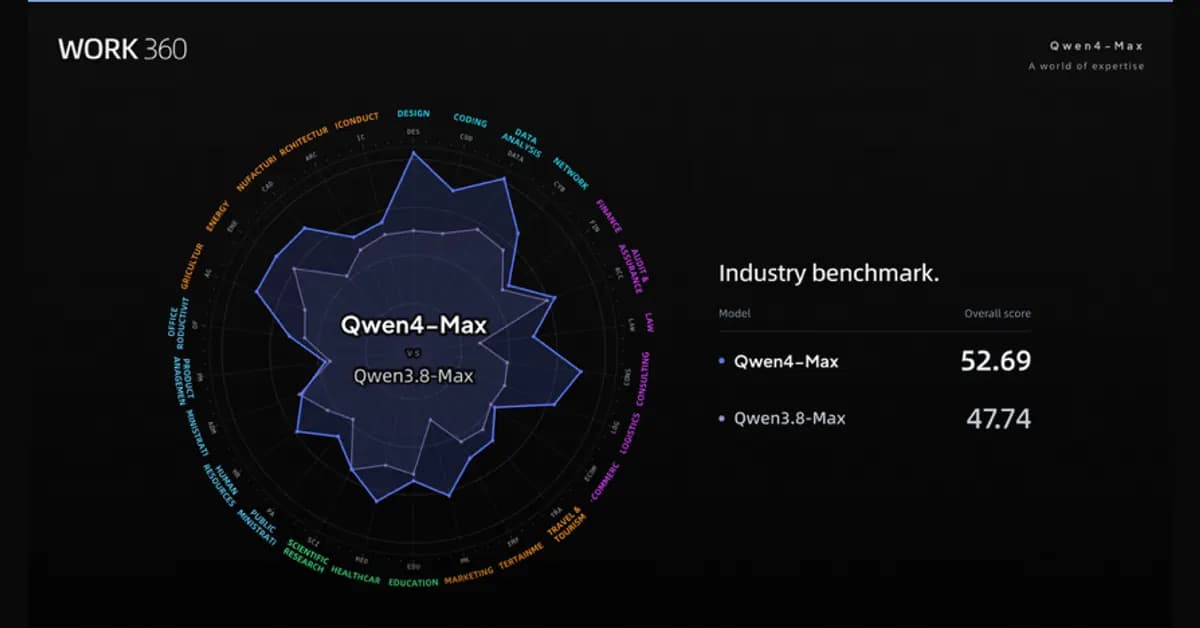
Alibaba has officially launched the Qwen4-Max model as its latest large-scale artificial intelligence system for technical, scientific, and enterprise tasks. The release incorporates 2.4 trillion total parameters, native visual processing, and a context window reaching one million tokens. According to benchmark data from the Hangzhou-based developer, the system delivers improved performance across coding leaderboards, agent tasks, and specialized workplace workloads.
Architecture and Inference Efficiency of the Qwen4-Max Model
The system relies on an updated sparse Mixture-of-Experts design that modifies attention layers, residual connections, and data embeddings. Although the full build contains 2.4 trillion parameters, it activates 71 billion parameters per token. This represents a 25 percent reduction in active parameters compared to the earlier Qwen3.8-Max release at an identical scale. Consequently, computing requirements and inference expenses decrease during large deployments.
On the proprietary Work360 benchmark, which covers 721 specialized industry fields, the system lowered task costs by approximately 60 percent. It also consumed 35 percent fewer tokens in high-effort reasoning mode compared to its predecessor. Alibaba priced input tokens via implicit cache hits at $0.075 per one million tokens on its cloud platform, expanding access to enterprise software applications.
Benchmark Results and Operational Workflows
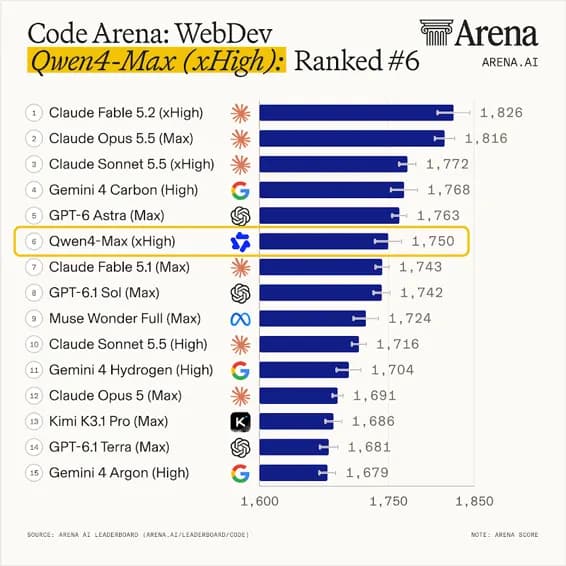
Performance evaluations place the system in sixth position on the Code Arena programming evaluation board. In addition, the release logged scores on agent evaluations, including Agents’ Last Exam, JobBench, Vals Index, and Chartography. Autonomous resource scheduling built into the architecture reduced data annotation call costs by an average of 9 percent while accelerating offline central processing unit rescheduling speeds by more than 14 times.
Industrial tests in automotive manufacturing showed notable productivity shifts. During a technical demonstration, the system reduced manual workpiece programming time from 475 minutes to 24 minutes, marking a 95 percent decline. Feedback-driven loops identified overcuts and material margins before physical milling started. Similar deployments support three-dimensional modeling, game production, and forward-deployed engineering across finance and healthcare.
Long-Horizon Agents for Scientific Research
In laboratory testing, the system executed continuous agent workflows over extended periods. To address processor cooling requirements, it ran a continuous 48-hour cycle across molecular design, synthesis simulation, and active learning to identify an experimentally validated coolant molecule. In an Alzheimer’s research project, the model completed 454 tool calls and 3,239 metric evaluations to design 24 candidate molecules.
Integrated Safety Protocols and Governance
Engineering safeguards were integrated across the training lifecycle to protect corporate systems. Code generation training incorporated vulnerability filters against injection attacks, memory flaws, and access control failures. Alibaba applied task-intent filtering to separate defensive patch mechanisms from offensive exploits, strengthening enterprise cybersecurity defenses against critical technical risks.