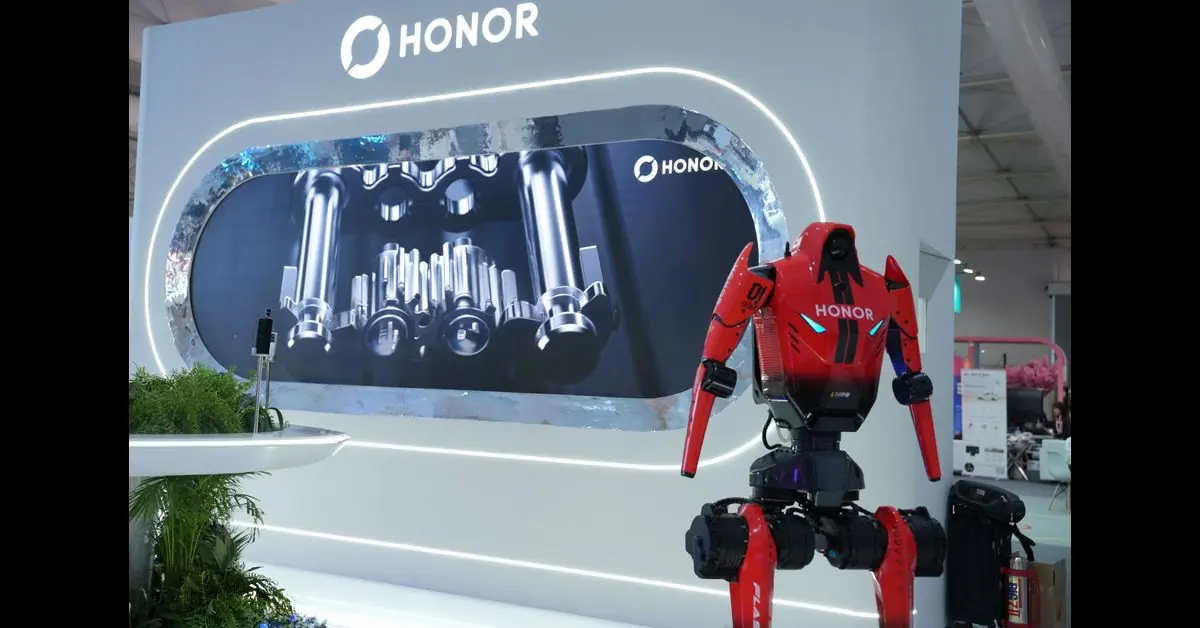
The HONOR Robotics D1 humanoid robot, nicknamed Lightning, has set multiple athletic records during testing, marking a significant milestone in physical artificial intelligence. The machine finished a half marathon in 50 minutes and 26 seconds. In shorter sprints, it completed 1,500 meters in 2 minutes and 30 seconds, and 100 meters in 9.32 seconds, reaching a peak speed of 14.5 meters per second.
The Emergence of Embodied Intelligence
These running metrics reflect broader technical shifts within the computing industry. Artificial intelligence is expanding beyond text processing on digital screens to interact directly with physical surroundings. Consequently, researchers refer to this field as embodied AI, combining real-time perception with mechanical movement.
Maintaining balance at high speeds requires continuous environmental calculation. The robot must adjust its posture instantly to match ground conditions. These rapid calculations demonstrate how artificial intelligence models are shifting from basic command execution to active spatial awareness.
Engineering Lessons from HONOR Robotics D1
The technological developments behind the HONOR Robotics D1 extend well beyond athletic tracks. System responsiveness, intent recognition, and sensor fusion developed for robotics directly inform future consumer electronics. Users increasingly demand personal hardware that adapts dynamically to daily routines rather than simply reacting to static inputs.
Consumer devices require rapid data processing to deliver personalized assistance. Therefore, advancements made in mechanical balance and machine vision provide a practical foundation for next-generation smart devices that operate in diverse environments.
Convergence with Consumer Technology
Robotics and personal electronics were previously developed as separate sectors. Today, both fields share common research targets, including power efficiency, situational awareness, and low-latency decision-making. As computer vision improves in robotics, corresponding benefits appear in automated camera systems and digital assistants.
Modern mobile devices are already adopting contextual algorithms developed through machine learning experiments. This convergence allows everyday consumer electronics to anticipate user needs with minimal manual configuration.
Future Outlook for Connected Systems
Future consumer technology will rely on connected networks of specialized hardware working together. The performance data gathered from the HONOR Robotics D1 highlights how quickly physical machine intelligence is advancing. Rather than treating robotics solely as experimental machinery, developers are utilizing these platforms as testing grounds for broader software capabilities that will eventually support everyday digital interactions.