
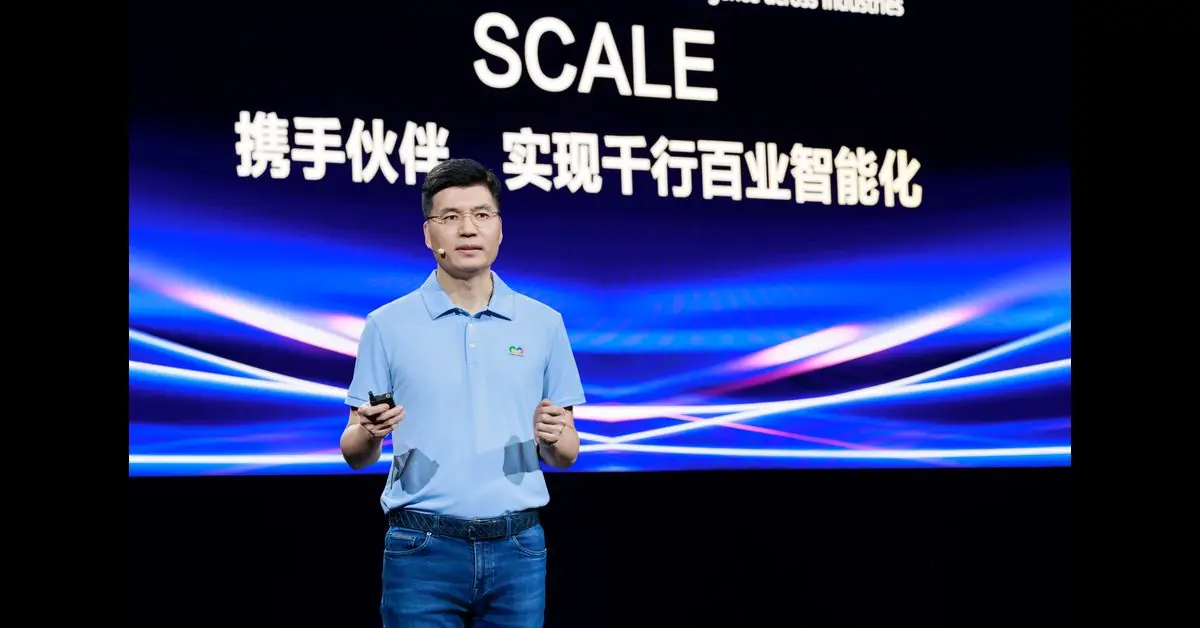
Huawei announced the launch of its new SCALE partner support system at HUAWEI CONNECT 2026 in Shanghai, aiming to assist enterprise partners in moving artificial intelligence implementations from experimental pilots to broad operational deployments.
During a keynote address titled “Scaling All Intelligence for Industry Success,” Leo Chen, Senior Vice President and President of Enterprise Sales at Huawei, detailed how the initiative intends to support businesses across global markets. The framework focuses on addressing five critical obstacles partners encounter during industrial intelligence rollouts: solution development, integration verification, solution delivery, operations and maintenance, and cross-system collaboration.
Key Pillars of the SCALE Partner Support System
The newly introduced SCALE partner support system provides five distinct categories of assistance: Scenario-based Solutions, Co-innovation, Aligned Marketing, Local Services with Consistent Quality, and Efficient Collaboration. Through these resources, the program offers continuous operational guidance across all project phases.
For scenario-based deployments, Huawei released foundation products spanning computing, data storage, enterprise networks, data protection, and cybersecurity. The hardware and software lineup also incorporates two new offerings: the SMECE solution and the DCS AI Solution. Partners working with Huawei have utilized these tools to develop more than 100 scenario-specific solutions across eight industrial sectors.
“The intelligent era is approaching fast. Huawei works with partners to provide products and solutions that solve real business problems. We want to share our own capabilities with our partners.”
Leo Chen, Senior Vice President and President of Enterprise Sales at Huawei
Co-Innovation and Technical Verification Framework
To support technical validation, Huawei has opened reference architectures covering 48 enterprise scenarios. Partners can reference these architectures when designing systems, setting up testing environments, and writing custom application code. In addition, the cloud-based OpenLab environment provides standardized interfaces and testing utilities to accelerate project development cycles.
Commercial enablement forms another central component of the framework. Huawei has made its Market-to-Lead operational workflows accessible to external teams, creating joint industry exhibitions and showcase installations. To date, the company has completed over 130 verification showcases alongside enterprise customers across global regions.
Workforce Training and Digital Collaboration Portals
Service delivery capabilities are managed through the O3 Partner Service Enablement Platform, which stands for online, open, and orchestration. Through structured workforce training programs, Huawei has certified more than 50,000 specialists focused on artificial intelligence disciplines over the preceding three-year period.
To coordinate operational tasks, Huawei deployed two dedicated digital portals: HUAWEI eFly and HUAWEI ePartner. These platforms centralize marketing workflows, transaction records, technical documentation, and AI-assisted system configuration tools. Chen noted that expanding structured collaboration will assist enterprises navigating digital transformation requirements as industrial automation demands continue to increase.