
1 Royal Commission For Riyadh City Launches The Riyadh Creative District In Kafd
The Saudi ICT sector recorded multiple developments across funding, policy updates, and technology rollouts during the final week of September 2026. National institutions and private enterprises expanded initiatives to support digital transformation and infrastructure development.
Investment in the Saudi ICT Sector
In early-stage venture funding, Saudi AI and fintech startup Abwab AI raised 15 million SAR in a seed funding round led by European venture capital firm Speed Invest, according to Asharq Al-Awsat.
Deals and Institutional Agreements
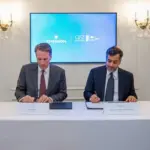
Saudi Arabia’s Ministry of Justice signed a formal cooperation agreement with Faisal University focusing on innovation and emerging technologies to exchange institutional expertise, support research and development, and build human capacity across the judicial sector, reported Okaz.
Policy and Regulatory Frameworks
The General Directorate of Passports enabled employers to issue final exit visas for domestic workers during their probationary periods through the Absher platform under specified regulatory conditions, as detailed by Saudi Gazette.
At the ministerial level, the Saudi Cabinet affirmed the Kingdom’s active participation in global governance frameworks during the UNESCO Global Forum on AI Ethics 2026, according to X @SDAIA_SA.
In healthcare regulation, the Saudi Food and Drug Authority granted marketing authorization to two domestically developed medical software products utilizing artificial intelligence for diabetic retinopathy detection and X-ray image analysis, reported Asharq Al-Awsat.
In public transportation, CEER rolled out new smart transport regulations in Makkah that introduce an advance permit system alongside 16 advanced technologies for smart buses to enhance safety and fleet management, reported Al Yaum.
Government data sharing also progressed as the Ministry of Justice, the Ministry of Health, and the Nuclear and Radiological Regulatory Commission published official datasets on the SDAIA open data platform, according to X @SDAIA_SA.
These regulatory steps align with an integrated national framework prioritizing data and machine intelligence to balance technological innovation with public sector governance, according to Al Yaum.
New Technological Launches
Defense and operational systems saw notable deployments as the Saudi Royal Navy launched the locally developed Mawj security platform, achieving operational savings exceeding 16 million SAR, reported Al Yaum.
To support accessibility, Saudi Arabia launched Helm, a digital character driven by automated models designed to assist individuals with disabilities and visual impairments, according to Asharq Al-Awsat.
In natural language computing, a Saudi scientist developed an Arabic-speaking machine learning model designed to deliver domain knowledge directly in the Arabic language, stated X @McitGovSa.
The General Presidency for the Affairs of the Two Holy Mosques deployed autonomous cleaning robots operating around the clock across the Prophet’s Mosque courtyards to ensure continuous facility maintenance, reported Al Yaum.
In the automotive manufacturing domain, national electric vehicle manufacturer CEER revealed technical and design specifications for its initial electric vehicle, Exobot, according to Asharq Al-Awsat. The company operates as a joint venture between the Public Investment Fund and Foxconn to establish local manufacturing facilities, noted Ars Technica.
Finally, Aramco Digital established a national industrial communications network under the Supreme Industrial Security Authority to reinforce critical infrastructure protection across the Saudi ICT sector, according to X @Aramco_Digital.