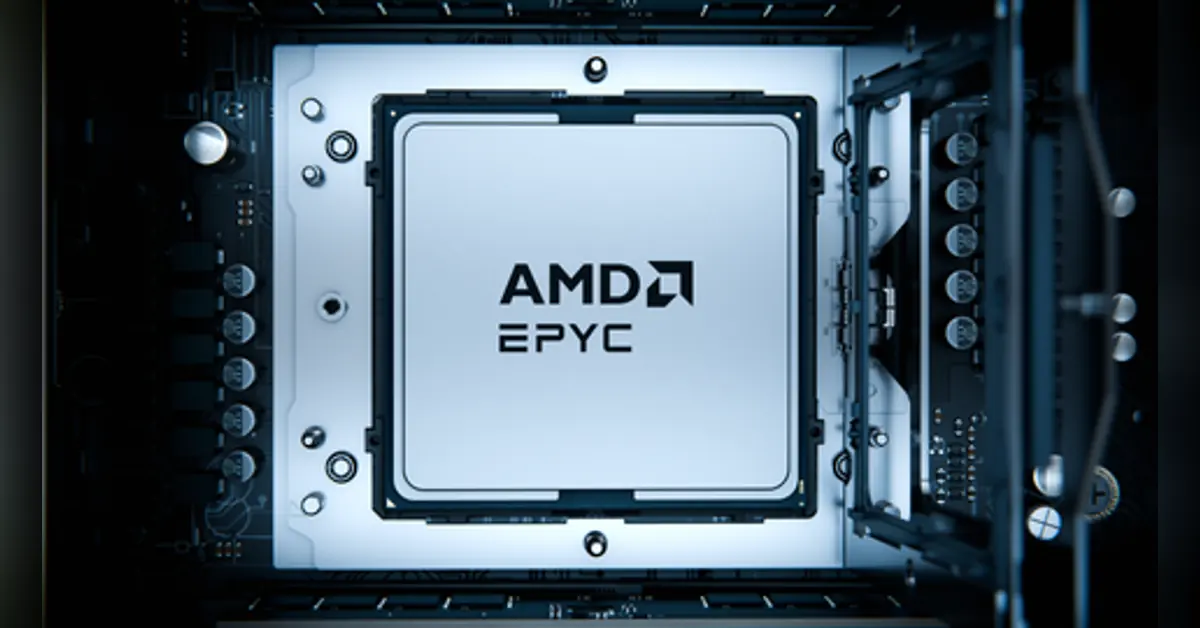
The AMD EPYC 9006 Series server CPU is part of a portfolio of solutions for agentic AI, cloud, enterprise, high-performance and general-purpose computing. (Credit: AMD)
AMD EPYC CPUs deliver measurable performance advantages across agentic artificial intelligence and enterprise environments, according to test data published by AMD. The company released performance metrics evaluating its 6th Gen AMD EPYC 9006 series server processors, codenamed Venice, across enterprise, cloud-native, and high-performance computing workloads.
Workload Demands in Agentic AI
Infrastructure requirements for modern artificial intelligence have shifted beyond training and basic inference models. Agentic AI systems combine data retrieval, tool execution, orchestration, and host node management into integrated operational pipelines. Consequently, these multi-step workflows require diverse processor configurations to handle shifting computational demands at each stage of task execution.
Unlike conventional deep learning workloads that rely primarily on specialized accelerators, agentic workflows demand high-throughput general-purpose compute to coordinate complex API calls, structured database queries, and decision logic. These operational steps place heavy performance requirements on server processor memory bandwidth, per-core responsiveness, and multi-threaded scaling across distributed enterprise infrastructure.
Performance Comparisons of AMD EPYC CPUs
In SPECrate 2026 Integer benchmark testing, the 96-core AMD EPYC 9996 server processor recorded 1.2 times the per-core performance of an NVIDIA Vera platform. Furthermore, the testing demonstrated 2.24 times the platform-level performance compared to the same platform. In a modeled 100-kilowatt rack configuration, the processor delivered an estimated 3.4 times the throughput of a Vera-based setup.
Enterprise and Technical Computing Metrics
AMD tested the hardware across common enterprise environments, including server-side Java, OpenSSL, MongoDB, Redis, and NGINX applications. The published results showed performance gains ranging between 2.4x and 3.7x in transaction processing workloads. Against the Intel Xeon 6980P processor, the EPYC 9996 achieved 1.8x to 3.13x performance advantages in technical computing workloads, such as molecular dynamics, materials modeling, and weather forecasting simulations.
Market Availability and Deployment Plans
The Venice processor family operates on a unified software foundation spanning configurations from 8-core edge setups to 256-core flagship units. This broad hardware hierarchy allows enterprise data centers and hyperscale operators to deploy targeted compute density across diverse operational tiers without fragmenting their software stack or development pipelines.
The company stated that Venice hardware is currently in production. Major original equipment manufacturers plan system rollouts soon, while cloud service providers will begin deploying AMD EPYC CPUs in data center infrastructure later this year.