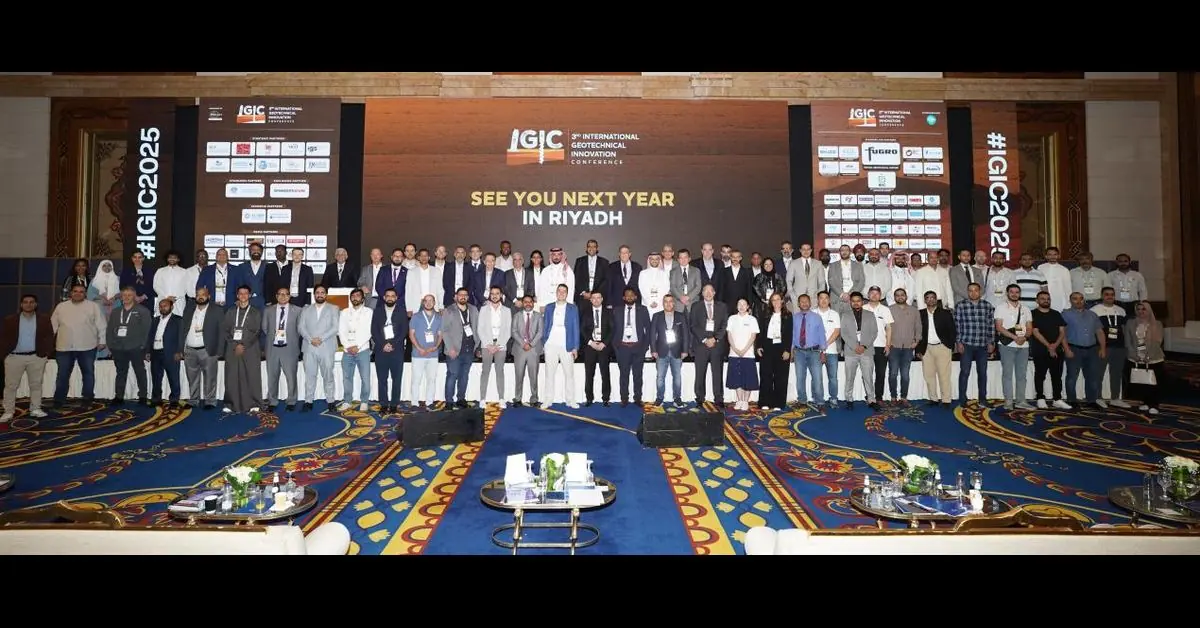
The IGIC 2026 gathering will take place on 14–15 October 2026 at Fairmont Riyadh to address complex ground engineering requirements across major regional developments. More than 700 delegates, 45 speakers, 60 sponsors, and 15 institutional partners from over 40 countries will attend the third edition of the event.
Saudi Arabia is currently building large-scale urban, transport, tourism, and mining infrastructure that intersects with challenging geological formations. Engineers across the region encounter fractured rock, karst cavities, sabkha soils, groundwater pressures, and extreme desert climates. Consequently, geotechnical planning has become essential for structural safety and project schedules supporting the economy.
Key Focus Areas at IGIC 2026
The conference agenda includes more than 25 dedicated technical sessions. Discussions will examine ground engineering solutions for skyscrapers, deep excavations, rail infrastructure, subways, and utility networks. In addition, specialists will review mass ground improvement methods, rock mechanics, groundwater control, and geohazard mitigation.
“With Saudi Arabia and the wider Middle East witnessing unprecedented investment in giga-projects, urban development and resilient infrastructure, innovation in areas such as ground improvement, automation, AI and sustainable geotechnics is more important than ever. Through continued collaboration and knowledge sharing, we can reduce project risks, strengthen industry best practices and help build safer, smarter and more sustainable foundations for the region’s future.”
Dr. Marwan Alzaylaie, Senior Manager, Geotechnical Engineering at Dubai Development Authority
Mining and Subsurface Risk Management
As Saudi Arabia expands its national mining sector, technical panels will focus on tailings dam stability, open-pit slope safety, and underground excavation risks. Furthermore, speakers will evaluate digital subsurface mapping, rock mass characterisation, and seismicity monitoring across active mining operations.
Integration of Artificial Intelligence and Digital Tools
Engineering teams are deploying artificial intelligence and machine learning models to analyze site investigation data and create predictive models of ground behavior. Sessions will also explore remote sensing tools such as LiDAR, InSAR, and aerial drones to monitor ground shifts and detect emerging geohazards early.
Contractual Risk and Forensic Engineering
Beyond physical construction methods, the conference will cover forensic geotechnical engineering and contractual risk allocation. Panels will examine ground-model uncertainty, root-cause analysis, and practical dispute avoidance strategies for regional contractors. Fugro has joined IGIC 2026 as the official geotechnical partner alongside several international solution providers.