Zoom Advances Its AI Strategy With a New Unified Context Layer
Zoom introduced its new Unified Context Layer during the annual Zoomtopia conference to connect meeting discussions directly with business execution. The tool links spoken interactions, chat records, and shared files to give team members and automated systems immediate access to project histories. According to the company, customer interaction often begins in a video call, moves to a telephone exchange, and continues across messaging channels, which frequently fragments operational context.
How the Unified Context Layer Works
By bringing conversation history together with operational files, the Unified Context Layer allows workers to locate critical data without manual searching across multiple programs. The software functions across Zoom Workplace as well as connected external applications. Administrators can configure specific permission controls to manage access rights while automated systems coordinate to generate insights.
Company data shows that client numbers for Zoom Virtual Agent increased by 256 percent. Furthermore, staff using the company’s artificial intelligence solutions reported completing duties twice as fast, with 72 percent noting a high business impact compared to a market average of 63 percent.
“AI models are only as powerful as their understanding of your business, and that context makes all the difference. Fragmented product experiences isolate conversations, stall decisions, and drag businesses down. Today, with the Unified Context Layer, we’re laying the groundwork for a system of action designed to turn conversations into completed work.”
Eric Yuan, Founder and CEO of Zoom
Expanded Integrations Across Workplace Tools
Several workflow additions accompany the new system. A feature called Follow the meeting provides tailored transcripts and overviews for individuals missing portions of a call, with delivery expected in December 2026. In addition, Enriched notes will associate presentations and in-meeting text with relevant points inside searchable records starting November 2026.
Hardware partnerships with DTEN and Bota extend My Notes functionality to physical conference rooms. Through new workflows, meeting recaps connect to platforms such as Salesforce and Zoom Chat to automate administrative follow-ups without specialized workflow builders.
Developer Connections and Protocol Servers
Software engineers can now link external environments directly to Zoom capabilities via Model Context Protocol servers and application programming interfaces. Consequently, external assistants like Claude, Codex, Copilot, and Muse can interact with scheduling and contact center actions. Teams can also query the Unified Context Layer directly from interfaces like GPT, Gemini, and Slackbot.
Security Controls and Meeting Enhancements
For enterprise safety, Zoom introduced centralized controls and native sensitivity labels that synchronize with Microsoft Purview. Additional cybersecurity defenses include synthetic media detection tools planned for December 2026 to identify deepfake risks during hiring sessions and client calls.
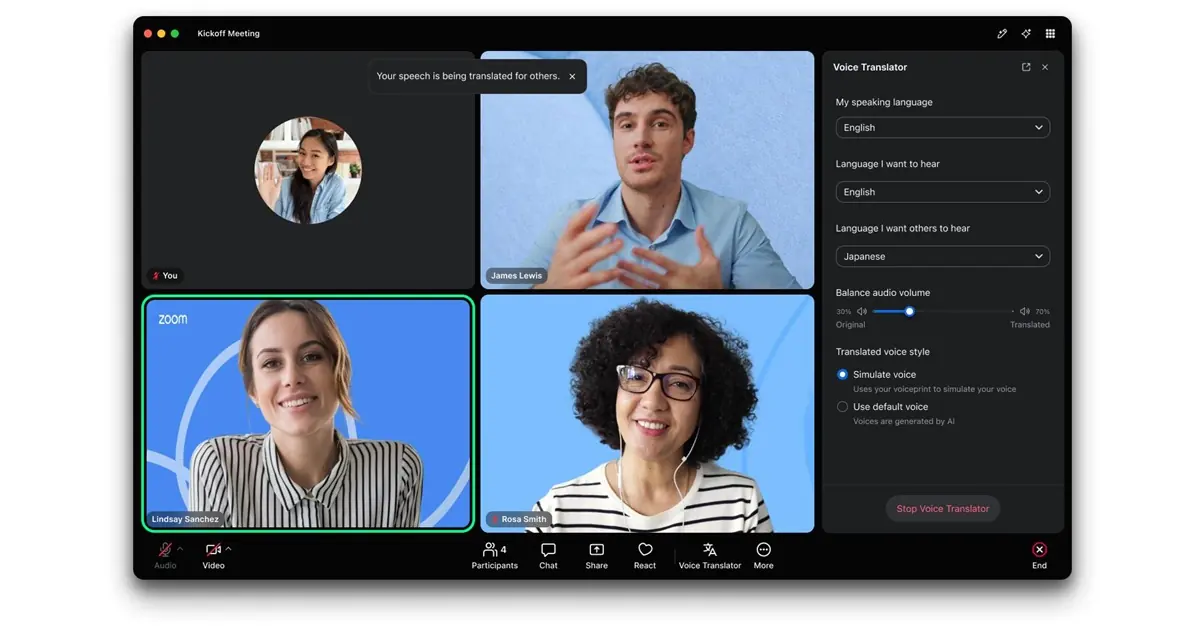
Meeting quality updates include real-time voice translation under the Translate Me feature, scheduled for October 2026, alongside automated posture adjustments and voice accent smoothing arriving in December 2026. High-frame-rate screen sharing at 60 frames per second is available immediately for all desktop clients.