AI-generated illustration
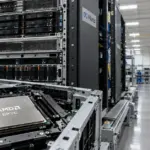
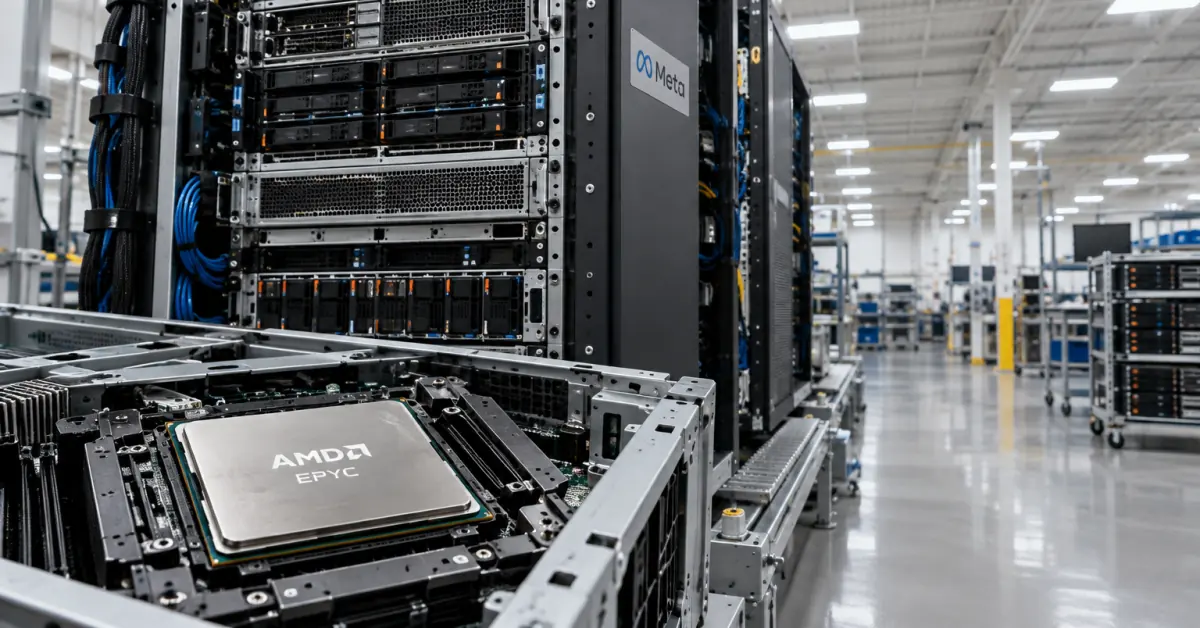
Meta has expanded its deployment of AMD AI infrastructure to support large-scale artificial intelligence models and user-facing services. The partnership includes the initial installation and testing of AMD Helios rackscale solutions inside Meta data centers before wider deployment. In addition, AMD EPYC server processors now power the dedicated computing environments behind Meta’s Muse personal agent.
Scale of AMD AI infrastructure Deployment
Meta has deployed millions of EPYC processors across several hardware generations and serves as a lead customer for sixth-generation EPYC central processing units. Both companies are also collaborating on future designs, including the upcoming processor code-named Verano. Furthermore, the hardware roadmap aligns engineering decisions around current and future Meta computing workloads.
AMD Instinct graphics processing units operate in production at Meta for model training, content ranking, and recommendation engines. The social technology group was an early definition customer for the AMD Instinct MI450 architecture. Meta also plans to deploy a custom AMD Instinct GPU configured specifically for its internal computational tasks.
Executive Perspectives on Computing Demands
Lisa Su, Chair and Chief Executive Officer of AMD, stated that technical collaboration between the two enterprises spans several hardware cycles. The companies are preparing systems designed for gigawatt-scale data center operations to support complex computing workloads.
“Meta is a strategic partner for AMD, and we have built this partnership through years of deep technical collaboration – from EPYC processors powering Meta’s infrastructure to Instinct GPUs and open software supporting its AI workloads.”
Lisa Su, Chair and CEO, AMD
Mark Zuckerberg, founder and Chief Executive Officer of Meta, explained that computing investments remain central to operating advanced systems. Consequently, hardware partnerships support the computing capacity needed across the company’s global services.
“AMD has been a key partner in building out the compute that’s running our frontier models. We’re making big investments in the computing power that will enable us to bring personal superintelligence to everyone, and AMD plays an important role in that.”
Mark Zuckerberg, founder and CEO, Meta
Software Integration and Open-Source Frameworks
Software integration forms a major component of the collaboration between both hardware and application teams. AMD delivered Day-0 support for Meta’s Muse Spark Open models on Instinct accelerators. In addition, Muse Glimmer operates directly on Ryzen AI personal computers and Radeon graphics cards.
The engineering teams also contributed optimizations to open software frameworks, including PyTorch, Triton, and ROCm. Specifically, engineers optimized recommendation models running on AMD Instinct MI350X processors, making these performance improvements available to the broader software developer community.
Equity Investment and Future Hardware Roadmaps
Financial commitments accompany the technical agreements between the two technology firms. As part of the arrangement, AMD agreed to invest $1 billion in Meta’s equity offering. This capital commitment aligns with shared planning across silicon development, systems architecture, and software optimization.
Looking ahead, future engineering work will influence upcoming platforms such as the AMD Instinct MI500 series accelerators and next-generation rack systems. As data centers scale toward gigawatt capacity, both organizations plan to continue coordinating product timelines to run complex artificial intelligence workloads across global computing networks.