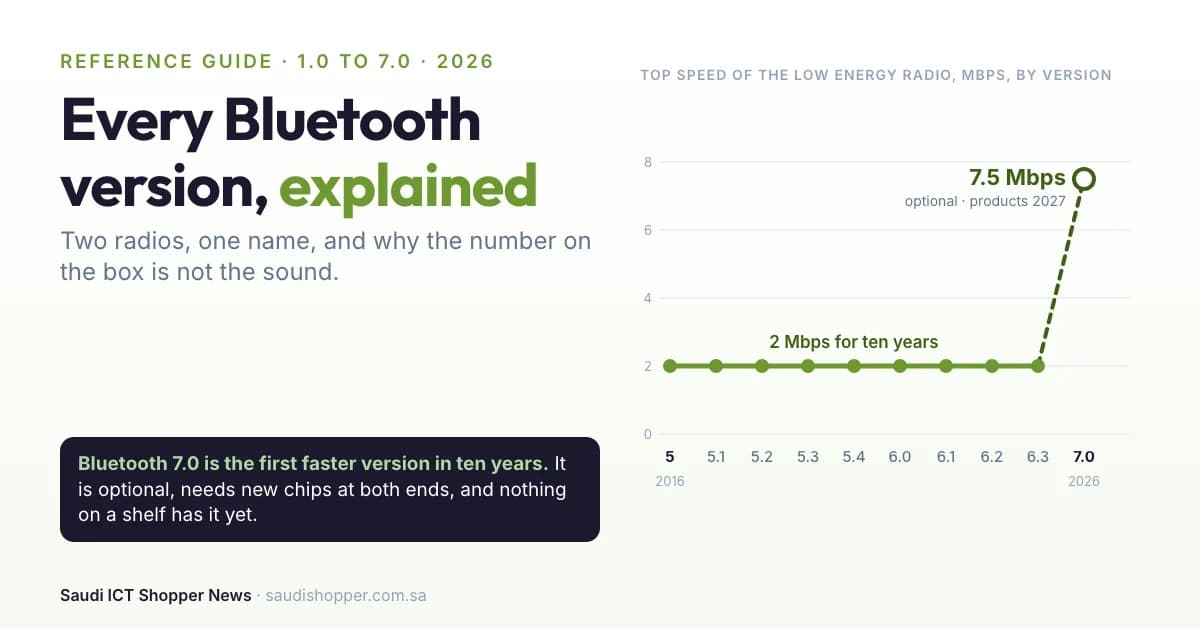
On 4 November 2026 the Bluetooth SIG adopted Bluetooth 7.0, and with it the first rise in Bluetooth’s top speed in ten years: 2 megabits per second becomes 7.5. It is also optional, it needs a new radio chip in both the phone and the earbuds, and nothing on a shelf in Riyadh or anywhere else has it yet. For the ten years before it, from Bluetooth 5 to Bluetooth 6.3, the number on the box changed almost everything except the speed. This guide explains every Bluetooth version from 1.0 in 1999 to 7.0 in 2026, in plain language, with the one rule that makes the whole family make sense, and a cheat sheet for the day the box says “Bluetooth 6.0” and you wonder whether that is good.
The short version
- Twenty-seven years, seven major numbers. Bluetooth 1.0 (1999) to 7.0 (November 2026). Since 2025 a new minor version arrives about every six months.
- One rule explains the family: since 2010 every Bluetooth chip carries two different radios under one name. Classic plays your music and calls. Low Energy runs watches, trackers, sensors and, more recently, a new kind of audio. A version number covers both, and almost every new feature is optional.
- The version is not the sound. How earbuds sound is decided by the codec (SBC, AAC, aptX, LDAC, LC3) that the phone and the earbuds both support. A Bluetooth 5.0 phone with LDAC beats a Bluetooth 5.4 phone that falls back to SBC.
- From December 2016 to November 2026 the top speed did not move. Bluetooth 5.1 to 6.3 added direction finding, LE Audio and Auracast, shelf labels, privacy and distance measurement to within tens of centimetres. None of them was faster.
- Bluetooth 7.0 is faster, on paper. Its High Data Throughput mode reaches 7.5 Mbps. It is optional, needs new hardware at both ends, and the lossless audio standard meant to use it is expected in 2027. Do not pay extra for “Bluetooth 7” today.
- In Saudi Arabia half the phones cannot use the newest audio features. Apple supports neither LE Audio nor Auracast on any iPhone or AirPods, and iPhones are about half of Saudi mobile web traffic. Android 16 phones and the big hearing-aid brands do support them.
Every Bluetooth version at a glance
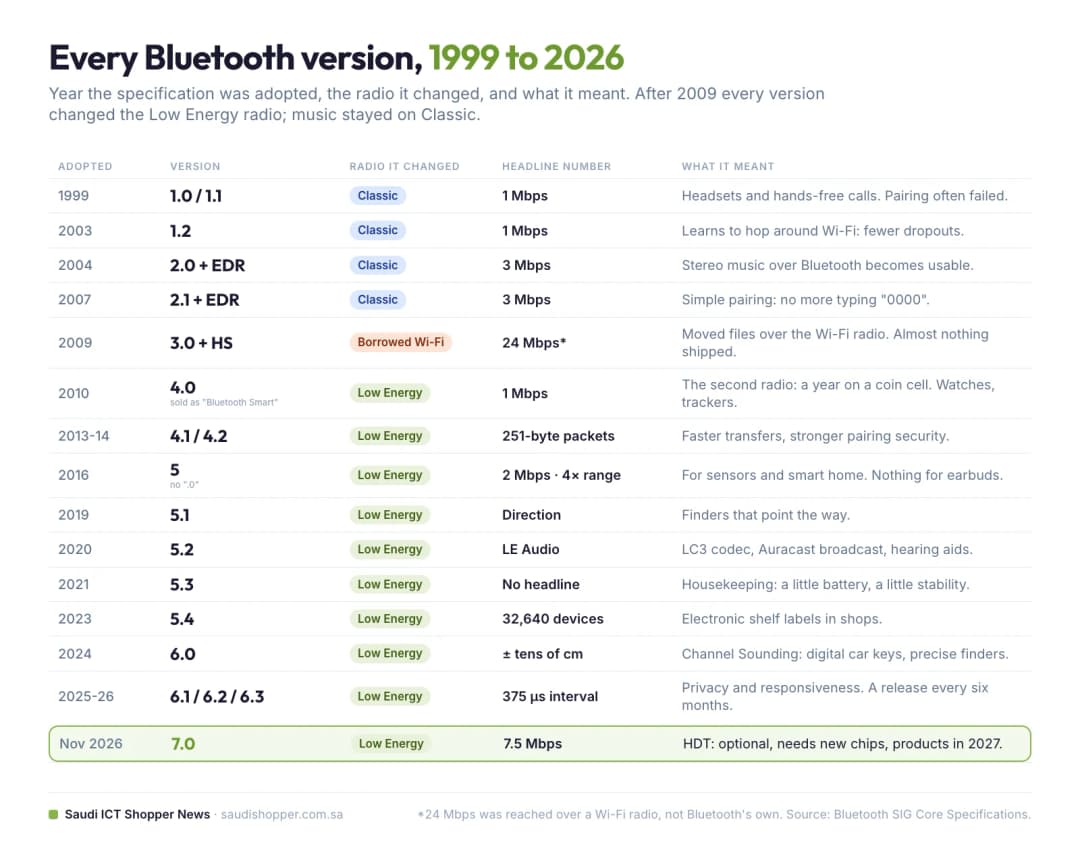
The table lists every version of the Bluetooth Core Specification, the radio it changed, its headline number and what it meant for someone buying a device. Years are the year the specification was adopted; products usually followed a year or more later.
| Version | Adopted | Radio it changed | Headline number | What it meant for the buyer |
|---|---|---|---|---|
| 1.0 and 1.1 | 1999, 2001 | Classic | 1 Mbps on air, about 0.7 Mbps of data | Wireless headsets and hands-free calls. Pairing often failed |
| 1.2 | 2003 | Classic | 1 Mbps | Adaptive frequency hopping: fewer dropouts next to Wi-Fi |
| 2.0 + EDR | 2004 | Classic | 3 Mbps | Stereo music over Bluetooth becomes usable |
| 2.1 + EDR | 2007 | Classic | 3 Mbps | Secure Simple Pairing: the end of typing “0000” |
| 3.0 + HS | 2009 | Classic, plus a borrowed Wi-Fi radio | 24 Mbps over the Wi-Fi radio | Almost nothing shipped with it |
| 4.0 | 2010 | Low Energy (new) | 1 Mbps, a year on a coin cell | Fitness bands, watches, trackers, beacons |
| 4.1 | 2013 | Low Energy | No change | Lives better next to 4G; one device can play two roles |
| 4.2 | 2014 | Low Energy | Packets grow from 27 to 251 bytes | Faster transfers and stronger pairing security |
| 5 (no “.0”) | 2016 | Low Energy | 2 Mbps, or four times the range at 125 kbps | Smart home and sensors. Nothing for earbuds |
| 5.1 | 2019 | Low Energy | Direction finding | Finders that point the way, not just beep |
| 5.2 | Dec 2019, announced Jan 2020 | Low Energy | Isochronous channels | LE Audio, the LC3 codec, Auracast, modern hearing aids |
| 5.3 | 2021 | Low Energy | No headline number | Small gains in battery and stability |
| 5.4 | 2023 | Low Energy | 32,640 devices on one network | Electronic shelf labels in shops |
| 6.0 | 2024 | Low Energy | Distance to within tens of centimetres | Digital car keys and finders that know how far, not just “near” |
| 6.1, 6.2, 6.3 | 2025 to May 2026 | Low Energy | 375 microsecond connection interval (6.2) | Privacy, responsiveness, faster ranging. One release every six months |
| 7.0 | Nov 2026 | Low Energy | Up to 7.5 Mbps (optional HDT mode) | Nothing to buy until 2027 |
First, a note on the names
Bluetooth is named after Harald “Bluetooth” Gormsson, a tenth-century Danish king. Intel engineer Jim Kardach proposed the name in 1997 as a working title for a radio meant to unite phones and computers, as Harald had united Danish tribes, and the logo joins the runes for H and B. The Bluetooth Special Interest Group (SIG), the industry body that writes the specification, was founded in May 1998.
Three naming habits cause most of the confusion on the box.
- “Bluetooth 5” has no “.0”. From 2016 the SIG dropped the decimal from its marketing for major versions. Retailers still print “5.0”. They are the same thing.
- The suffixes were features, not versions. “+ EDR” (Enhanced Data Rate, 2004) and “+ HS” (High Speed, 2009) were optional extras. “Bluetooth Smart” and “Smart Ready” were the 2011 to 2016 retail names for Low Energy devices and the phones that could talk to them. Both names were retired in 2016.
- A version is a floor, not a feature list. Since 4.0 almost every new feature is optional. A product may print “Bluetooth 5.3” while supporting none of the things 5.1, 5.2 and 5.3 added. The number tells you what a chip may do, never what your earbuds are actually doing.
The one rule that explains every Bluetooth version
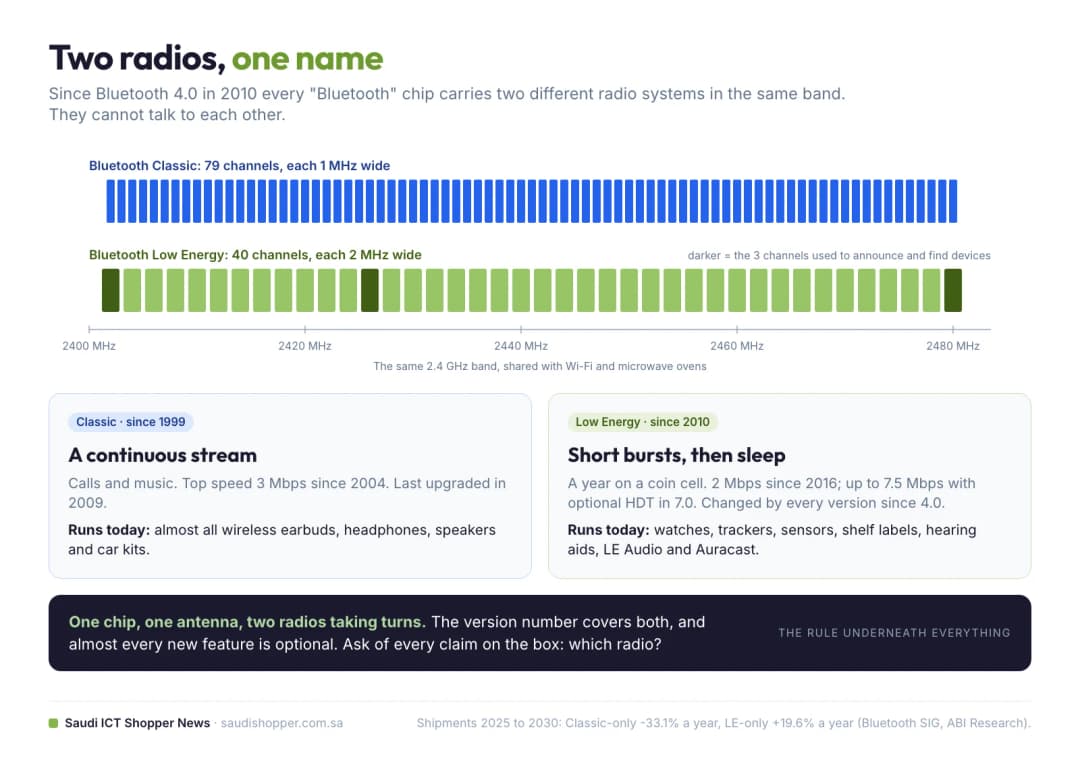
Two radios share one name. Since Bluetooth 4.0 in 2010, a “Bluetooth” chip is really two radio systems that happen to use the same band and the same antenna.
| Bluetooth Classic | Bluetooth Low Energy (LE) | |
|---|---|---|
| Born | 1999 | 2010 (Bluetooth 4.0) |
| Built for | A continuous stream: calls and music | Short bursts from a device that sleeps most of the time |
| Channels in the 2.4 GHz band | 79 channels, 1 MHz wide | 40 channels, 2 MHz wide |
| Top speed | 3 Mbps (since 2004) | 2 Mbps (since 2016); up to 7.5 Mbps with the optional HDT mode in 7.0 |
| What runs on it today | Almost all wireless earbuds, headphones, speakers and car kits | Watches, fitness bands, trackers, sensors, shelf labels, hearing aids, LE Audio and Auracast |
| Last major change | 2009 | Every version since 2010 |
The two radios cannot talk to each other. A phone is “dual-mode”: one chip that takes turns between the two. A fitness band is usually LE only. And here is the fact that explains the last fifteen years: every version from 4.0 to 7.0 changed the Low Energy radio, while music kept playing over Classic, a radio last upgraded in 2009.
So when a box says “Bluetooth 5.4”, ask one question for every claim that follows: which radio? “Twice the speed” and “four times the range” in Bluetooth 5 were Low Energy. Your earbuds were streaming over Classic, and got neither. The industry numbers show where this is heading: according to the Bluetooth SIG’s 2026 market dashboard, built on ABI Research forecasts, shipments of Classic-only devices are falling by 33.1% a year between 2025 and 2030, LE-only devices are growing by 19.6% a year, and 99% of all Bluetooth devices shipped in 2030 will include the LE radio.
Bluetooth 1.0 to 1.2 (1999 to 2003): the hands-free years
The first Bluetooth did one job: replace the cable between a phone and a headset. Version 1.0 arrived in 1999 with 1 Mbps on the air, of which about 0.7 Mbps carried data, across 79 channels that the radio hops between 1,600 times a second so that no single noisy channel can kill the link. The first Bluetooth phone, the Ericsson R520m, went on sale in 2001.
Early Bluetooth was famous for refusing to pair. Version 1.1 (2001) fixed many of the errors and became the first version that devices from different makers could rely on. Version 1.2 (2003) added adaptive frequency hopping: the radio notices which channels a nearby Wi-Fi network is using and stops hopping onto them. Every Bluetooth device since has it, and it is the reason a headset and a 2.4 GHz Wi-Fi router can share a room at all.
For a buyer: nothing with Bluetooth 1.x is on sale today. Its legacy is the headset profile and the hopping trick.
Bluetooth 2.0 + EDR (2004) and 2.1 (2007): stereo music, and the end of “0000”
Enhanced Data Rate tripled the on-air speed to 3 Mbps, about 2.1 Mbps of it usable. That was enough to make A2DP, the profile that carries stereo music, work well, and wireless headphones became a product people actually bought. Twenty-two years later that 3 Mbps is still the top speed of the Classic radio, and it is still what carries the music to almost every pair of wireless earbuds sold.
Bluetooth 2.1 (2007) replaced the four-digit PIN with Secure Simple Pairing: the devices agree keys between themselves and, at most, ask you to confirm a six-digit number. If you have never typed “0000” to connect a headset, this is why.
For a buyer: every phone, laptop and car still speaks this version of Classic. It is why a headset from 2010 pairs with a phone from 2026.
Bluetooth 3.0 + HS (2009): the generation that borrowed Wi-Fi, and lost
Bluetooth 3.0 promised 24 Mbps. It did not get there with a better Bluetooth radio. Two devices would find each other over Bluetooth and then move the file transfer onto the Wi-Fi radio sitting next to it in the same phone. The “+ HS” part was optional, few products implemented it, and Wi-Fi Direct soon did the same job without Bluetooth in the middle.
It matters for one reason: it is the last time anyone tried to make Bluetooth faster by brute force for seventeen years. The next version went the opposite way.
For a buyer: ignore “+ HS” wherever you still see it. The 24 Mbps figure in old comparison tables was never Bluetooth’s own speed.
Bluetooth 4.0 (2010): the second radio
Bluetooth 4.0 added Low Energy, a separate radio designed around one goal: let a small device run for a year on a coin cell. It does that by sleeping almost all the time, waking for a few milliseconds to say something short on one of 40 channels, and going back to sleep. The first phone with it was the iPhone 4S in 2011. Fitness bands, smartwatches, item trackers, heart-rate straps and beacons all exist because of this radio.
It was slower than Classic (1 Mbps) and could not carry music. That was the point. From here on, “Bluetooth” means two radios, and the version number mostly describes the newer one.
Bluetooth 4.1 (2013) and 4.2 (2014)
Version 4.1 taught the radio to stay out of the way of 4G signals in the neighbouring band and let one device act as both hub and accessory. Version 4.2 raised the size of a Low Energy packet from 27 to 251 bytes, which the SIG said made transfers up to 2.5 times faster, added stronger pairing (LE Secure Connections) and let sensors reach the internet through a gateway.
For a buyer: anything “Bluetooth 4.x” still works with today’s phones. The 251-byte packet set in 4.2 stayed the limit for twelve years, until 7.0.
Bluetooth 5 (2016): twice the speed and four times the range, for sensors, not earbuds
Bluetooth 5, adopted in December 2016, is the version most people have heard of, and the most misunderstood. It gave the Low Energy radio three new options:
- 2 Mbps, double the previous Low Energy rate, for faster syncing and firmware updates.
- Long range (“coded”): the radio repeats each bit so the receiver can recover it from a weaker signal. Range goes up about four times, speed drops to 500 or 125 kilobits per second.
- Eight times more data in an advertisement, the short broadcast a beacon or tracker sends to anyone listening.
All three are Low Energy features and all three are optional. A pair of earbuds streaming music over the Classic radio gained nothing from any of them, yet “Bluetooth 5.0” on an earbud box was sold for years as longer range and better sound. The range of a music link is set by the power and antenna of the two devices, exactly as it was in 2010.
For a buyer: “5.0” on earbuds is a manufacturing date, not a feature. On a smart lock, a sensor or a tracker it can mean real range. And remember the 2 Mbps: it stays the ceiling of the Low Energy radio through eight more versions.
Bluetooth 5.1 (2019): where is it?
Version 5.1 added direction finding. A receiver with several antennas can measure the angle a signal arrives from, so a finder can point towards a lost item instead of only reporting that it is somewhere near. It is the start of a theme that runs to Bluetooth 6: Bluetooth learning where things are.
For a buyer: useful in warehouses and hospitals. Consumer trackers mostly chose other methods, until Bluetooth 6.
Bluetooth 5.2 (2020): the one that changes your earbuds
This is the version that matters for sound, and the box rarely says why. Bluetooth 5.2 gave the Low Energy radio isochronous channels, a way to deliver data on a strict clock, which is what audio needs. On top of that the SIG built LE Audio, announced in January 2020 and completed in July 2022. It is a second, separate way to send sound, over the Low Energy radio instead of Classic:
- LC3, a new mandatory codec. In the SIG’s listening tests LC3 at 160 kbps scored higher than the old default SBC at 345 kbps, less than half the bit rate, which means the same sound for less battery.
- Multi-stream: separate, synchronised streams to the left and right earbud, instead of one bud relaying to the other.
- Hearing aids as a first-class Bluetooth device.
- Auracast broadcast audio: one transmitter, any number of listeners. A television in a gym, a gate announcement in an airport, a lecture in a hall, a friend sharing a playlist, all tuned into from your own earbuds or hearing aids, the way you would join a Wi-Fi network.
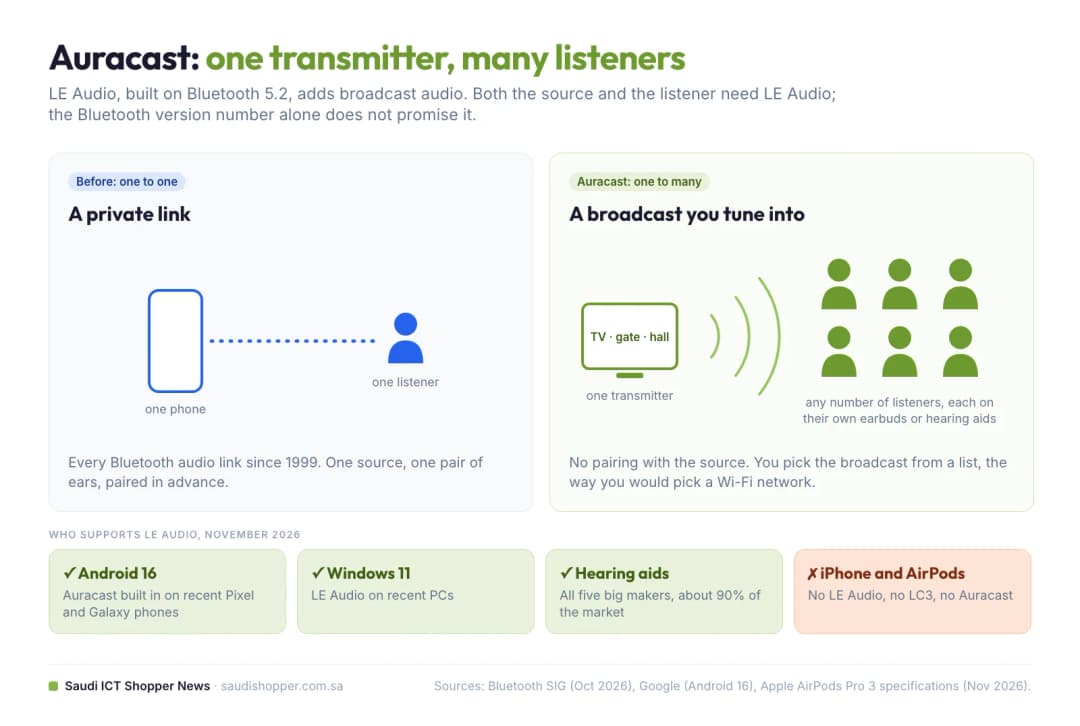
Who has it in November 2026? Android 16 has Auracast built into the system on recent Pixel and Galaxy phones. Windows 11 supports LE Audio on recent PCs. All five of the large hearing-aid makers, about 90% of that market, now sell Auracast hearing aids, the SIG said in October 2026. Apple has none of it: the specification page for AirPods Pro 3 lists Bluetooth 5.3 and mentions neither LE Audio, LC3 nor Auracast, and iOS 27 did not add them.
For a buyer: LE Audio only works when both ends support it, and it is optional, so “Bluetooth 5.2” or later on the box does not promise it. Look for the words “LE Audio” or “Auracast”.
The Bluetooth version is not sound quality
Music does not travel over Bluetooth as it is stored. It is compressed by a codec on the phone and decompressed in the earbuds. The codec, not the Bluetooth version, sets the ceiling on sound quality, and the phone and the earbuds can only use a codec they both have.
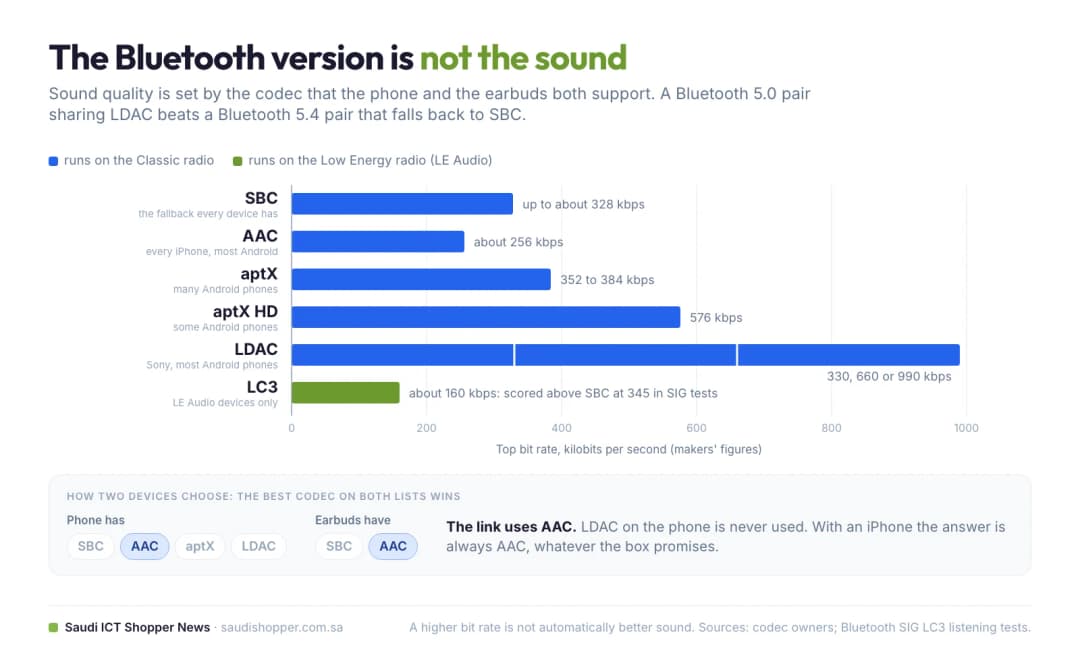
| Codec | Typical top bit rate | Who has it | Radio |
|---|---|---|---|
| SBC | About 328 kbps | Everything. It is the mandatory fallback | Classic |
| AAC | About 256 kbps | Every iPhone and AirPods, most Android phones | Classic |
| aptX | 352 to 384 kbps | Many Android phones with Qualcomm chips | Classic |
| aptX HD | 576 kbps | Some Android phones and headphones | Classic |
| LDAC | 330, 660 or 990 kbps | Sony, and most Android phones since Android 8 | Classic |
| LC3 | About 160 kbps for stereo music | LE Audio devices only | Low Energy |
Bit rates are the makers’ own figures and the real rate moves with signal quality. A higher bit rate is not automatically better sound: LC3 is designed to match or beat SBC at half the rate.
The negotiation is simple and unforgiving. The phone and the earbuds compare lists and use the best codec on both. If only one of them has LDAC, LDAC is not used. An iPhone will use AAC with every earbud ever made, whatever the box promises. Which leads to the least intuitive fact in this guide: a Bluetooth 5.0 phone and earbuds that share LDAC will sound better than a Bluetooth 5.4 pair that fall back to SBC.
The earbud market is large enough for this to matter. The SIG’s dashboard puts earbud shipments at 500.2 million in 2026, rising to 800.2 million in 2030, while over-ear headphones fall from 286.9 million to 137.5 million.
For a buyer: read the codec list, then check your phone has the same one. That is the whole test.
Bluetooth 5.3 (2021) and 5.4 (2023): quieter connections and shelf labels
Version 5.3 is housekeeping. Devices can change how often they talk to each other more smoothly, which saves a little battery, and both ends can now agree on which channels are noisy. Nothing a shopper will notice, although it became the number printed on most earbuds from 2023.
Version 5.4 was written for shops. It lets one access point hold a two-way conversation with up to 32,640 tiny devices and encrypts what they broadcast: the electronic price label on a supermarket shelf. The SIG’s dashboard expects electronic shelf labels to grow from 46.5 million units in 2026 to 175.7 million in 2030.
For a buyer: 5.3 and 5.4 earbuds are not better than 5.2 earbuds because of the number. Compare codecs, battery and noise cancelling.
Bluetooth 6.0 (2024): centimetres, not megabits
Bluetooth 6.0 added one feature that people will feel: Channel Sounding. Until now a phone estimated distance from signal strength, which is a guess that can be metres out and that a thief can fake by relaying the signal from a key inside a house to a car outside it.
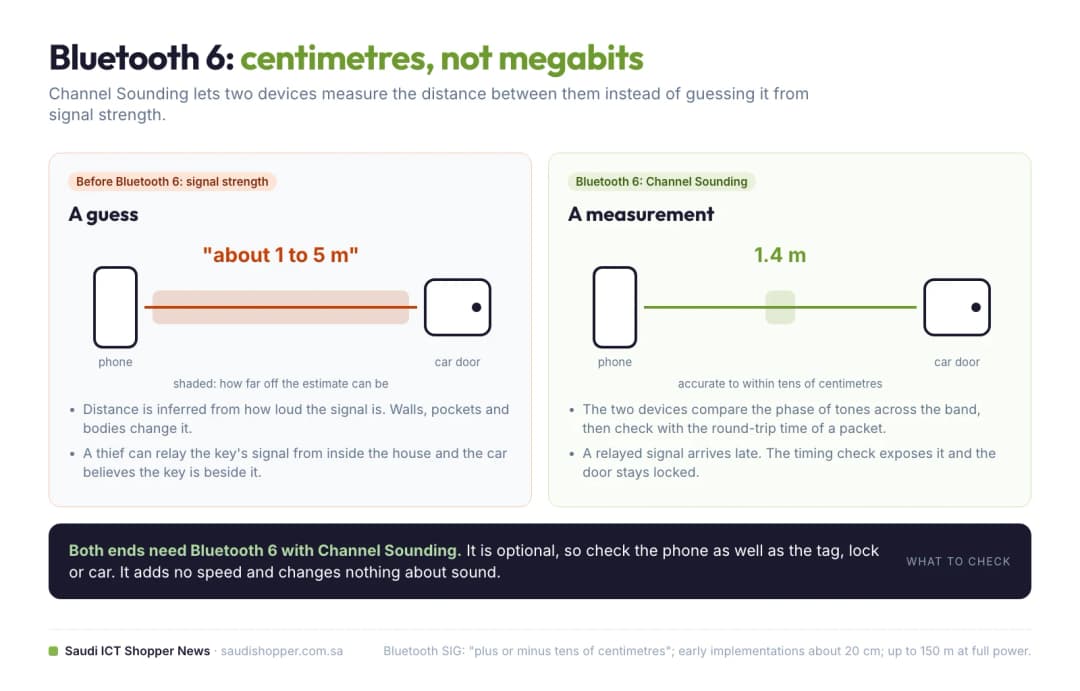
Channel Sounding measures instead of guessing. The two devices exchange tones across the band and compare their phase, then cross-check the result with the round-trip time of a packet. The SIG describes the result as accurate to within “plus or minus tens of centimetres”, says early implementations reach about 20 cm, and gives a range of up to 150 metres at full power. Because a relayed signal arrives late, the timing check exposes it. A digital car key can then unlock only when the phone is truly beside the door, and a finder can say “1.4 metres” instead of “nearby”. Both devices need Bluetooth 6 with Channel Sounding; it too is optional.
Bluetooth 6.1, 6.2 and 6.3 (2025 to 2026)
In 2025 the SIG moved to a release every six months, so minor versions now arrive faster than products can adopt them. Version 6.1 (May 2025) makes a device’s rotating address harder to track. Version 6.2 (November 2025) cuts the shortest gap between two exchanges to 375 microseconds, which matters for game controllers and mice, and hardens Channel Sounding against attack. Version 6.3 (May 2026) speeds up Channel Sounding and tidies radio test limits.
For a buyer: Bluetooth 6 is no faster than Bluetooth 5 and does not improve sound. Pay for it in a car key, a tracker or a smart lock that names Channel Sounding. Ignore 6.1 to 6.3 on a box.
Bluetooth 7.0 (November 2026): the first speed rise in ten years, and you cannot buy it yet
Bluetooth 7.0, adopted in early November 2026, contains the feature the audio industry has waited for: High Data Throughput, or HDT. The SIG’s announcement on 4 November says it “increases the maximum supported bit rate to 7.5 Mbps, nearly four times that of the Bluetooth LE 2M PHY”. It is the first increase in Bluetooth’s own top speed since December 2016, and the first time the Low Energy radio is faster than Classic.
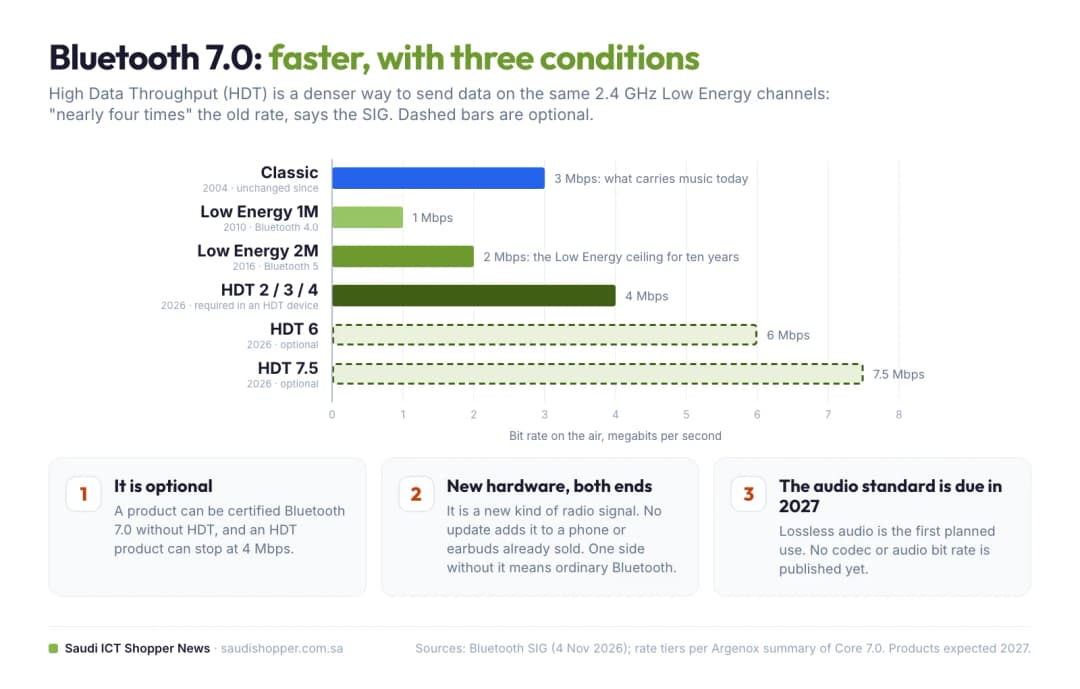
HDT is not a new band or a wider channel. It is a new, denser way of putting data onto the same 2.4 GHz Low Energy channels. According to engineering summaries of the specification, a device that supports HDT must offer 2, 3 and 4 Mbps, while 6 and 7.5 Mbps are optional. A connection still begins as ordinary Low Energy, switches up if both sides agree, and drops back when the signal weakens. The largest packet grows from 251 bytes to 8,175.
Three limits will not be printed on the box:
- It is optional. The SIG calls HDT “an optional feature” of Bluetooth 7.0. A product can be certified as Bluetooth 7.0 and not have it. And an HDT product can stop at 4 Mbps.
- It needs new hardware, at both ends. HDT uses a different kind of radio signal from the one every existing Bluetooth chip produces, so audio trade reports citing the SIG’s technical overview say no software update can add it to a phone or to earbuds already sold. If either end lacks it, the link is ordinary Bluetooth.
- The audio standard is not finished. The SIG names “standardized lossless and high-resolution audio” as the first use of HDT and expects it in 2027. No codec, bit depth or sample rate has been published. And 7.5 Mbps is the rate of the radio, not of the music; the usable figure for audio is lower and has not been stated.
The rest of Bluetooth 7.0 is plumbing: stream settings that can change without a dropout, temporary keys that do not require pairing, and tools for testing encrypted links.
For a buyer in 2026: there is nothing to buy. The first HDT products are expected during 2027, lossless audio will need a new phone and new earbuds bought together, and a “Bluetooth 7 ready” sticker promises nothing. If you need earbuds now, buy them on codec and comfort.
What the Saudi rules allow, and what half the market cannot use
Bluetooth uses the 2400 to 2483.5 MHz band, which is licence-exempt in Saudi Arabia. The radio rules are in technical specification RI117 of the Communications, Space and Technology Commission (CST), which limits devices in this band to 100 milliwatts and follows the European standard EN 300 328. Since February 2025 the approval itself is no longer issued by CST: a wireless product needs a SASO certificate obtained through the SABER platform, tested against CST’s specification. Stock sold by Saudi retailers has it. A grey import may not.
The bigger local limit is the phone in your pocket. StatCounter put Apple at 51.6% of Saudi mobile web traffic in September 2026, a measure of use rather than sales. No iPhone supports LE Audio or Auracast. So the two most useful audio features of the last six years, low-power LC3 audio and broadcast audio, are out of reach for roughly half the phones in the Kingdom, whatever earbuds their owners buy. We also found no public venue in Saudi Arabia, in English or Arabic sources, that has announced an Auracast installation; the deployments the SIG named in October 2026 are in New Zealand, Japan and Germany.
How the speed stopped for ten years, and what moved instead
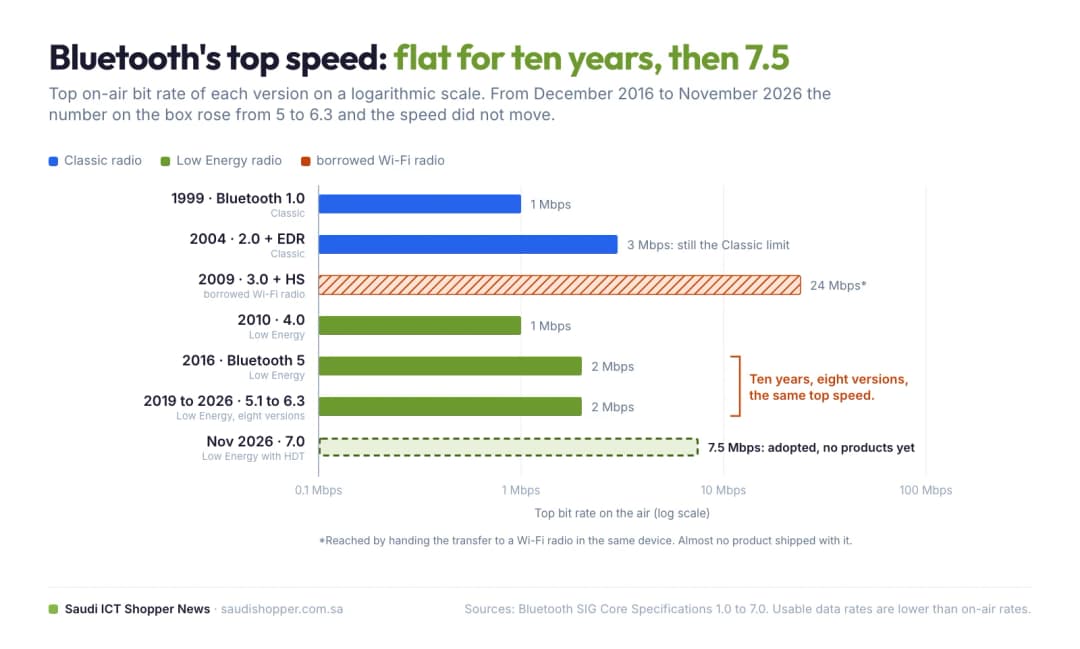
Put the top speed of each version on one chart and the shape is unusual for a technology. It rises from 1 to 3 Mbps in five years, spikes to a borrowed 24 Mbps that nobody used, drops back to 1 Mbps when Low Energy arrives, reaches 2 Mbps in 2016, and then does not move for a decade while eight versions pass.
The reason is in the shipments. The SIG’s dashboard expects close to six billion Bluetooth devices in 2026 and 8.1 billion a year by 2030, growing 8.4% a year. Phones are not where that growth comes from: smartphone shipments are forecast to slip from 1,179.7 million to 1,124.7 million. Smart labels, the paper-thin tags on parcels and goods, go from 169.4 million to 1,286.6 million and pass smartphones. A label, a sensor or a shelf tag does not need megabits. It needs to be cheap, small, private and able to say where it is, and that is exactly what versions 5.1 to 6.3 delivered.
Bluetooth 7.0 bends the curve because audio finally asked for more than Classic’s 3 Mbps could give. The dashboard figures were last updated on 1 July 2026, before 7.0 was adopted, so they do not count any effect from it.
Which Bluetooth should you buy? The cheat sheet
What all of this means on the shop floor at Jarir or eXtra, or on a product page:
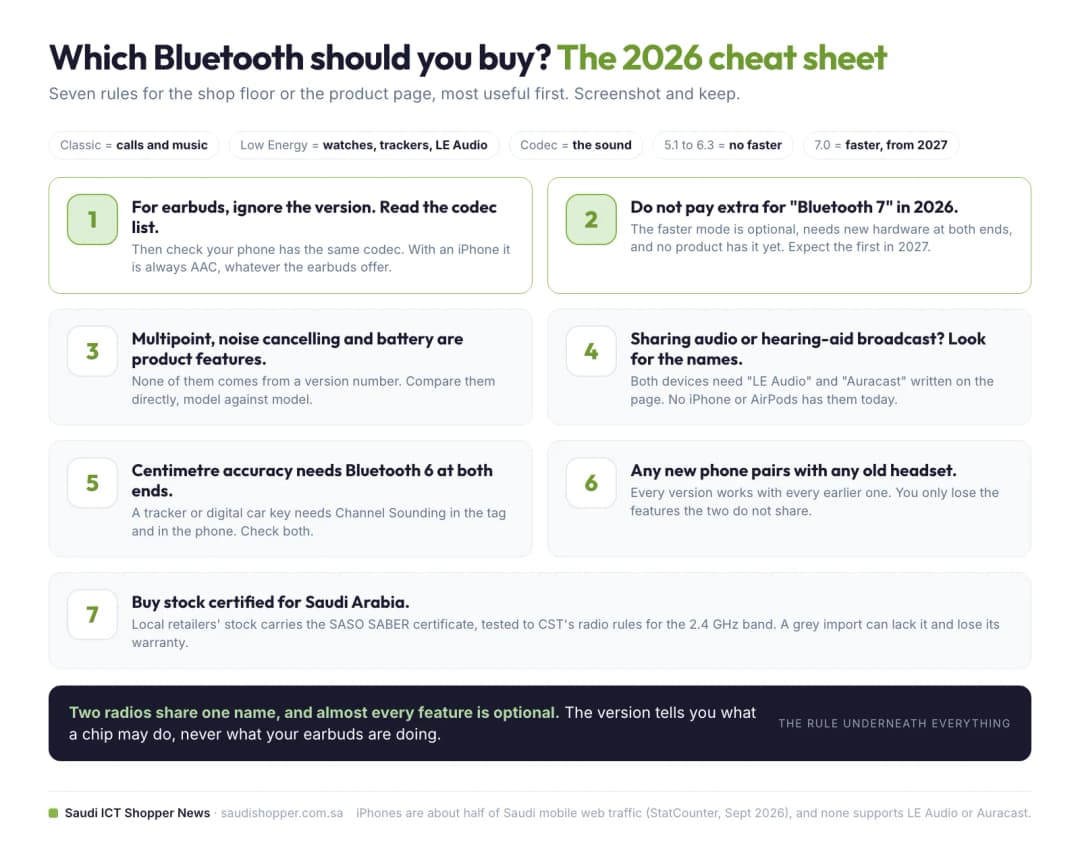
- For earbuds, ignore the version and read the codec list. Then check your phone has the same codec. iPhone means AAC, whatever the earbuds offer.
- Do not pay extra for “Bluetooth 7” in 2026. The faster mode is optional, needs new hardware at both ends, and no product has it yet.
- Multipoint, noise cancelling and battery life are product features, not versions. Compare them directly.
- Want audio sharing or hearing-aid broadcast? Both devices need LE Audio and Auracast by name. No iPhone has them today.
- A tracker or car key that promises centimetres needs Bluetooth 6 Channel Sounding at both ends. Check the phone as well as the tag.
- Any new phone pairs with any old headset. You only lose the features the two do not share.
- Buy stock certified for Saudi Arabia. Local retailers’ stock carries the SABER certificate; a grey import can lack it and lose its warranty.
Bluetooth glossary: the terms on the box, in one sentence each
- Bluetooth Classic (BR/EDR): the original radio from 1999, which carries calls and almost all wireless music.
- Bluetooth Low Energy (LE): the second radio, added in 2010, built for devices that sleep most of the time.
- Dual-mode: a chip with both radios, as in every phone and laptop.
- EDR: Enhanced Data Rate, the 2004 upgrade that took Classic to 3 Mbps.
- Profile: a rulebook for one job, such as A2DP for stereo music or HFP for calls.
- Codec: the method used to compress sound for the trip; both devices must share it.
- SBC, AAC, aptX, LDAC: codecs that run over the Classic radio, from basic to high bit rate.
- LE Audio: the newer way to send sound over the Low Energy radio, introduced with Bluetooth 5.2.
- LC3: the codec of LE Audio, designed to match older codecs at about half the bit rate.
- Auracast: LE Audio broadcast, one transmitter to any number of listeners.
- Multipoint: staying connected to two devices at once, such as a laptop and a phone; a product feature, not a version.
- PHY: the physical layer, the way bits are put on the air, such as 1M, 2M, Coded or HDT.
- Coded PHY (long range): a Bluetooth 5 mode that trades speed for about four times the range.
- HDT: High Data Throughput, the optional Bluetooth 7.0 mode that reaches up to 7.5 Mbps.
- Lossless: audio that arrives bit for bit as it was stored; Bluetooth has no standard for it yet.
- Channel Sounding: the Bluetooth 6 method of measuring distance to within tens of centimetres.
- Adaptive frequency hopping (AFH): avoiding channels that Wi-Fi is using.
- Pairing: the one-time exchange of keys that lets two devices trust each other.
Frequently asked questions about Bluetooth versions
On paper, yes. Bluetooth 7.0, adopted in November 2026, adds an optional mode called High Data Throughput that raises the top speed of the Low Energy radio from 2 Mbps to 7.5 Mbps. In practice no product has it yet, it needs new radio hardware in both devices, and the first products are expected in 2027.
Not yet. The Bluetooth SIG says standardized lossless and high-resolution audio will be the first use of the new High Data Throughput mode and expects it in 2027. No codec or audio bit rate has been published, and it will need a new phone and new earbuds that both support it.
It can be certified to a newer version on paper, but it cannot gain the faster High Data Throughput mode. That mode uses a new kind of radio signal that existing Bluetooth chips cannot produce, so it requires new hardware.
No. Both top out at 2 Mbps on the Low Energy radio and 3 Mbps on the Classic radio. Bluetooth 6.0 added Channel Sounding, which measures distance to within tens of centimetres, and other efficiency features. It did not add speed or better sound.
No. Every Bluetooth version works with every earlier one. A new phone pairs with old earbuds and old phones pair with new earbuds. You only lose optional features that one side does not have.
No. Sound quality is set by the codec that the phone and the earbuds both support, such as SBC, AAC, aptX, LDAC or LC3, and by the earbuds themselves. A Bluetooth 5.0 pair that shares LDAC will sound better than a Bluetooth 5.4 pair that falls back to SBC.
LE Audio is a newer way of sending sound over the Bluetooth Low Energy radio, built on Bluetooth 5.2. It brings the LC3 codec, hearing-aid support and Auracast broadcast audio. It is optional, so check for the words LE Audio or Auracast on the product page. Both the phone and the earbuds must support it.
No. As of November 2026 no iPhone or AirPods model supports LE Audio, the LC3 codec or Auracast. Android 16 supports Auracast on recent Pixel and Galaxy phones.
Not for earbuds. The long range mode in Bluetooth 5 belongs to the Low Energy radio and is used by sensors, locks and trackers. Music streams over the Classic radio, where range depends on transmit power and antenna design, not on the version.
Bluetooth, 2.4 GHz Wi-Fi and microwave ovens all use the same band. Bluetooth hops between channels to avoid interference, but a strong nearby source can still block it. Moving a few metres away or switching the router to 5 GHz usually solves it.
Sources
- Bluetooth SIG, Bluetooth High Data Throughput delivers a higher level of wireless performance (4 November 2026); press release; HDT feature page
- Bluetooth SIG, Specifications: adopted Core versions and deprecation dates (checked 12 November 2026)
- Bluetooth SIG, Bluetooth Market Dashboard (ABI Research data, last updated 1 July 2026, read 12 November 2026)
- Bluetooth SIG, Channel Sounding; LE Audio; An introduction to Bluetooth LE Audio (LC3 listening tests)
- Bluetooth SIG, A new milestone for Auracast broadcast audio (22 October 2026); Just released: Bluetooth Core 6.3 (May 2026); Bluetooth Core 5.4 technical overview (February 2023)
- Argenox, Bluetooth Core Specification 7.0 adopted (November 2026); Into The HiFi, Bluetooth adopts High Data Throughput: new radios required (November 2026)
- Google, LE Audio and Auracast support on Android (September 2025); Apple, AirPods Pro 3 technical specifications (checked November 2026)
- Novel Bits, Bluetooth Low Energy vs Bluetooth Classic; Nordic Semiconductor, Bluetooth 5
- Communications, Space and Technology Commission, Regulations (technical specification RI117, licence-exempt data communication equipment); UL Solutions, Saudi Arabia wireless regulatory updates (SASO SABER certification since February 2025)
- StatCounter, Mobile vendor market share, Saudi Arabia (September 2026)
Last updated November 2026. Version dates are the adoption dates of the Bluetooth Core Specification. Codec bit rates are the makers’ published figures. Infographics by Saudi ICT Shopper News.