
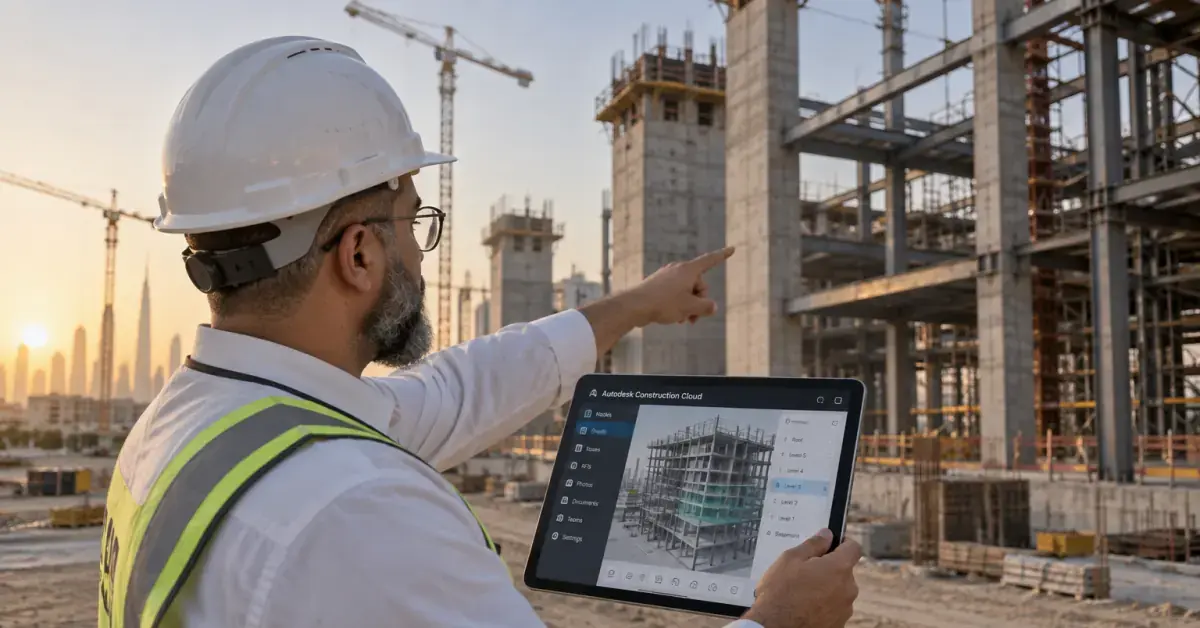
Adoption of digital construction tools is expanding across the Middle East faster than in European markets, according to Autodesk’s State of Digital Construction 2026 report. The study surveyed 1,500 industry professionals across six regional markets, including 250 respondents across the UAE and Saudi Arabia. Findings indicate that regional firms increasingly rely on specialized software to manage expanding infrastructure and commercial developments.
Regional Demand for Digital Construction Tools
Survey data shows that 98% of Middle East construction professionals expect their reliance on digital construction tools to rise within three years. This figure surpasses the EMEA average of 95%. In Saudi Arabia specifically, 54% of respondents anticipate significant growth in technology usage as project requirements accelerate across the Kingdom’s economy.
Regional organizations also lead the EMEA region in Building Information Modeling deployment, with 40% currently using the system. Field management tools remain critical for regional operators, with 44% identifying them as vital for delivery. Furthermore, 38% of respondents judge project success by technology adoption and operational efficiency alongside schedule adherence.
“The Middle East is no longer looking to catch up with other markets in technology investment, but is setting the pace across EMEA. The next step is turning that momentum into tangible outcomes on project sites.”
Evgenia Maksimova, Senior Manager for Emerging Markets EMEA at Autodesk
Rising Role of Artificial Intelligence and Automation
Emerging applications such as artificial intelligence are shaping future software investments across the construction sector. About 34% of Middle East respondents cited AI and automated workflows as the most important factors for incoming project software. This represents the highest proportion recorded across all surveyed markets in EMEA.
Contractors prioritize practical implementations, focusing on automating repetitive administrative tasks and calculating project risks. Consequently, digital construction tools must deliver predictive analytics to handle large-scale programs without increasing overhead costs.
Mobile Access and Site Connectivity Priorities
Operational connectivity between remote job sites and central offices represents another clear priority for regional builders. Around 38% of Middle East respondents stated that enhanced mobile access would improve the utility of their construction software. In comparison, only 22% of surveyed professionals in the United Kingdom shared that view.
In addition, 36% of regional respondents highlighted documentation workflows and integration with third-party software platforms as essential requirements. Reliable connectivity through telecom networks ensures that site teams receive real-time project updates directly on their field hardware.
Workforce Skills and Implementation Challenges
Despite strong investment plans, technical limitations continue to influence adoption schedules across the region. Nearly 31% of respondents identified internal skill shortages as the main barrier to expanding their digital workflows. Software expenses ranked second at 30%, while 28% pointed to data security and system integration hurdles.
To mitigate these constraints, 34% of Middle East companies evaluate software vendors based on the quality of user training and technical support provided. Industry leaders emphasize that workforce training must accompany capital investments to secure planned returns across long-term building programs.