
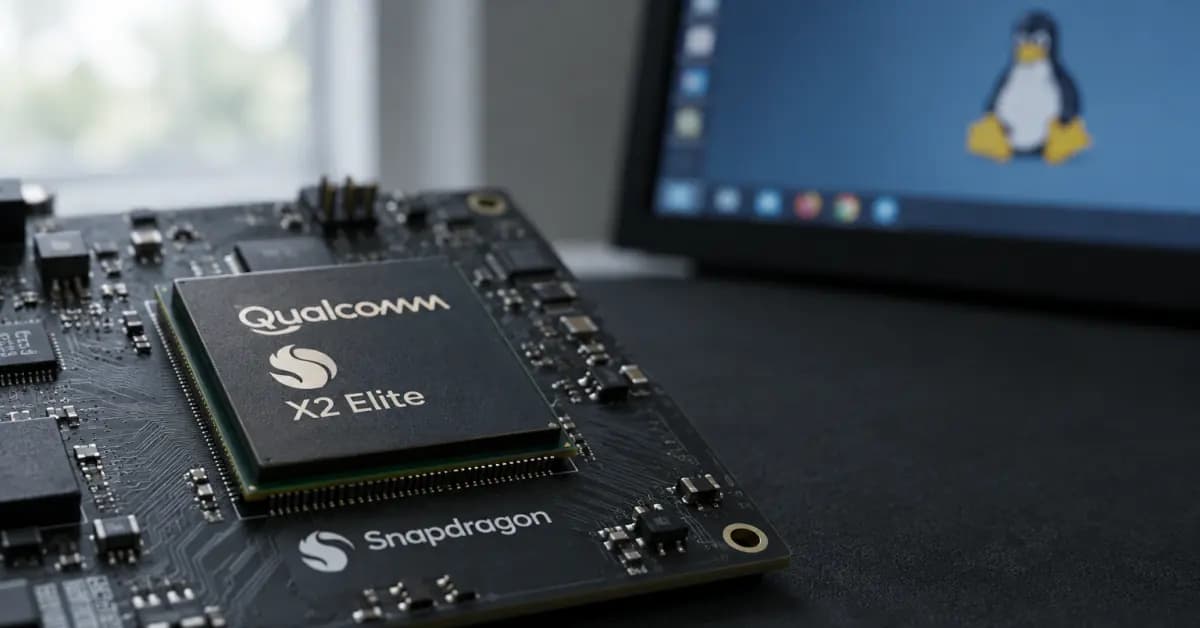
KORA Systems and Qualcomm Technologies have developed a full Linux desktop operating system for the Snapdragon X2 Elite computing platform. Following nearly a year of technical collaboration, the companies adapted the platform to run large artificial intelligence models on personal computers. The engineering initiative establishes the foundation for two distinct operating systems scheduled to arrive on commercial devices in 2027.
Linux Desktop Architecture on Snapdragon X2 Elite
The platform runs directly from the Linux kernel up to a new desktop interface engineered specifically for intelligent computing. Hardware execution relies on the Qualcomm Oryon central processing unit, the Qualcomm Adreno graphics processor, and an 80 TOPS Qualcomm Hexagon neural processing unit. Qualcomm Technologies continues to submit hardware support directly into the mainline Linux kernel to assist broader software integration.
Engineers addressed legacy software requirements by incorporating translation technologies. These compatibility tools allow users to run selected Windows x86-64 applications inside the Linux environment. Consequently, individuals maintain access to critical productivity programs while shifting to the updated architecture.
Technical Foundations of Cortex Engine
At the center of both operating systems sits Cortex, a hybrid inference engine that coordinates computational tasks across every processing unit on the chip. The hybrid inference engine distributes computing workloads across the processor, ensuring that the Snapdragon X2 Elite balances tasks among its CPU, GPU, and NPU. Furthermore, Cortex can extend scheduling routines to other networked devices across a local environment.
The system configuration runs a 26-billion-parameter language model directly on local hardware without cloud dependence. Automatic speech recognition and embedding models operate simultaneously on the machine. This architecture preserves data privacy by keeping sensitive enterprise records strictly on local storage drives.
“Every operating system in use today was designed before the computer had a mind. For close to a year, we have been building what comes after it with Qualcomm Technologies, on Snapdragon platforms: a full Linux desktop, large models running on the device, and the CPU, GPU and NPU working on the task as one machine.”
Kirt McMaster, Chief Executive Officer, KORA Systems Inc.
Enterprise Functions in HUMAIN OS
The enterprise-oriented software platform, HUMAIN OS, was created through a joint initiative between KORA and HUMAIN. First showcased at LEAP 2026 in Riyadh, the system structures daily digital workflows around user intent, contextual data, and direct actions. It combines workplace communication channels, calendars, and file systems into one single workspace.
Autonomous software agents reside directly in the underlying operating system rather than functioning as separate add-on software. An integrated neural file system classifies corporate documents by content and semantic meaning rather than basic file names. Meanwhile, manufacturers plan to ship initial commercial computers using the Snapdragon X2 Elite hardware and HUMAIN OS during 2027.
Independent Systems for Creators and Developers
The second platform, named KORA, serves software developers and creative professionals. It incorporates the identical Cortex scheduling engine and neural workspaces while providing open model-layer compatibility. Users retain full freedom to deploy models from any research lab locally or connect to remote infrastructure.
KORA Systems includes engineering personnel who previously deployed platforms such as Cyanogen, Android, and GameOS to consumer devices. Qualcomm Technologies confirmed that commercial hardware releases from original equipment manufacturers will begin rollout throughout 2027.