AI-generated illustration
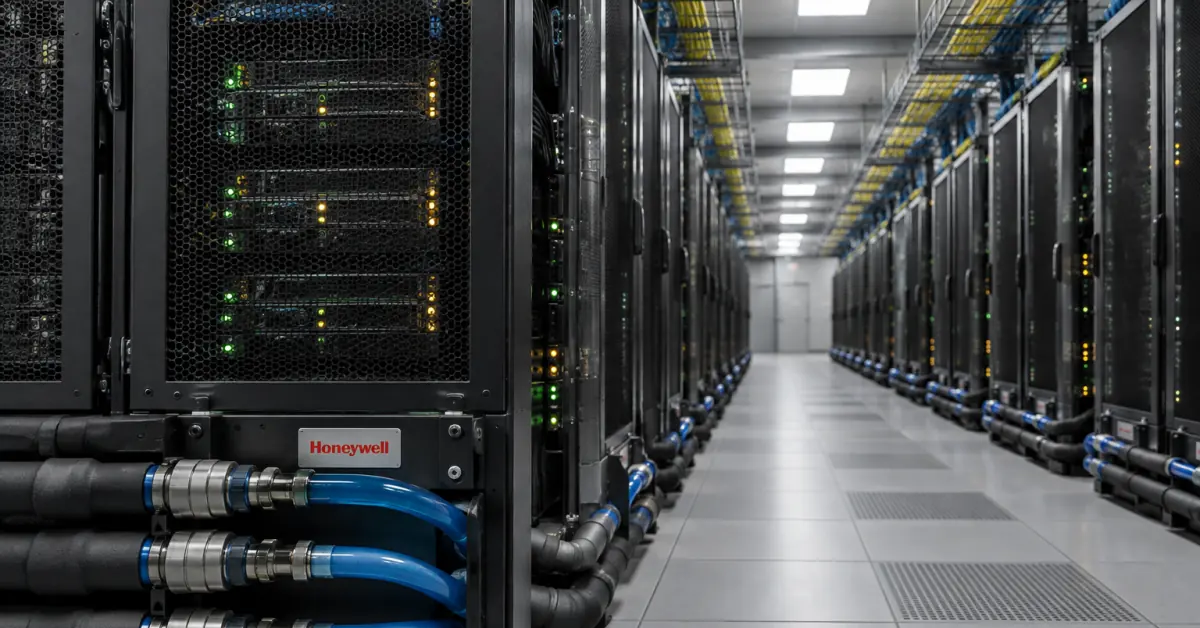
Honeywell Aerospace has installed its Thermal Response Module at the Equinix Co-Innovation Facility in Ashburn, Virginia, to test cooling continuity in liquid-cooled artificial intelligence infrastructure. The deployment addresses thermal challenges as high-density computing facilities transition toward advanced cooling methods to protect processing hardware.
Thermal Response Module Mechanics and Capabilities
The Thermal Response Module functions as a thermal buffer between coolant distribution units and operational servers. Specifically, it uses proprietary phase-change materials to store and release thermal energy during electrical disturbances or sudden spikes in computing demands.
According to technical specifications, the unit delivers 7.6 times more cooling power than chilled water systems. Consequently, it stabilizes fluid temperatures within seconds and provides thermal buffering for several minutes, integrating directly into fluid loops without requiring architectural changes.
Liquid Cooling Market Expansion
Research from Omdia indicates that fewer than half of existing data centers use liquid cooling setups today. However, the liquid cooling market is projected to grow at an annual rate of 20% over the next five years as computing clusters expand.
Because graphic processors demand stable temperatures to prevent performance throttling, thermal fluctuations present serious risks to artificial intelligence clusters. Therefore, operators are turning to direct-to-chip cooling systems supported by buffering modules to protect expensive hardware components from sudden heat excursions.
Testing Results at Equinix Facility
Testing conducted at the Ashburn facility demonstrated that the system manages rapid cooling variations while maintaining a smaller physical footprint than conventional buffer tanks. Pawel Wlodarczak, design innovation director for Global Design at Equinix, verified the results during operational trials.
“Testing at our Ashburn Co-Innovation Facility demonstrated the technology’s capability to manage rapid GPU cooling load fluctuations while requiring a smaller footprint in comparison to buffer tanks.”
Pawel Wlodarczak, Design Innovation Director, Global Design, Equinix
Moreover, the module includes onboard state-of-charge sensing and adaptable heat exchangers that work independently of coolant distribution hardware vendors. This modular design permits installation in configurations ranging from edge facilities to large data center clusters managing high-intensity computing hardware workloads.
Cross-Industry Technology Applications
The engineering behind this hardware stems from thermal management systems developed for aerospace and defense applications. Rich DeGraff, president and CEO of Control Systems for Honeywell Aerospace, noted that heat profiles in aerospace systems closely reflect demands found in modern digital infrastructure.
“We have taken phase-change material technology developed to protect mission-critical aerospace and defense systems and applied it to a similar challenge in AI infrastructure.”
Rich DeGraff, President and CEO of Control Systems, Honeywell Aerospace
In conclusion, the hardware helps operators limit performance throttling and shift electric power toward computational tasks to support the digital economy.