

AI-generated illustration
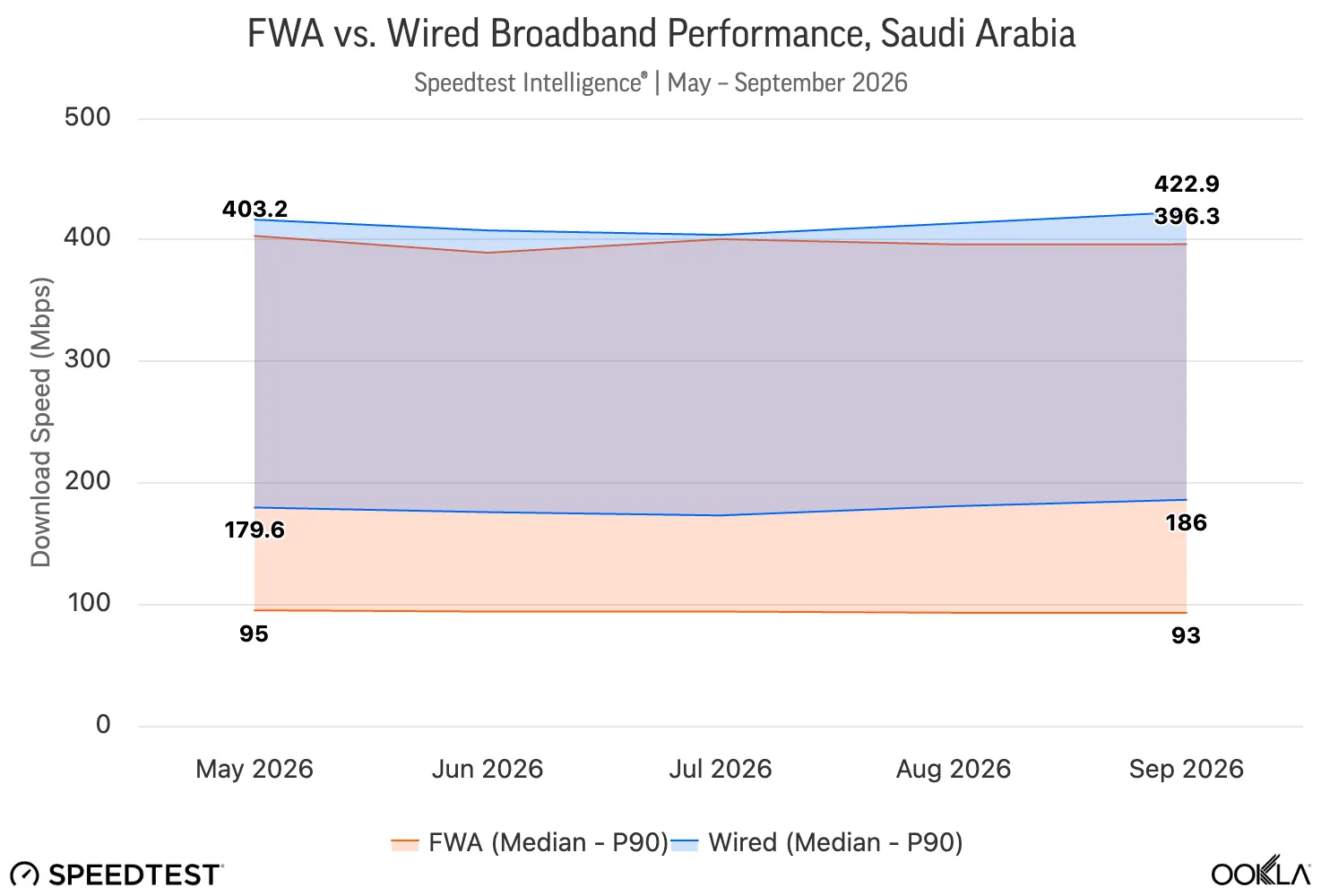
Saudi Arabia’s 5G home internet, sold as fixed wireless access (FWA), reaches around 400 Mbps at the 90th percentile, level with wired broadband, but the typical Saudi FWA user sees a median download speed of 93 Mbps, about half the 173–186 Mbps of wired connections, according to a new report from Ookla, the company behind Speedtest.
The report, written by Ookla lead industry analyst Karim Yaici and published on Tuesday, compares FWA with wired broadband across the six Gulf Cooperation Council (GCC) markets using Speedtest Intelligence data from May to September 2026. FWA is home internet delivered over the mobile network through a 5G router instead of a fiber line, and all three Saudi operators, stc, Mobily and Zain, sell it with unlimited data.
5G home internet in Saudi Arabia: strong peaks, weak upload and latency
In September 2026, FWA in Saudi Arabia posted a median download speed of 93 Mbps and a median upload speed of 19 Mbps, the lowest upload figure in the GCC. Wired broadband was around twice as fast on download (173–186 Mbps) and close to five times faster on upload, at around 95 Mbps.
The gap closes in good conditions. The fastest 10% of Saudi FWA samples reached around 400 Mbps, matching the top 10% of wired connections. Ookla says this highlights the potential of 5G home internet as a fiber substitute where signal conditions allow it.
Latency is the weakest point. Saudi FWA recorded a median loaded latency of 321 ms, the highest in the region and more than 3.7 times that of wired broadband. Loaded latency is the round-trip response time while a download saturates the connection, which is what video calls and online gaming feel when someone else in the home is streaming.
Price parity, but fiber starts faster
Saudi operators price entry-level FWA at parity with entry-level fiber, Ookla notes, but fiber packages typically start at 200 Mbps while FWA starts at 100 Mbps. Competition between stc, Mobily and Zain centres on monthly price, headline download speed (commonly 100–200 Mbps, with selected packages at 300 Mbps or higher), router quality, Wi-Fi extenders, entertainment bundles and contract flexibility.
The Kingdom had more than 3 million fixed broadband subscribers as of the third quarter of 2026, a household penetration of around 42%. Homes covered by fiber grew from 1.6 million in 2017 to 5.8 million by the end of 2025, and fiber accounts for around 65% of fixed connections, roughly 2 million lines, with FWA and DSL making up the rest. Under Vision 2030 the country aims to reach a further 3.8 million households with fiber by 2030, supported by the Communications, Space and Technology Commission’s National Open Access Broadband initiative, which requires operators to share passive fiber infrastructure.
On the wireless side, stc, Mobily and Zain activated 5G Standalone (SA) networks in 2023, 2024 and 2025 respectively, but none had announced a nationwide commercial 5G SA or 5G-Advanced launch as of October 2026. Ookla describes Saudi operators as holding a strong mix of new low-band spectrum and 3.8 GHz capacity spectrum.
Kuwait leads the Gulf, Saudi Arabia sits fifth
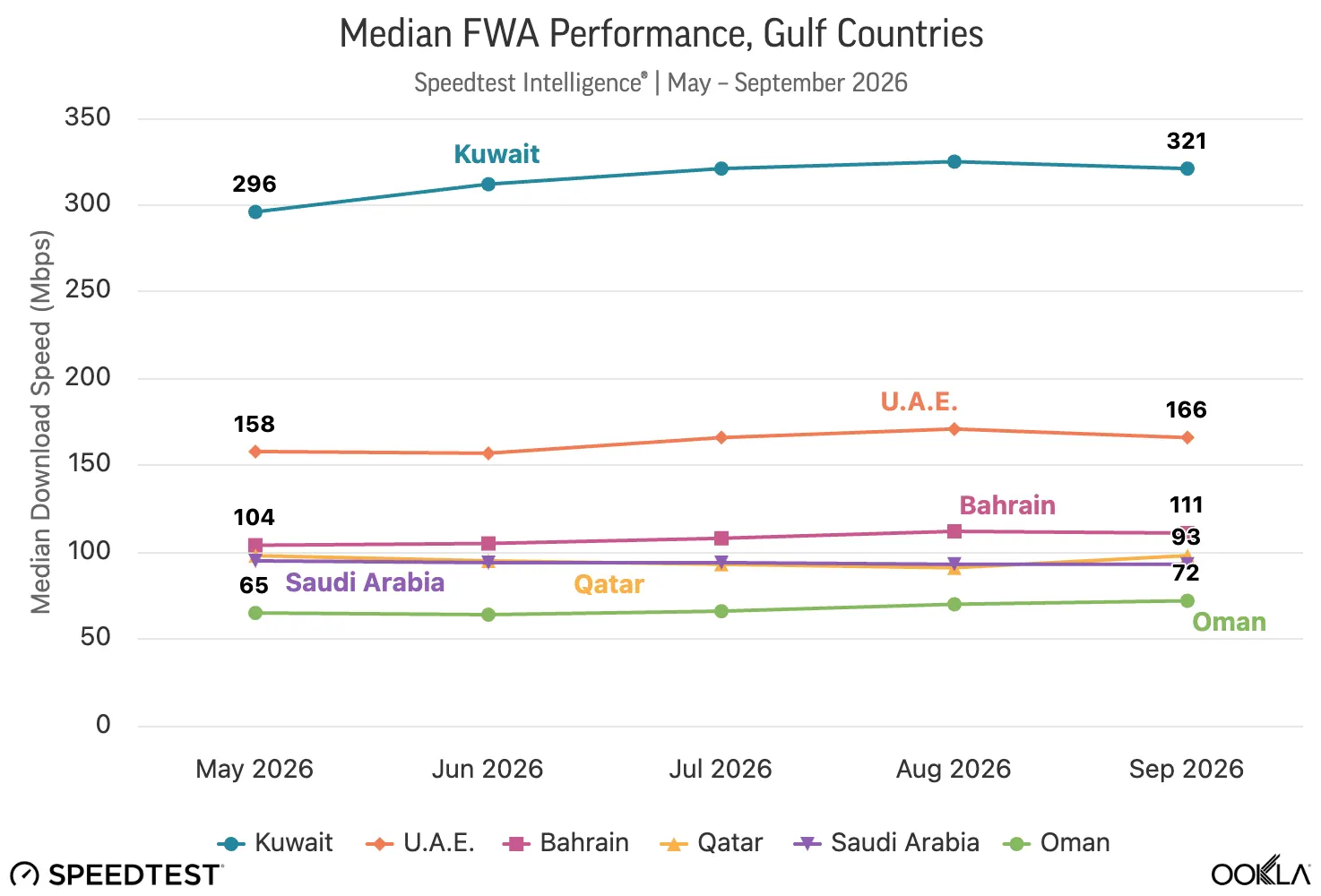
Kuwait topped the GCC with a median FWA download speed of 321 Mbps and a loaded latency of 152 ms in September 2026. The U.A.E. was second at 166 Mbps, followed by Bahrain at 111 Mbps, Qatar at 98 Mbps, Saudi Arabia at 93 Mbps and Oman at 72 Mbps. Oman improved fastest, up 11% between May and September.
On loaded latency, Kuwait (152 ms), Qatar (163 ms) and the U.A.E. (174 ms) led, Bahrain followed at 226 ms, while Oman (316 ms) and Saudi Arabia (321 ms) recorded the highest figures.
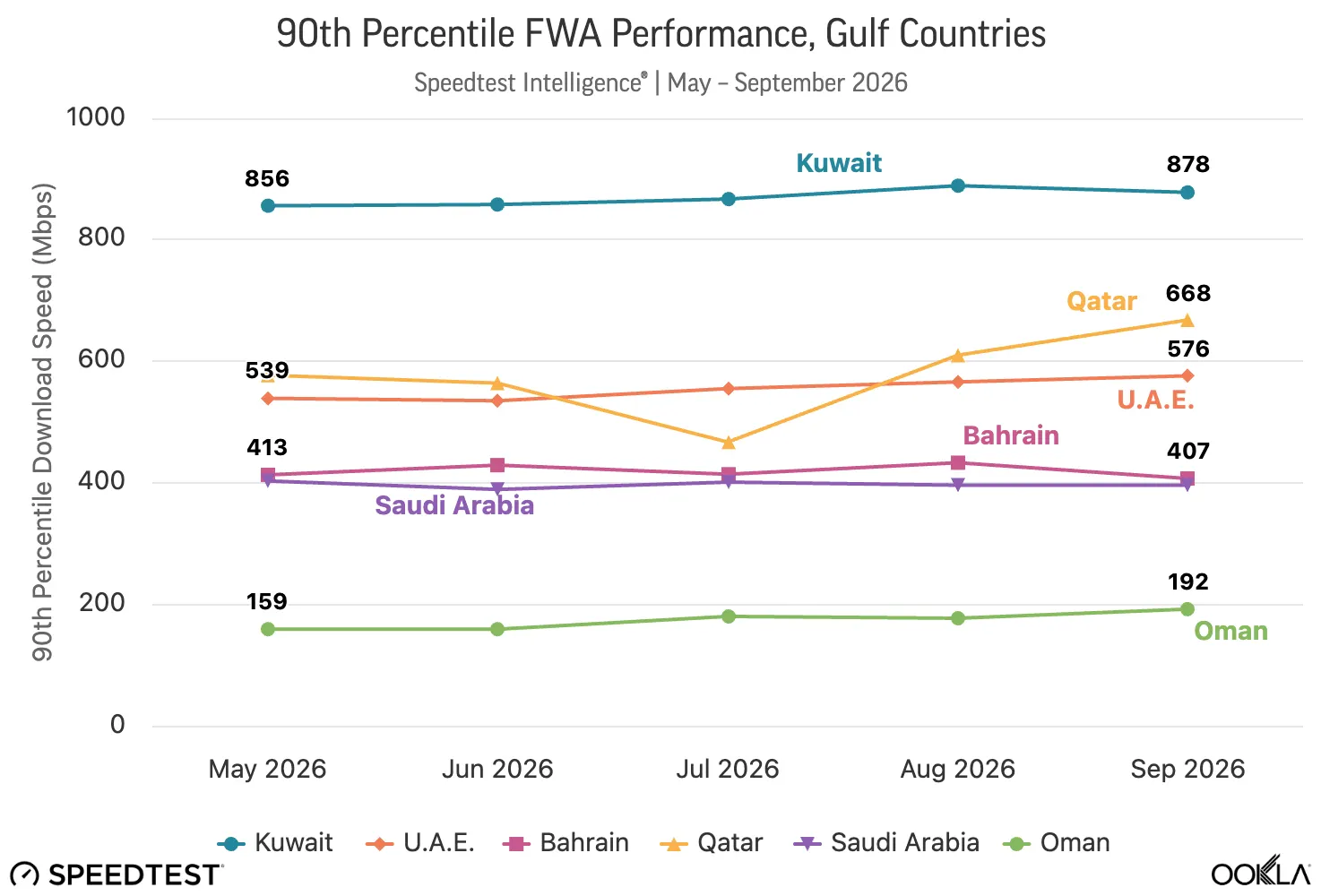
At the 90th percentile, Kuwait reached 878 Mbps, about 2.7 times its median and the narrowest gap in the region. Qatar was second at 668 Mbps, the U.A.E. reached 576 Mbps, Bahrain and Saudi Arabia sat in the middle at around 400 Mbps, and Oman trailed at 192 Mbps.
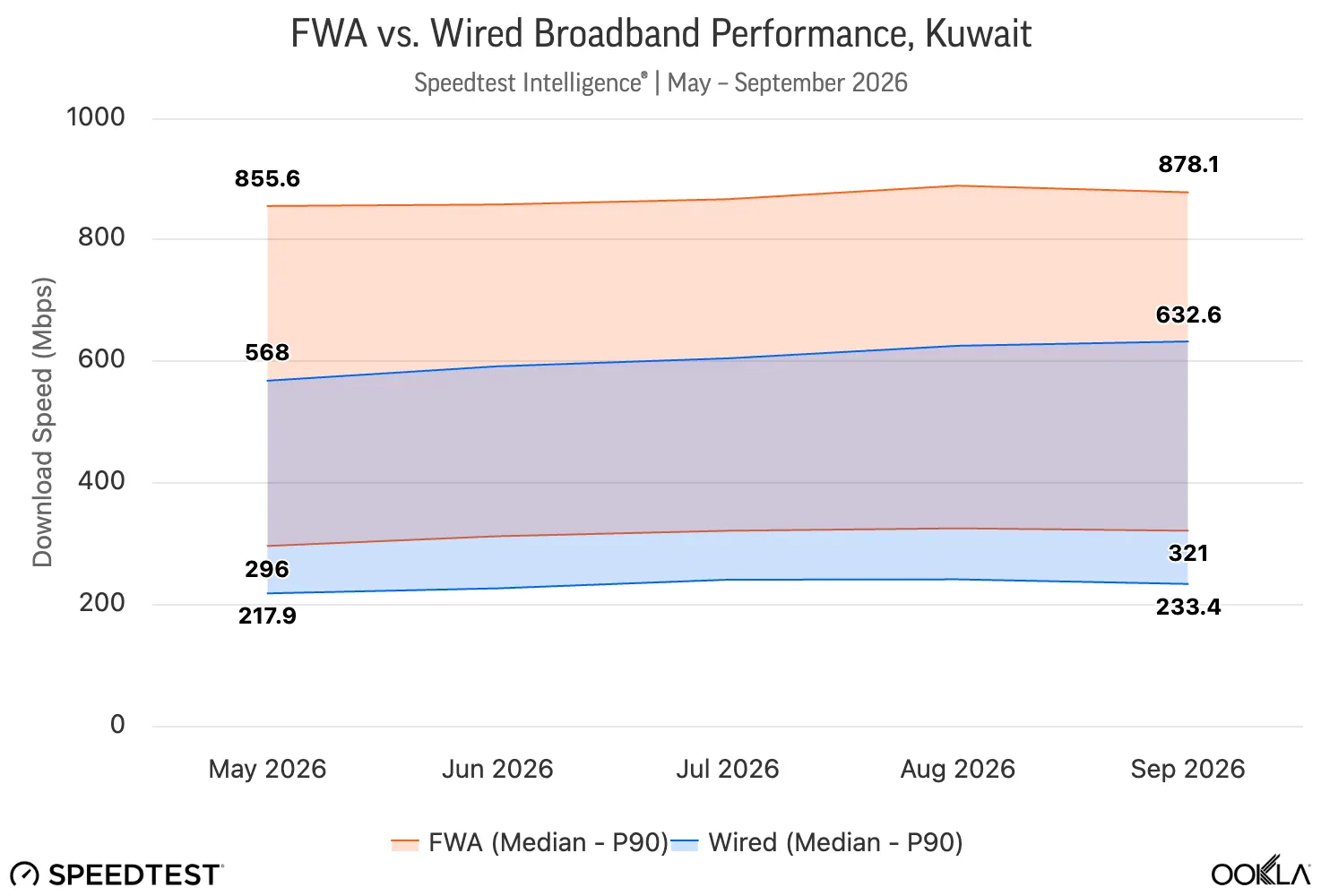
Kuwait is the only GCC market where FWA beats wired broadband on median download speed and latency. Ookla attributes this to 5G-Advanced networks launched by Zain, stc and Ooredoo in 2025, more than 3,000 5G-Advanced sites, carrier aggregation across 3.5 GHz and 2.3 or 2.6 GHz spectrum, and outdoor Wi-Fi 7 customer equipment. Kuwait’s regulator counted more than 1.2 million active 5G-Advanced subscribers by mid-2026.
The U.A.E. paradox and the shift to 5G-Advanced
The U.A.E. shows the opposite pattern. It recorded the world’s highest median 5G SA mobile download speed in the fourth quarter of 2025, at 1.24 Gbps, yet its FWA median of 166 Mbps is about half of fiber’s 356–385 Mbps. Ookla links this to older, indoor-only 5G routers that limit radio performance.
Across the region, FWA networks are moving from conventional 5G to 5G SA and 5G-Advanced. The newer networks are commercially available in Kuwait, Qatar and the U.A.E., and in trials in Bahrain, Saudi Arabia and Oman. Ericsson’s 2026 Mobility Report puts 5G subscription penetration in the GCC at 53%, projected to reach 88% by 2031.
What it means for Saudi households
For a Saudi home with a strong 5G signal, 5G home internet can deliver fiber-class peak speeds with no technician visit and flexible contracts. For households that depend on upload speed and low latency, such as remote workers on video calls and gamers, the report’s figures favour fiber where it is available. The upload and latency gap should narrow once Saudi operators move FWA onto 5G SA and 5G-Advanced networks and newer outdoor routers, as Kuwait has done.
Ookla identifies FWA Speedtest samples through their fixed location and predictable usage patterns, a method it describes as novel, and measures wired broadband as fiber-dominated in every GCC market except Kuwait.