
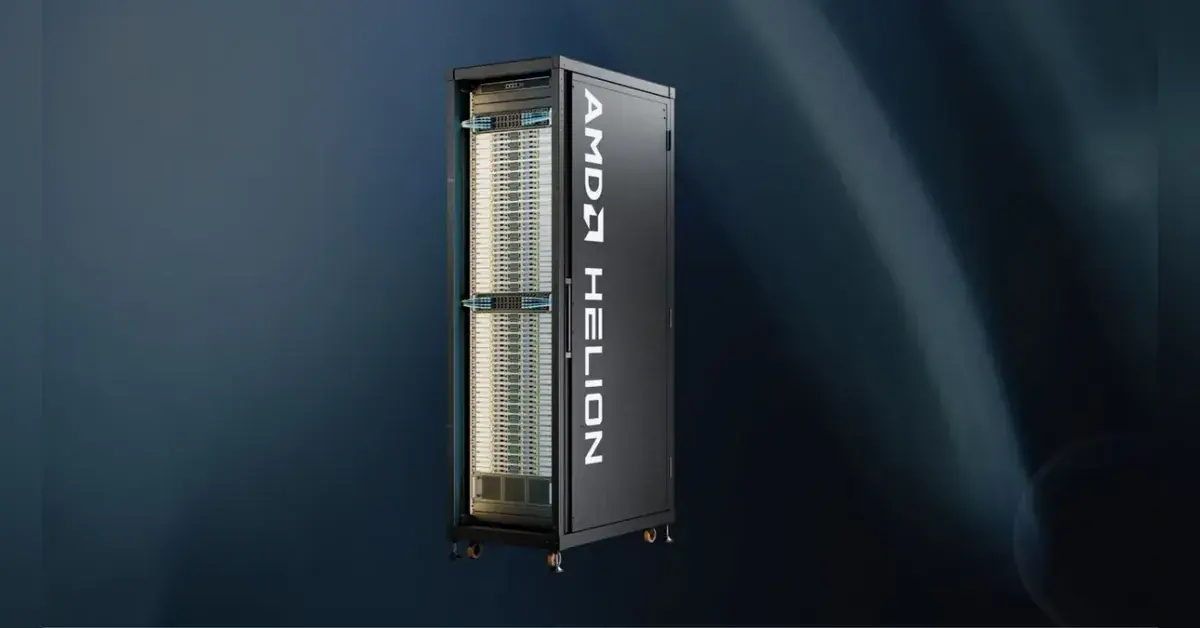
AMD Helion has been introduced by AMD as an open blueprint for agentic AI infrastructure based on Open Compute Project specifications. The system addresses the diverse computing needs of agentic workloads by offering CPU-centric racks for hyperscale environments alongside combined CPU and GPU setups for enterprise systems.
Architectural Details of AMD Helion
The specification enables customers to balance core density and power consumption against compute requirements. In hyperscale installations, the blueprint supports a CPU-only design powered by 6th Gen AMD EPYC processors delivering up to 32,768 CPU cores. This setup provides dedicated capacity for agent execution while routing calls to distinct model inference clusters. As enterprise deployments in artificial intelligence expand, hardware configurations must address both task execution and model calls.
For enterprise data centers, an integrated configuration combines AMD EPYC CPU nodes with AMD Instinct MI350P GPU nodes on a single rack platform. The architecture supports liquid cooling as well as air-cooled options. It also integrates an open token router that directs agent calls across open-source and proprietary models. Hardware teams can adapt these systems to run within existing data center computers and power setups.
“Agentic AI is not a single workload. It spans personal agents, enterprise applications, code execution and complex workflows, each with different compute requirements. To do that takes optimized compute and infrastructure that can adapt to different workloads. With AMD Helion, we are bringing AMD EPYC performance, open software and flexible rack designs together so our partners can build systems around customer needs and make efficient use of available power.”
Dan McNamara, Senior Vice President and General Manager, Compute and Enterprise AI, AMD
Hardware Partner Implementations
Several computing manufacturers confirmed integration plans for the architecture. Dell Technologies plans to support the reference design through its Dell PowerRack systems, incorporating storage and networking modules. Wiwynn and Supermicro are adapting the rack design to align with Open Compute Project standards while offering modular integration and cooling systems. Hon Hai Technology Group and Lenovo also indicated plans to build enterprise configurations around 6th Gen EPYC platforms.
Networking and Enterprise Software
Cisco Compute stated that it will connect and manage agent workloads running on these architectures across enterprise networks. Similarly, HPE indicated that it will support open large-scale systems using liquid-cooled and air-cooled networking configurations. Because enterprise agentic software interacts with various digital services and apps, system suppliers are focusing on unified management tools across compute tiers.
Specification Contribution and Availability
AMD announced plans to contribute the complete specification to the Open Compute Project community for open industry adoption. System manufacturers are currently completing validation testing with component suppliers. Hardware configurations based on the specification are scheduled to become available through ecosystem partners in November 2026.