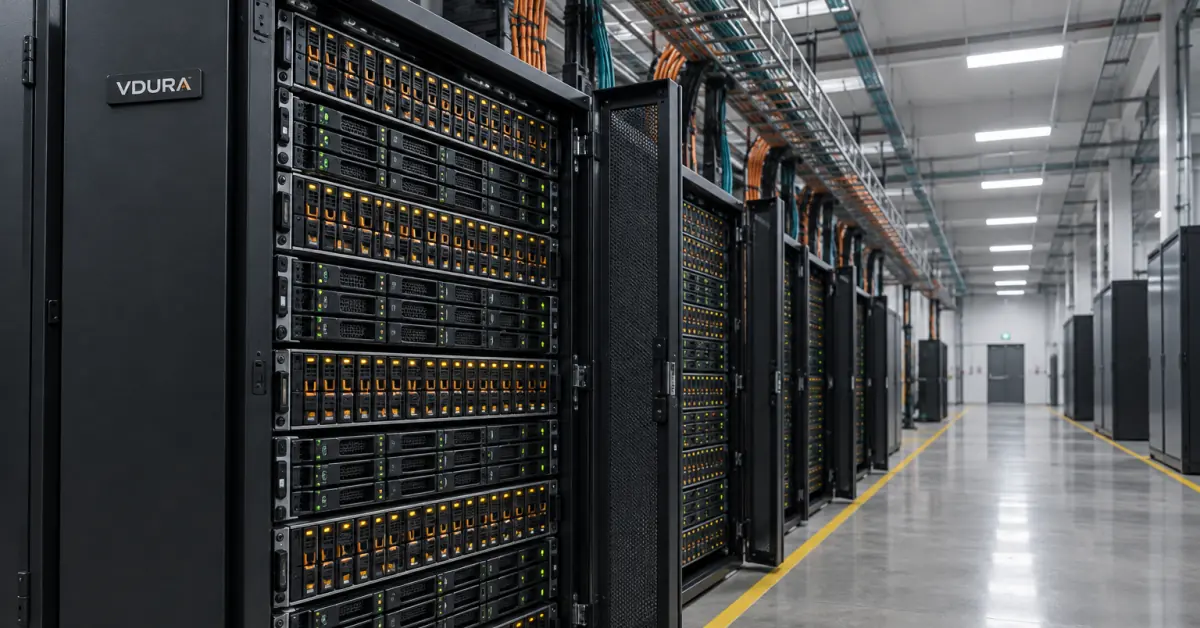
AI-generated illustration
VDURA Data Platform V12 is now generally available to address data supply bottlenecks across artificial intelligence factories and specialized cloud environments. The software platform allows operators to serve multiple tenants through a single shared storage system while moving data between flash and hard disks according to workload requirements.
Multi-Tenant Management in VDURA Data Platform V12
AI data centers run large clusters of graphics processing units to complete model training cycles and inference workloads. When storage systems fail to feed processors quickly, expensive computing clusters sit idle waiting for information. VDURA Data Platform V12 uses the company’s HYDRA architecture to assign isolated quality of service levels, namespaces, encryption keys, and network pathways to different users on identical hardware.
Furthermore, cloud providers renting capacity can isolate customer data without constructing separate storage infrastructure for each client. The system incorporates REST APIs, Kubernetes CSI drivers, and infrastructure-as-code automation. Consequently, administrators can provision storage environments using identical workflows deployed across their broader artificial intelligence clusters.
“Neocloud and AI factory operators told us exactly what they need from storage: keep the GPUs fed, isolate the tenants, automate everything, expand capacity for cold data without a second system, and move that data back to flash the moment it warms up for extended context. V12 is that list, shipped.”
Ken Claffey, CEO of VDURA
Context-Aware Tiering and Parallel Access
AI workflows handle information differently across project lifecycles. Model training requires immediate access to vast datasets, whereas older project files can reside on higher-capacity physical disks until needed. In response, the platform integrates Context-Aware Tiering to shift records between flash media and rotational drives automatically as access patterns change.
File access and Amazon S3 object protocols operate within the same platform environment. As a result, engineering teams avoid generating redundant copies across data ingestion, training checkpoints, and archival stages. Data paths feature RDMA connectivity and the DirectFlow parallel client to move information directly to GPU nodes with minimal host CPU intervention. Additionally, the VeLO metadata engine coordinates high volumes of concurrent file requests.
Hardware Integration and Enterprise Deployments
Engineers qualified VDURA Data Platform V12 on Supermicro Building Block Solutions combining all-flash and hybrid physical servers. Operators can alter capacity ratios between flash memory and magnetic media as their computing workloads evolve over time.
Security measures include active snapshots for recovery points, data encryption in transit and at rest, and automated self-healing routines. Meanwhile, the release is available for V5000-class hardware and serves as an upgrade for existing V11 customers. VDURA Sentinel proactive support is included, providing automated diagnostic requests alongside hardware dispatch options via VDURACare Premier.
Live Demonstration in Abu Dhabi
The company scheduled live demonstrations of the software at Ai Everything Abu Dhabi on 6 and 7 October at ADNEC Centre, Booth H3-D45. Company partner Hafþór Björnsson will participate at the event space alongside technical staff to showcase the storage architecture to regional technology providers.