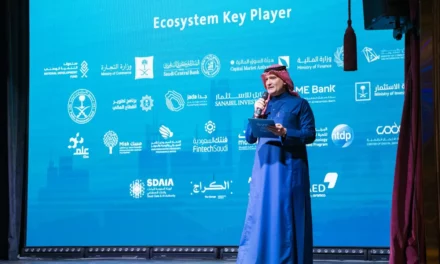
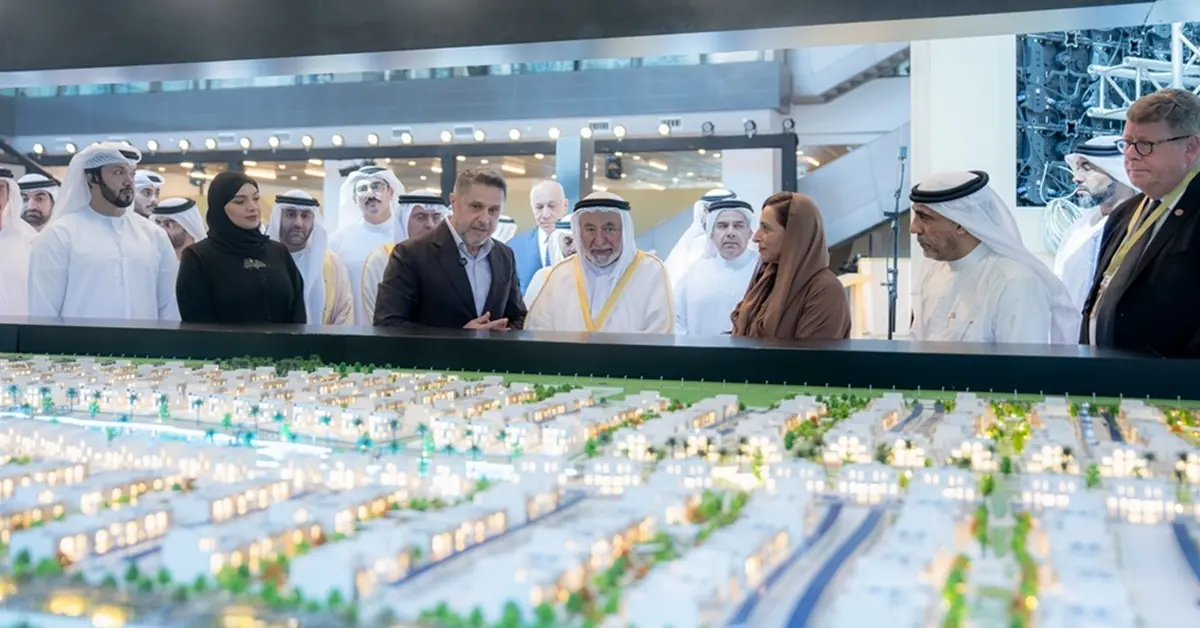
H.H. Sheikh Dr. Sultan bin Mohammed Al Qasimi, Ruler of Sharjah, during the inauguration of “Uruk”
Sharjah has unveiled a sustainable city model called Uruk designed for the post-AI era during the opening of the second edition of Sharjah Next. The project was introduced in the presence of His Highness Sheikh Dr. Sultan bin Mohammed Al Qasimi, Supreme Council Member and Ruler of Sharjah, alongside Her Highness Sheikha Bodour bint Sultan Al Qasimi, President of American University of Sharjah and Chairperson of Sharjah Research, Technology and Innovation Park (SPARK).
The initiative brings together a strategic partnership between SPARK, the American University of Sharjah (AUS), and SEE Holding. Furthermore, the collaboration integrates expertise in research, scientific development, and urban planning to establish resource independence and technological infrastructure.
Self-Sufficiency and Clean Energy in the sustainable city model
The sustainable city model aims to achieve complete operational self-sufficiency by generating all power needs through solar installations, wind turbines, and biogas systems. In addition, the urban design integrates groundwater desalination facilities and treated water recycling systems to secure municipal supplies.
Waste management protocols will follow circular economic systems to eliminate landfill dependency. Meanwhile, local food supplies will rely on indoor vertical farms, open agricultural fields, fish farming facilities, egg production units, and apiaries for honey. Private agricultural plots will also allow residents to grow produce directly within the community, complemented by regional agricultural distributors across Sharjah to support the broader economy.
Integration of Robotics and Autonomous Systems
Uruk plans to integrate autonomous robotics and automated platforms directly into its municipal operations. Specifically, autonomous machines will manage routine residential deliveries, public street cleaning, and neighborhood security monitoring to ease daily tasks for residents.
“Our ambition is to create an AI-powered innovation city, where technology is embedded into its foundations from the outset. A city where researchers work alongside entrepreneurs, global companies collaborate with universities, ideas are tested in real-world settings, and innovations move faster from the laboratory into society.”
Hussain Al Mahmoudi, CEO of SPARK
Urban transport will prioritize pedestrian movement and dedicated cycling infrastructure throughout the development. Moreover, electric transit options and shared electric vehicles will replace conventional combustion transport in connection with modern automotive networks.
Living Laboratory for Research and Innovation
The sustainable city model functions directly as an active testbed for technology development and academic validation. Researchers, university students, and technology founders will test emerging digital solutions under real-world municipal operating conditions, collaborating directly with education programs.
“The true measure of progress is not what technology can achieve, but what it makes possible for people. When a city produces its essential resources, manages them intelligently and eases everyday demands, it gives residents something invaluable: more time for family, creativity, health and community life.”
Faris Saeed, Founder and Chairman of SEE Holding
Community Development and Future Outlook
Residents will take an active part in evaluating neighborhood technologies and proposing operational adjustments to city systems. Consequently, this collaborative framework helps align technical research with tangible community requirements while accelerating the commercial deployment of practical civic inventions.